
Four Steps. One Model. A Realistic Affiliate Marketing Blueprint.

You sat down looking for four steps to building a successful affiliate marketing business, but ended up with forty browser tabs, three conflicting tutorials, and the distinct feeling that you have been moving backward.
One guide told you to follow your passion. Another told you to pick something profitable. A third told you to start with keyword research. The advice contradicts itself, and meanwhile, your free evening is gone, and you still have not decided what your site will even be about.
That is not a focus problem. That is what happens when advice built for people with unlimited time gets handed to someone building a site on five to ten hours a week. Stack fragmented advice on top of fragmented tools inside a timeline built for someone with 40 free hours a week, and most beginners run out of steam before they publish their first article.
This guide covers one model. Four steps, in sequence, each one replacing a piece of conventional advice that sounds reasonable and consistently fails in practice. Nothing here requires prior technical experience, a large startup budget, or a passion you have been waiting to monetize.
TL;DR: The Four-Step Affiliate Marketing Blueprint
Step 1: Choose a Niche That Solves a Problem, Not One That Reflects a Hobby
The advice every beginner hears first is to follow their passion. The reasoning sounds solid: if you love the topic, you will produce content consistently and stick with it long enough to see results. What that advice leaves out is the part where passion has no relationship to market demand.
General fitness. Personal development. Travel. Photography for beginners. These categories produce content that search engines have encountered tens of thousands of times, written by sites with years of established reputation and links from other websites (domain authority and backlink profiles) that a new affiliate site cannot realistically compete with.
Passion gets you to the keyboard. It does not get you to page one of a saturated niche where sites with millions of indexed pages already own every keyword worth targeting.
The more productive starting question is not what you care about, but who is actively searching for a solution to a specific, urgent problem, and does that problem have products attached to it. That reframe shifts the entire project from content creator to problem solver, and it is the functional difference between a niche that ranks and one that quietly disappears after six months of effort.
The table below illustrates the contrast in practical terms.
Niche Approach
Example Topic
Search Intent
Conversion Probability
Passion-Based (Broad)
General fitness
Informational, scattered
Low (solutions too vague)
High-Pain Problem
Posture correction for remote workers
Solution-seeking, urgent
High (audience wants a fix now)
Passion-Based (Broad)
Photography
Mixed hobbyist browsing
Low to medium
High-Pain Problem
Photography for real estate agents
Specific commercial intent
High (business need, not hobby)
Passion-Based (Broad)
Personal finance
Broad, highly competitive
Very low for new sites
High-Pain Problem
Debt payoff for single-income households
Urgent, emotionally driven
High
General Fitness
Niche Approach: Passion-Based (Broad)
Search Intent: Informational, scattered
Conversion Probability: Low (solutions too vague)
Posture Correction for Remote Workers
Niche Approach: High-Pain Problem
Search Intent: Solution-seeking, urgent
Conversion Probability: High (audience wants a fix now)
Photography
Niche Approach: Passion-Based (Broad)
Search Intent: Mixed hobbyist browsing
Conversion Probability: Low to medium
Photography for Real Estate Agents
Niche Approach: High-Pain Problem
Search Intent: Specific commercial intent
Conversion Probability: High (business need, not hobby)
Personal Finance
Niche Approach: Passion-Based (Broad)
Search Intent: Broad, highly competitive
Conversion Probability: Very low for new sites
Debt Payoff for Single-Income Households
Niche Approach: High-Pain Problem
Search Intent: Urgent, emotionally driven
Conversion Probability: High
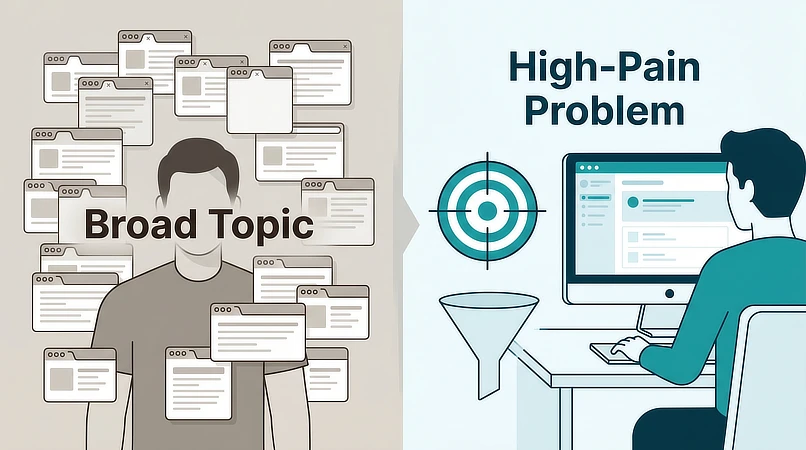
AI tools built for niche research have made this validation process faster than it used to be. You can map topic clusters (groups of closely related content), assess search volume on long-tail terms (highly specific, less competitive search phrases), and evaluate competitor authority before you commit to building anything.
The goal is not to find a topic nobody covers. It is to find the specific slice of a problem-space where existing content is weak, audience intent is commercial, and you can produce something more useful than what is already ranking.
For a more detailed walkthrough of running that validation before you register a single domain, this data-backed market analysis works alongside strategic niche evaluation criteria to help you confirm commercial viability before you commit.
Step 2: Build on Infrastructure That Doesn’t Consume Your Available Hours
Most people treat niche selection as a hard decision and infrastructure as a boring admin step. That framing will cost you.
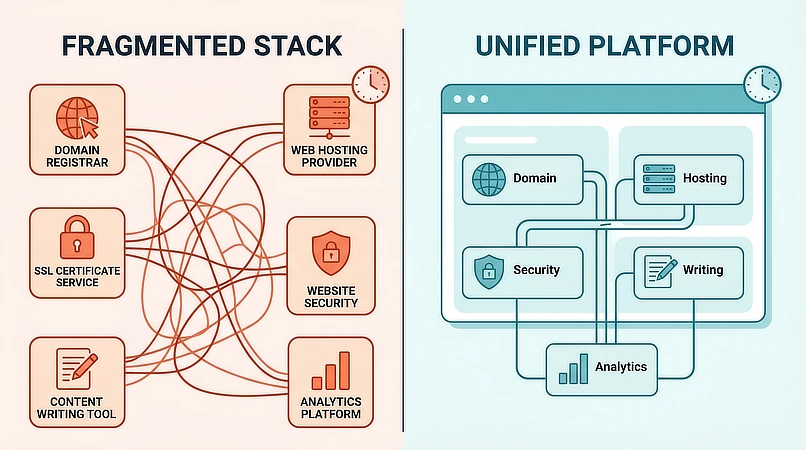
The standard starting advice is to pick a domain registrar, sign up for hosting, install WordPress, and start building. What it skips is the step-by-step cost of managing each of those as separate systems when your available window is five to ten hours a week.
Domain renewals, hosting tickets, theme compatibility errors, plugin conflicts, SSL certificate warnings: none of these are technically complicated. But each one takes time you had planned to spend writing.
When you are working with a constrained weekly window, a two-hour troubleshooting session does not just delay one article. It delays the content calendar, the internal linking plan, and the first real commission opportunity.
The fragmented stack does not only cost money. It costs the resource you have the least of.
The Real Cost of the Fragmented Approach
The table below compares what the fragmented approach actually demands against what a consolidated platform requires. The time column is where most people underestimate the problem.
Infrastructure Approach
Software Required
Weekly Time Investment
Estimated Monthly Cost
Fragmented Stack
Domain registrar, separate hosting, WordPress plus theme, security plugin, SEO plugin, keyword tool, AI writing tool, email marketing tool
3 to 5 hours (maintenance alone)
$80 to $180 or more
Consolidated Hub
Single unified platform covering hosting, training, keyword research, AI tools, and community support
Under 1 hour
$49 to $99 as a single subscription
Fragmented Stack
Software Required: Domain registrar, separate hosting, WordPress plus theme, security plugin, SEO plugin, keyword tool, AI writing tool, email marketing tool
Weekly Time Investment: 3 to 5 hours (maintenance alone)
Estimated Monthly Cost: $80 to $180 or more
Consolidated Hub
Software Required: Single unified platform covering hosting, training, keyword research, AI tools, and community support
Weekly Time Investment: Under 1 hour
Estimated Monthly Cost: $49 to $99 as a single subscription
There is also a psychological cost to the fragmented approach that does not show up in a spreadsheet. When your infrastructure is unstable, every session starts with a low-grade anxiety about what might break before you finish.
Clean, consolidated infrastructure removes that. It also communicates something to visitors before they have read a single sentence: a well-functioning site signals credibility in a niche full of sites that look like they were assembled over a weekend and abandoned.
If you are building this on evenings and weekends, the practical answer is a single platform that handles hosting, keyword research, and site-building from one interface. That is not a small thing. Every hour you are not managing separate tools is an hour you are writing or editing instead.
If you want to see what that looks like in daily workflow terms before committing to any individual subscription, explore how unified platforms eliminate technical setup.
Step 3: Deploy Content as a Systematic Asset, Not a Creative Act
“Content is king” is technically accurate and practically useless as instruction. It tells you what matters without telling you how to produce it consistently inside a schedule most people’s lives do not naturally accommodate. Sitting down three evenings a week and waiting for inspiration is not a content strategy. It is hope wearing a workflow costume.
The more useful framing is that each article is a digital asset with a specific job. That job is to intercept a search query, answer it with more clarity and depth than the competing results, and guide the reader toward a product or service that solves the problem they were looking for. That framing converts content creation from a creative exercise into a repeatable process. You know exactly what you are building before you open a document, which means the available hours go toward execution rather than deliberation.
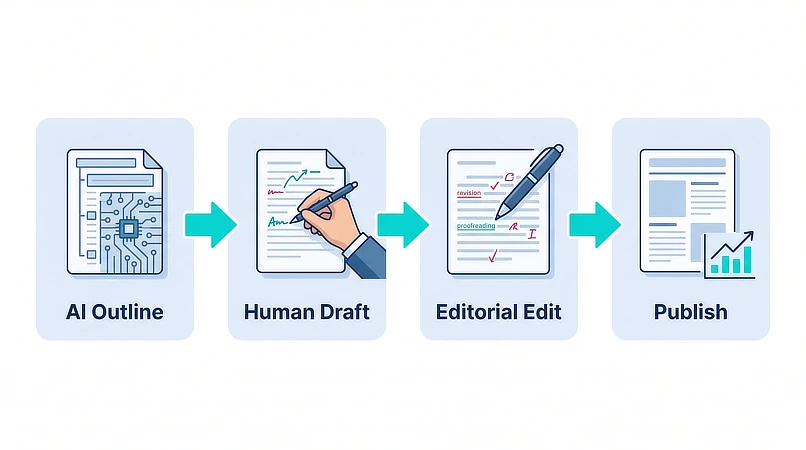
AI Article Designers are a legitimate part of that process now. A well-prompted AI tool can produce a structural outline, surface subtopics worth covering, and suggest a logical content flow in minutes. What it cannot do is add the human texture that builds trust with a reader who has already been burned by sites that publish polished summaries with no real experience behind them.
Search Engine Journal’s research on content quality makes this plain: what Google and real readers both evaluate is whether the site behind the article actually understood the problem. That signal only comes from heavy editing that injects specific, grounded observations into the structure the AI generated.
In the workflow I run, the ratio is roughly fifteen minutes of AI-assisted outlining to two or three hours of human editing. If the editing stage feels optional, the draft is not ready. For a step-by-step breakdown of where to intervene in an AI draft to restore the human texture that actually converts, ethical AI content workflows covers the specific editing decisions that separate useful content from content that simply exists.
Step 4: Monetize Through Transparent Partnerships and Honest Timelines
The standard advice on monetization is to join reputable programs, promote relevant products, and track your performance. All of that is correct as far as it goes. What it consistently leaves out are the specifics that determine whether a new affiliate site survives long enough to earn anything.
You need to know what kind of programs to prioritize, what the growth timeline actually looks like at each stage, and why your disclosure habits need to be in place before you publish your first article, not after you have published twenty of them.
What the First Twelve Months Actually Look Like
The zero-to-three-month window is foundation-building. Your site is indexed (recognized and categorized by Google), early articles are published, and you are accumulating the content volume search engines need to understand what your site covers. Organic traffic in this phase is thin, and that is not a sign that something is broken. It is the normal shape of how search-driven growth works.
The three-to-six-month window is where traction starts appearing on your lower-competition content. First commissions arrive somewhere in this range for sites following a disciplined niche and publishing approach. The six-to-twelve-month mark is where most people running this model start seeing numbers worth building on. If you are measuring success at month two, you are measuring the wrong thing against the wrong timeline.
When I evaluate programs for a time-limited workflow, digital products and software consistently come out ahead. They pay 20 to 50 percent in recurring commissions compared to two to eight percent for physical products, and they scale without inventory or fulfillment on your end.
Choose your programs before you choose your content topics, not after, so the articles you write are pointed at products where the commission justifies the content work.
Disclosure Before Your First Article, Not Your Twenty-First
Most beginners treat FTC disclosure as a formality to sort out when the site feels more established. A footer disclaimer, something generic buried where nobody reads it, and they move on.
Here is what actually happens when you backfill this: you have twenty articles live with inadequate disclosure language, and every reader who notices has already formed an opinion about your credibility before they reach your recommendation.
The setup is not complicated. A short, plain-language disclosure sits above the introduction of every article containing affiliate links. Not at the bottom of the post. Not in the site footer. The Federal Trade Commission’s current affiliate disclosure guidelines are clear that readers need to see the disclosure before they engage with the content and follow any links. One sentence, above the fold, on every post. Build that habit before article one is live, not after you have had to retrofit twenty pages.
There is also a trust argument that the compliance framing misses entirely. Readers in this niche have been burned by sites that hide their commercial relationships behind vague language and footnotes.
A site that discloses clearly and upfront stands out from that pattern rather than confirming it. In a space where scam fatigue is real and persistent, transparency is a positioning decision as much as a legal one.
You can also explore whether other content formats fit your monetization model through alternative digital content mediums, though for a site built around organic search, written content remains the highest-leverage starting point.
The Blueprint Only Works If the Infrastructure Lets You Execute It
The four steps above work as a connected system. Step 2 is the one that determines whether you ever get consistent time in Steps 3 and 4.
For a grounded look at the specific platform built around exactly this architecture, including what each pricing tier covers, where the training is genuinely strong, and where the limitations are, read the detailed platform analysis. It covers the full picture, including the tradeoffs, because that is the only useful basis for deciding whether an integrated approach fits where you are right now.
If you are ready to evaluate the model against your actual weekly hours, start with the free tier, follow the four steps in sequence, and publish your first article this week. The methodology produces results when it is running, not when it is being read about.
If you are working through any of these four steps right now and something is not clicking, drop a question in the comments, and I will point you in the right direction.

Sonia Zannoni
Hi, I’m Sonia Zannoni, creator of Click to Prosper. I share practical tools, workflows, and honest guidance to help you build an online business with more clarity and less chaos.
About Sonia
Feeling stuck between too many tools and too much advice? Start with the beginner path.
View the Blueprint