Make Money With Podcasting: Your Download Count Is the Wrong Metric

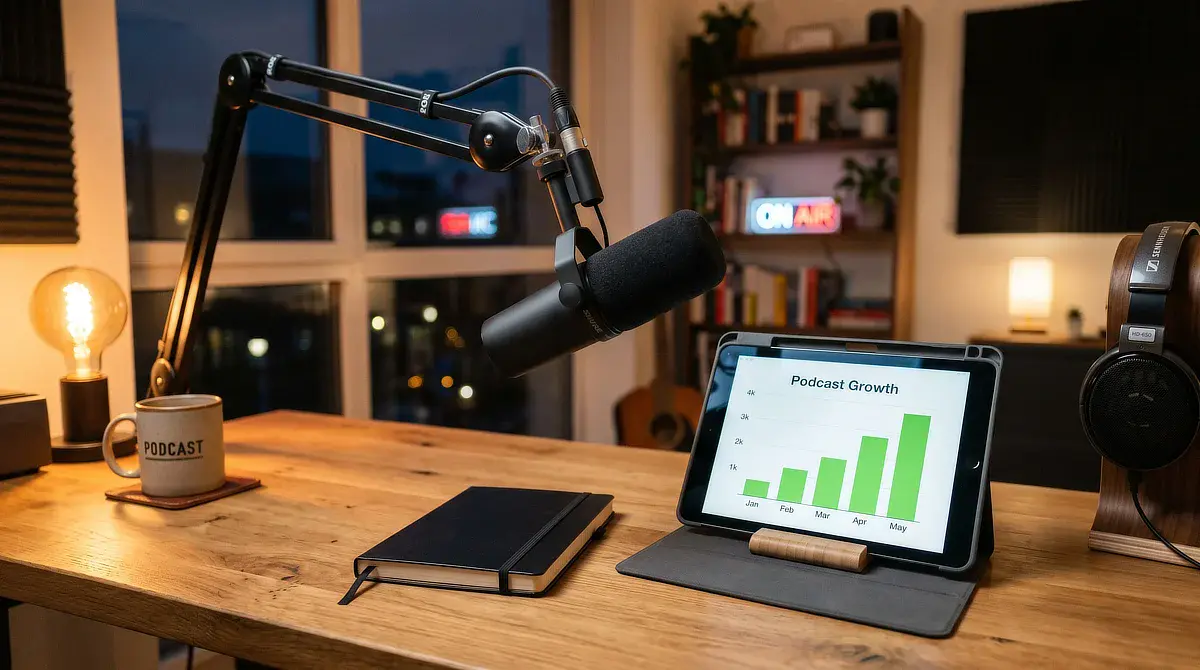
You open your podcast analytics on a Tuesday night, and the number staring back at you is 150 downloads. You spent six hours recording, editing, and uploading that episode. You wonder, not for the first time, whether any of this is actually going anywhere.
The problem isn’t your download count. The problem is that everything you have read about how to make money with podcasting was written for someone with a hundred thousand listeners, not someone building an audience from scratch.
The industry is obsessed with Joe Rogan scale, and that framing makes independent creators feel like their small but loyal audiences have no economic value whatsoever.
They do. You just need a different playbook.
This guide breaks down exactly how to monetize a podcast when you are starting out, focusing on the active monetization strategies that work at any audience size and the owned digital infrastructure that turns a podcast into a real business.
TL;DR: Podcast Monetization
Why the Old Podcast Advertising Model Fails Beginners
The math behind traditional podcast sponsorships isn’t in your favor. It helps to understand exactly why before you spend another month chasing download numbers.
Programmatic podcast advertising runs on Cost Per Mille (CPM), which means a sponsor pays you a set rate for every thousand downloads an episode receives. Industry CPM rates typically land somewhere between $15 and $30 for a mid-roll ad. Run the numbers: if your episode gets 300 downloads, a $20 CPM sponsor pays you $6 for that episode. That isn’t a business model. That is noise.
The table below compares the two core monetization frameworks so you can see the gap clearly.
Monetization Model
Download Requirement
Revenue Potential
Operational Friction
Programmatic CPM Advertising
10,000+ per episode to attract a sponsor
Low: cents per listener
High: agencies often vet audience size before contact
Affiliate Marketing / B2B Sponsorships
No minimum; trust-based
High: commission per sale or flat niche deal
Low: You control outreach and placement
Programmatic CPM Advertising
Download Requirement: 10,000+ per episode to attract sponsors
Revenue Potential: Low: cents per listener
Operational Friction: High: agencies often vet audience size before contact
Affiliate Marketing / B2B Sponsorships
Download Requirement: No minimum; trust-based
Revenue Potential: High: commission per sale or flat niche deal
Operational Friction: Low: You control outreach and placement
According to Edison Research, podcast consumption has grown steadily for over a decade, but listener engagement and niche specificity are what drive actual purchasing behavior, not raw download totals. Sponsors who understand that are worth your attention. Ad networks chasing download minimums are not.
The shift that actually helps small creators is moving away from volume metrics and toward depth of engagement. A listener who has followed you for six months and trusts your judgment is worth more than a thousand casual subscribers who skip your mid-roll ads.
The Shift to Active Audience Monetization
Active monetization means you stop waiting for an ad agency to decide your download count is large enough. You proactively recommend the tools, software, or services your audience genuinely needs, and you earn a commission when they buy.
This approach works at any audience size, and the reason is simple: affiliate purchases are triggered by trust, not by reach. If you are covering a niche with enough specificity that 500 people actively seek out your show every week, you have an audience that specific software brands, local service providers, and digital tool companies would pay to access.
Understanding what you actually need to start affiliate marketing makes this transition much less complicated than most beginners assume.
Let’s look at a concrete example. Suppose your podcast covers productivity systems for freelance designers. Your listeners are trying to manage clients, track billable hours, and stay organized. A project management platform that pays a 30% recurring commission per referral is a natural fit.
When you mention how you actually use it in your own workflow, your listeners don’t experience it as advertising. They experience it as a recommendation from someone they trust. That is a fundamentally different dynamic than a mid-roll ad for a mattress company.
The Critical Role of Your Owned Digital Hub
Spotify and Apple Podcasts are excellent discovery tools. They are terrible business foundations.
Both platforms control where your listeners go after an episode ends. They limit your link placement options, they own the relationship with the audience, and they can change their algorithms or policies at any point without warning.
Building your entire podcasting business on those platforms is like building a retail store in a mall you don’t own, and that can close without notice.
Every podcaster who is serious about monetization needs a central WordPress website. This isn’t optional infrastructure. It is where your show notes live (with full affiliate disclosures and clickable links), where you capture email addresses from listeners who want more, and where organic search traffic finds you independent of any podcast platform algorithm.
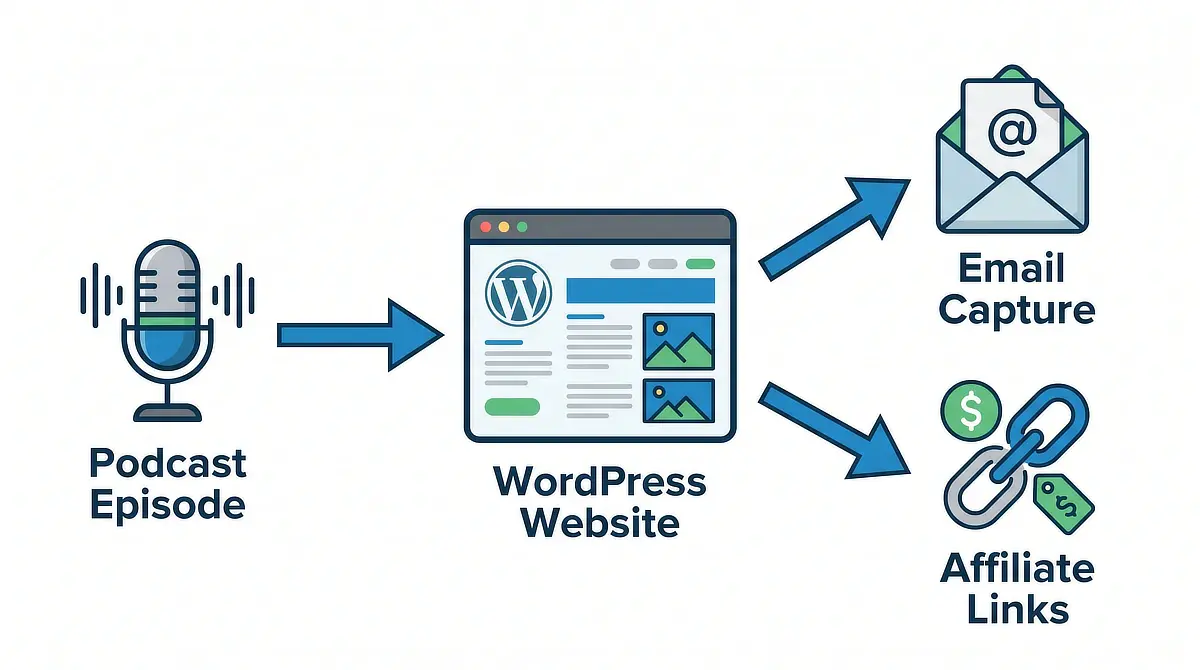
The website also captures an entirely different type of potential listener: people who search Google for answers to the exact questions your episodes address. A well-structured show notes page targeting a specific keyword gives your podcast a second discovery channel that runs parallel to the platforms. Some of those readers become listeners. Some of those listeners become buyers. That is the conversion engine that the podcast platforms cannot build for you.
Understanding how to start affiliate marketing the right way includes getting this foundation in place before you focus on driving traffic anywhere. And if you want to understand why the written content layer matters so much to the overall strategy, the breakdown of why blogging still works explains the search traffic dynamic in full.
Getting your WordPress site set up properly, with fast managed hosting and the right technical foundation, is where most solo creators lose time. If you want the full walkthrough on setting up your managed WordPress hosting, the platform that handles hosting, training, and keyword research in one place is worth starting with for free.
Keeping Your Audio Content FTC Compliant
Federal Trade Commission endorsement rules apply to podcasters, and the 2023 and 2024 updates tightened the requirements for audio and video creators specifically. If you are recommending a product and receiving any material benefit, including a commission, a free product, or even early access, you are required to disclose that relationship to your listeners.
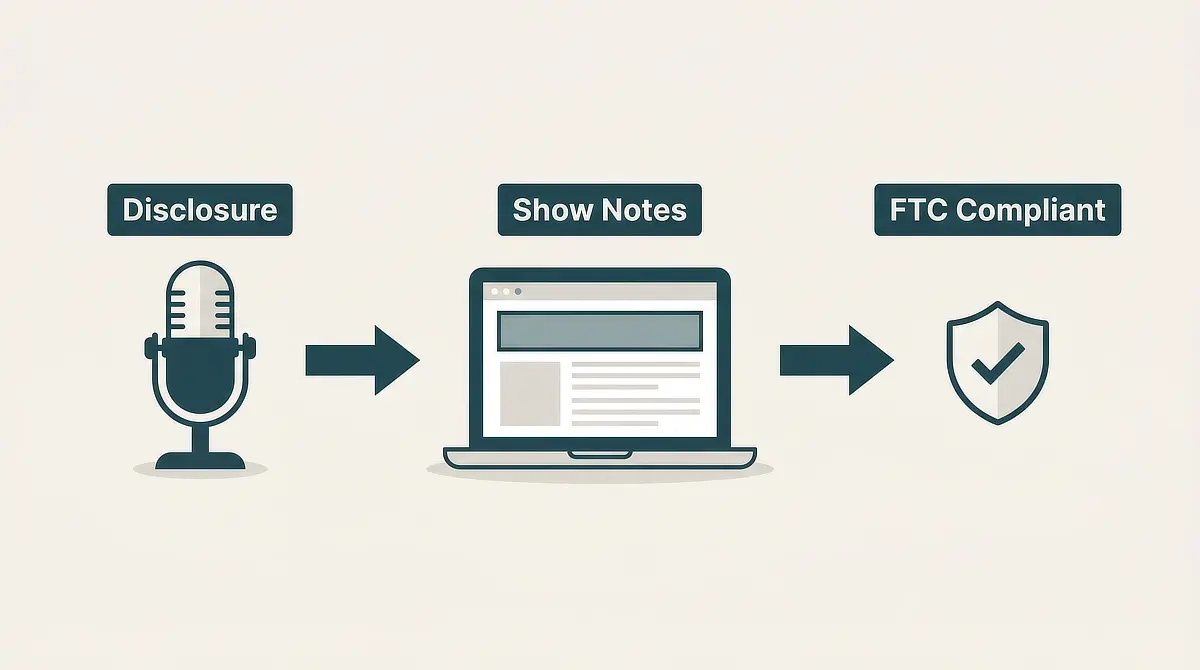
Verbal Audio Disclosures
The single most common compliance mistake podcasters make is treating their show notes disclaimer as sufficient. It is not. FTC guidance is clear that disclosures must be made where the recommendation is actually encountered. If your recommendation is in the audio, the disclosure must also be in the audio, stated clearly before or during the recommendation itself.
That disclosure doesn’t need to be a legal disclaimer read at half speed. Something direct and natural works: “I’m an affiliate for this tool, which means I earn a commission if you decide to sign up through my link. I only recommend things I’d actually use.” That sentence takes ten seconds and keeps you compliant. The Federal Trade Commission’s Endorsement Guides are the primary reference here, and they are worth reading in full at least once.
Written Show Notes Disclosures
Written disclosures still matter, but they function as a secondary layer, not the primary one. Your show notes page should include a clear, visible affiliate disclosure near the top, before any links appear. Standard language like “This post contains affiliate links. If you purchase through my links, I may earn a commission at no additional cost to you” covers the written requirement.
Note that free products trigger the exact same disclosure requirements as paid sponsorships. If a software company gives you complimentary access in exchange for coverage, that is a material connection. Disclose it the same way you would a paid deal.
A Sustainable Workflow for the Solo Creator
A podcast that consumes ten hours of editing for every thirty minutes of published audio isn’t a side hustle. It’s a second job with no income attached.
The workflow problem is real, and it is one of the primary reasons podcasters burn out before they see any monetization return. Most of that time isn’t spent on the parts of the work that matter. It is spent on mechanical tasks that modern tools handle better and faster than manual editing does.
The practical fix is a clean separation between your recording environment and your editing environment. Record locally in a quiet space with a decent plug-and-play USB dynamic microphone, using software that captures clean, uncompressed audio. Edit in a text-based platform like Descript that generates a transcript automatically, letting you remove filler words and bad takes by deleting text rather than scrubbing through a waveform. The time you recover from that workflow shift alone is significant.
AI tools have made transcript generation and show notes drafting genuinely fast. A 30-minute episode that used to take two hours to produce show notes for can now be drafted in twenty minutes with the right prompting and editing. That recovered time doesn’t disappear into your schedule. It goes into your monetization work: researching affiliate programs, optimizing your website’s keyword strategy, and building the content layer around your episodes.
If you want a structured approach to the keyword and content strategy side of that work, the guide on how to choose a profitable niche using AI walks through the targeting process in the context of a limited weekly schedule.
Protect your time deliberately. The recording and publishing workflow should take no more than four to five hours per episode by the time you have it dialed in. Everything beyond that is friction you can engineer out.
Building a Podcast Business That Doesn’t Require a Million Downloads
The podcasting industry will tell you that you need scale before you earn anything meaningful. That framing serves the ad networks. It doesn’t serve you.
The creators who actually generate income from podcasting at the beginner and intermediate level aren’t the ones chasing download records. They are the ones who picked a specific niche, built genuine trust with a small audience, created an owned website that captures that audience beyond the podcast platforms, and recommended products their listeners actually need.
That is the full picture: active monetization through affiliate relationships, an owned digital hub that compounds your reach through search, FTC compliance that keeps your audience’s trust intact, and a workflow that doesn’t destroy your evenings.
None of it requires a massive following. It requires clarity on the approach and consistency in executing it.
Ready to build the digital hub for your podcast? Start the free Wealthy Affiliate Starter tier to set up your hosting, training, and keyword tools in one place.
Have questions about monetizing your podcast or want to share where you are in the process? Drop them in the comments below.
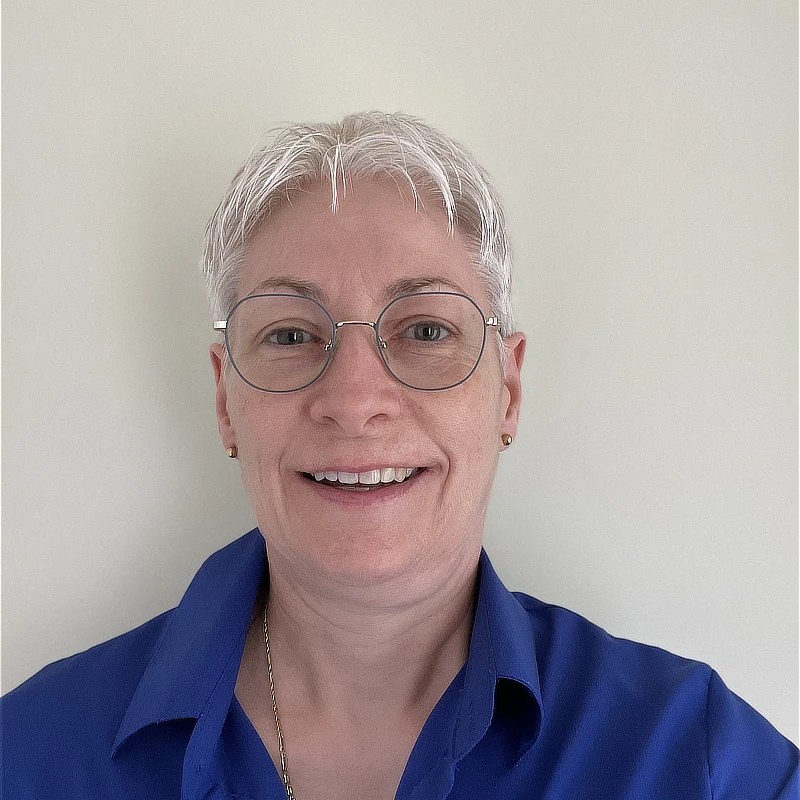
Sonia Zannoni
Hi, I’m Sonia Zannoni, creator of Click to Prosper. I share practical tools, workflows, and honest guidance to help you build an online business with more clarity and less chaos.
About Sonia
Feeling stuck between too many tools and too much advice? Start with the beginner path.
View the Blueprint