
Herbalife MLM Review: Why the Math Fails Most Beginners

Affiliate Disclosure: This post contains affiliate links. If you purchase through one of my links, I may earn a commission at no additional cost to you. Read the full Affiliate Disclosure for details.
Someone you know sent you a message about a business opportunity with Herbalife. Or maybe you kept seeing the same polished face on Instagram, posting about passive income, time freedom, and morning smoothies. The pitch looks legitimate. The lifestyle looks real. And now you are here, trying to figure out whether any of it holds up before you hand over money or start working your own contacts.
Your instincts to slow down are correct. The glossy presentation is built into the system. This Herbalife MLM review works through the numbers the company actually publishes, the regulatory history most promotional content leaves out, and the structural math that explains why so few people in this model end up ahead.
TL;DR: Herbalife MLM Review
The Deceptive Pitch Behind Local Nutrition Storefronts
You have probably walked past one of these without recognizing it. A small shop selling smoothies and wellness shakes, no corporate branding on the sign, often a friendly person behind the counter who wants to chat. These are called nutrition clubs. The missing logo is not a franchising quirk. It is a deliberate business model decision.
The parent company does not require distributors to display Herbalife branding on these storefronts because these locations do not function as conventional retail shops. They function primarily as recruiting environments. The drink you are handed is an entry point into a conversation about the business opportunity behind the counter.
Research from McGill University’s Office for Science and Society has examined how these clubs operate and why the storefront model rarely generates sustainable income through product sales alone. Operators frequently run the physical location at a net financial loss, subsidizing rent and overhead out of pocket, because the intended return is supposed to come from the new distributors they bring in, not from smoothie margins. For anyone thinking about opening one of these locations, that economic reality deserves to be the first question asked, not the last.
The Real Cost of Entry and Inventory Loading
The front-door cost looks manageable. The Digital Starter Kit in the US is currently priced around $54.95, which is low enough to feel like a low-stakes experiment. The real cost does not begin at that entry point. It begins when you try to qualify for commissions.
To remain active and eligible for multi-level compensation, distributors must consistently hit sales volume thresholds. When a new distributor cannot move enough product through actual outside customers to reach those numbers, the default solution is to buy the products themselves. This is inventory loading, and it is one of the most reliable mechanisms for pushing a new participant into a net negative financial position before they ever see a commission check.
The loading problem is structural. Volume requirements exist regardless of whether the market around you is already saturated with other distributors selling the same products to the same potential customers. If you are entering an area where Herbalife has operated for years, the probability of finding enough organic retail customers to hit your thresholds without self-purchasing is considerably lower than the pitch implies.
Breaking Down the Distributor Earnings Disclosures
This is where the numbers stop being abstract. Herbalife publishes a Statement of Typical Distributor Earnings, and the figures in it are not drawn from critics or competitors. They come directly from the company.
The Global Picture
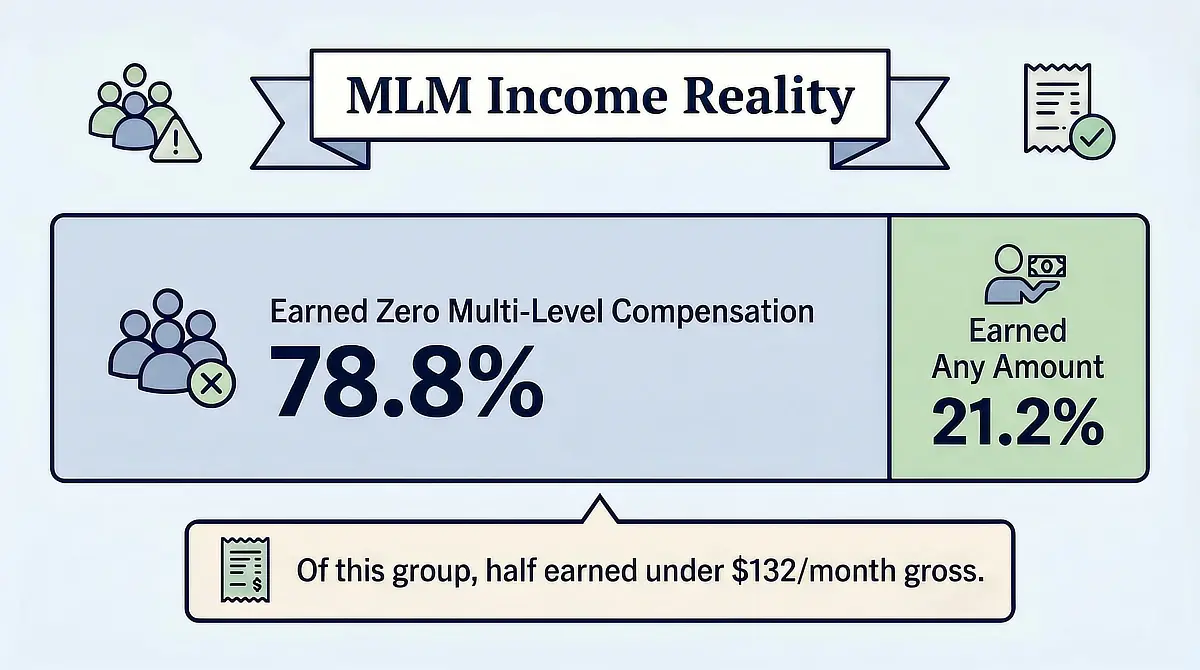
Across approximately two million active long-term distributors worldwide, roughly 78.8 percent earned zero multi-level compensation in a typical month. That figure does not count people who signed up and dropped out. It counts distributors who were actively engaged with the company and still received nothing from the multi-level commission structure.
Of the fraction who did earn something, half earned less than $132 USD per month before any expenses. Before accounting for the product purchases required to maintain active status. Before marketing, transportation, or the hours spent recruiting. The gross figure is already below minimum wage in most markets, and it represents the better half of everyone who earned anything at all.
The US Picture
US-specific data follows the same distribution. The compensation structure is built to reward distributors holding positions near the top of large, established downlines. For someone joining today without an existing network of committed recruits already in place, replicating those results is not a matter of applying more effort. The architecture of the structure sets that ceiling, and personal performance cannot override it.
Why Regulators Keep Cracking Down on Deceptive Marketing
The regulatory record here is not a historical curiosity. In 2016, Herbalife reached a $200 million settlement with the Federal Trade Commission, which included a requirement to restructure its business model and compensate distributors who had been harmed. The FTC’s concerns centered on deceptive income representations and a recruitment-over-retail business culture that the agency found problematic.
That settlement required operational changes. It did not change the underlying incentive structure that had produced the problem in the first place.
In a recent enforcement action, the Direct Selling Self-Regulatory Council (DSSRC) took administrative action against Herbalife regarding distributor-generated social media content.
Distributors were using hashtags referencing “financial freedom” and “generational wealth” in recruiting posts, in violation of guidelines established after the FTC settlement. The DSSRC action required the removal or modification of the offending content and a strengthening of distributor marketing standards.
Treating regulatory history as background noise is a mistake when evaluating a business opportunity. A pattern of enforcement actions tells you something specific about the gap between what this model promises in its marketing and what it delivers in practice.
The Social Cost of Monetizing Your Personal Network
Here is the cost that does not show up in an earnings disclosure.
The Herbalife model requires you to recruit people you already know. Friends, family, coworkers, former classmates, gym contacts. The framing is that you are sharing an opportunity with people you care about. What happens in practice is that every relationship becomes a potential transaction. The model trains you to think that way because your income depends on it.
People who have spent extended time in this environment describe a consistent pattern. The early months feel like community and shared purpose. Then the people around you start noticing that conversations tend to arrive at the same destination. Relationships that felt uncomplicated start feeling like pitches. And when the people you have recruited do not reach the outcomes they were promised, you carry some weight of that with you.
That is a real business risk for someone whose personal network represents years of trust-building. If you are looking for strategies for monetizing digital content, there are models that build an audience through search traffic and earn commissions without asking anyone in your life to buy a shake or sign up for anything. This inbound content approach differs structurally from outbound direct sales, because the audience comes to you.
The Mathematical Impossibility of Late Stage Saturation
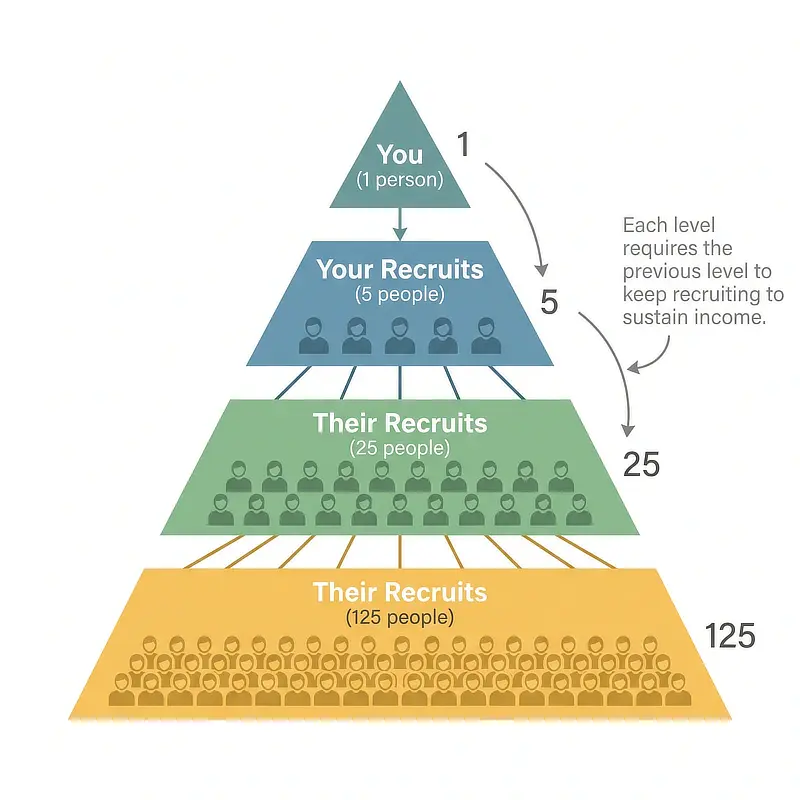
Multi-level commission structures require exponential downline growth to produce income at the higher tiers. The person at the top of a large, established downline earns a percentage of the volume generated by everyone below them. To replicate what that person earns, you would need to build a downline of comparable size.
Each member of your downline would then need to build their own comparable downline. Follow that logic across three or four generations of recruitment, and you arrive at numbers that exceed realistic market capacity quickly.
Herbalife has operated in the United States since 1980. Its distributor base numbers in the millions. The accessible warm market that early participants had, a network of contacts who had not already been introduced to the model, is not available to someone entering the system today in most markets. That saturation problem is not recoverable through personal ambition or harder work.
The important distinction is this: when someone exits the model after failing to earn a livable income, the standard explanation blames their execution.
The structural reality is that the design of the system produces this outcome for the vast majority of participants, regardless of effort. Understanding that distinction matters before you invest your time, money, and relationships into a vehicle built this way.
A Sustainable Alternative That Does Not Require Recruiting
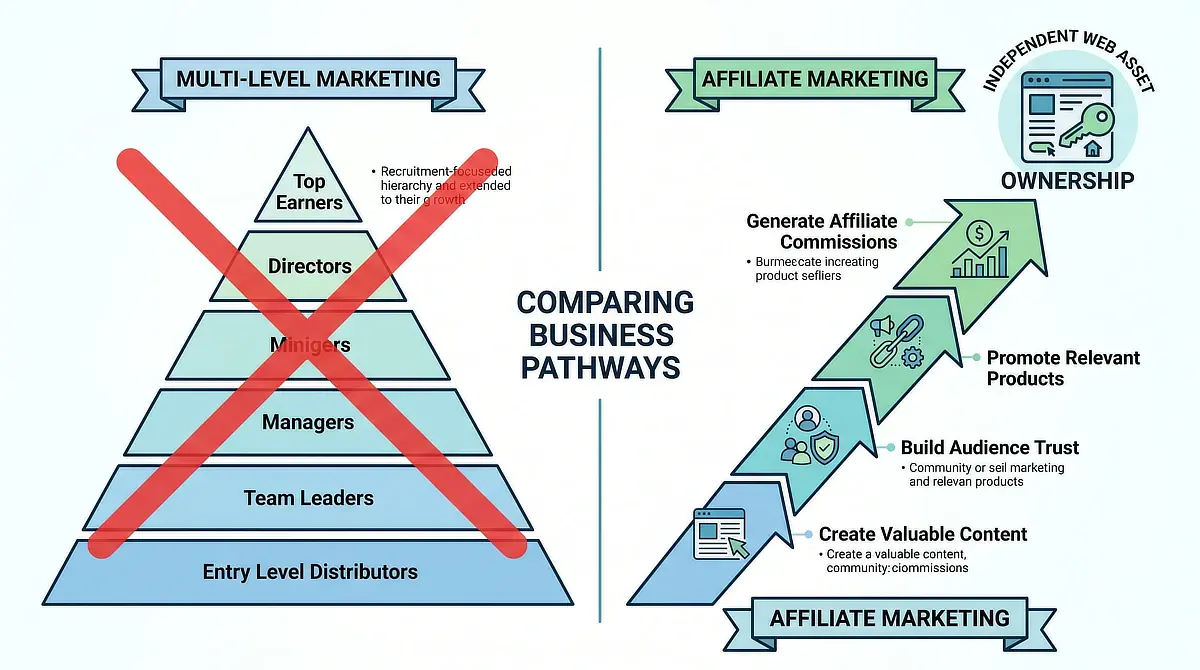
Walking away from the MLM model does not mean abandoning the underlying goal. The desire for flexible, location-independent income is rational. The problem was always the vehicle, not the destination.
The table below compares the core structural mechanics of multi-level marketing with asset-based affiliate marketing, the model built around owning a website and earning commissions through organic search traffic.
Feature
Multi-Level Marketing
Affiliate Marketing
Recruitment requirement
Mandatory for meaningful income
Zero
Asset ownership
Controlled by the parent company
100% owned by you
Traffic source
Pitching your warm market
Inbound organic search
Inventory requirement
Mandatory product loading
Zero physical products
Multi-Level Marketing
Recruitment requirement: Mandatory for meaningful income
Asset ownership: Controlled by parent company
Traffic source: Pitching your warm market
Inventory requirement: Mandatory product loading
Affiliate Marketing
Recruitment requirement: Zero
Asset ownership: 100% owned by you
Traffic source: Inbound organic search
Inventory requirement: Zero physical products
The differences in that table are not superficial. With affiliate marketing, you build a digital property that ranks in search engines and generates commissions when readers click through to products or platforms you recommend. Instead of buying products to hit a monthly quota, your only foundational costs are a domain name and website hosting. You are not recruiting friends. You are not managing inventory. You are not losing your active status because you took two weeks away from the business.
Building a digital business without relying on recruitment schemes is slower than most entry-level pitches imply. Six to twelve months before meaningful traffic is the realistic range, not six to twelve weeks. The tradeoff is that the asset you build compounds over time instead of requiring a constant supply of new recruits to sustain what you have already earned.
If you want to see what a sustainable affiliate marketing education platform looks like in practice, the full breakdown is in my main review. And if you want to understand the foundational mechanics before committing to any platform, the proven process for building an online business walks through the structure step by step.

Sonia Zannoni
Hi, I’m Sonia Zannoni, creator of Click to Prosper. I share practical tools, workflows, and honest guidance to help you build an online business with more clarity and less chaos.
About Sonia

Feeling stuck between too many tools and too much advice? Start with the beginner path.
View the Blueprint