
How to Start Affiliate Marketing Around a Full-Time Life

You sit down at the kitchen table on a Tuesday night with two free hours. The kids are in bed. The dishes are done. This is your window.
So you open YouTube and search for how to start affiliate marketing. Forty-five minutes later, you have seventeen browser tabs open, three competing “step one” instructions on a legal pad, and a course landing page promising a six-figure site in ninety days.
The two hours are gone. You haven’t built anything.
That’s not a motivation problem. It’s not a discipline problem either. It’s a mismatch problem. The checklists and launch guides floating around the internet are built for people with forty hours a week to throw at this. You have five. Following advice designed for someone else’s schedule will paralyze you every single time.
Here’s what this guide actually is: a realistic, stripped-back roadmap for how to start affiliate marketing without drowning in options, tools, or tactics that don’t belong in your first 90 days. One stage at a time, built specifically for someone with a real job and limited evenings.
TL;DR: How to Start Affiliate Marketing
The 90-Day Filter (What to Ignore When You Only Have 5 Hours)
Most beginner affiliate marketing guides open with a fifteen-step launch checklist. Register a domain, set up hosting, install a theme, configure your email platform, and set up tracking pixels.
By step six, you’re reading a forum thread about DKIM authentication records at 10 PM. The writing session is completely gone.
None of that is your fault. The advice just wasn’t written for someone with five hours a week.
Here’s the filter that protects your limited time: for the first 90 days, the only things that earn a place in your weekly schedule are finding low-competition topics to write about and writing genuinely helpful answers to those topics. That’s the whole job.
Everything else on the typical checklist either doesn’t matter yet or will slow you down. These specific items get ignored completely until month four at the earliest:
- Building email sequences and automated follow-up campaigns
- Buying paid traffic on Google, Facebook, or Pinterest
- Setting up tracking software and conversion dashboards
- Designing multi-step sales funnels
Those tactics matter eventually. They don’t matter right now. You don’t have the traffic to justify them, and learning them takes hours you need for writing.
Here’s what a realistic 5-hour week actually looks like when you’re getting started:
- 1 hour: keyword planning (finding one or two specific topics to write about that week)
- 3 hours: writing (one complete, helpful post drafted and ready to format)
- 1 hour: formatting, adding links, and publishing
That’s the whole week. If it sounds too simple, good. Simple is the point.
Step 1: Choose One Topic You Can Write About for Two Years
Niche selection is where a lot of beginners freeze. There’s this idea floating around that somewhere out there is the perfect niche, some combination of topic and market that unlocks easy rankings and high commissions. People spend weeks looking for it. The looking is usually what stalls them.
There is no secret category. The topic you pick matters far less than whether you can keep writing about it.
Here’s the only test worth running on any niche you’re considering: can you write about this subject twice a week for two years without getting bored, running out of ideas, or feeling like you’re faking it?
Two years. That’s what it actually takes to build a site with real topical authority (becoming Google’s trusted, go-to resource on a single subject) in Google’s eyes. If you can’t picture yourself eighteen months from now still finding new angles, the search volume doesn’t matter. The niche is wrong.
In practice, that means looking at topics where you have actual experience. Not necessarily professional credentials. Just genuine familiarity:
- Something you’ve spent real time figuring out, that other people are still confused by
- A hobby or interest where you naturally absorb new information without forcing it
- A challenge you’ve already solved, where you know the specific path someone else needs to take
The first post is always the hardest. By month six, you should be sitting down with a running list of thirty topics you still haven’t gotten to. If that sounds impossible for a niche you’re considering, that’s useful information before you commit.
Step 2: Unify Your Tools to Eliminate Tech Friction
Picture the typical Tuesday-night setup for a beginner trying to get their first site running. You have one tab open on a hosting dashboard, another with a domain registrar, and a third with a video explaining DNS records.
Add a blank WordPress draft and a keyword tool you subscribed to last week. It’s 9:45 PM, and nothing has been built.
That’s what tool fragmentation does to a part-time builder. It eats the writing hours before you ever reach them.
The fix is choosing one platform that keeps everything under one login: hosting, website builder, keyword research, training resources, and a support community, all in the same place. When you sit down with two hours, you spend two hours building something, not debugging the connections between four separate accounts.
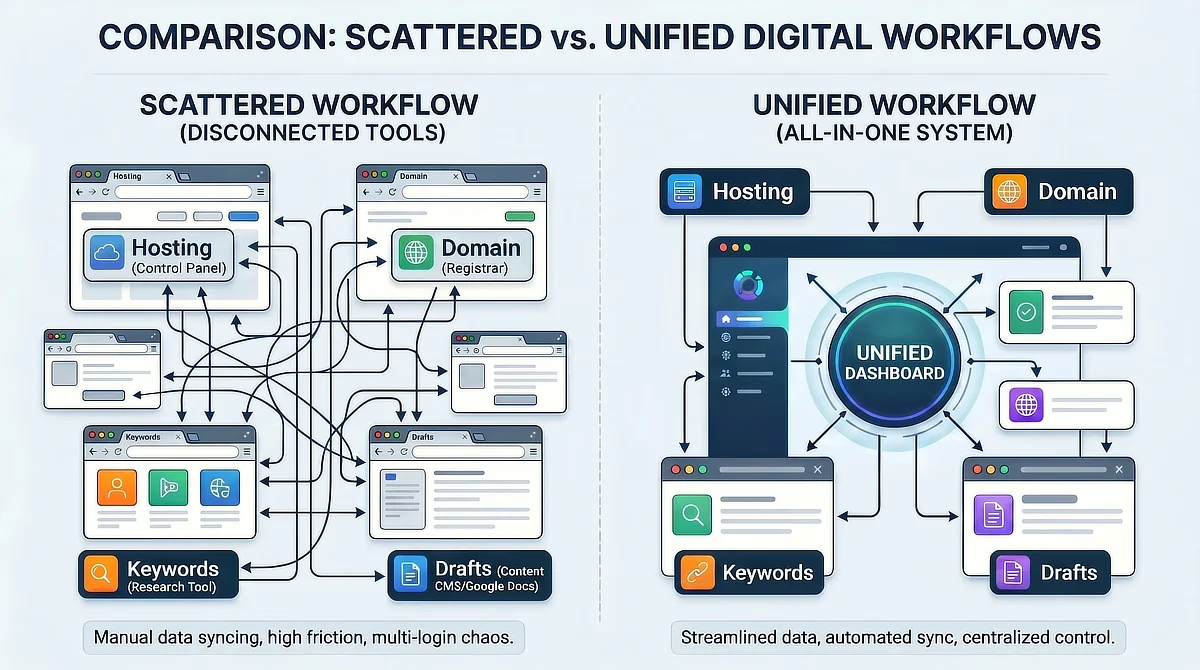
The table below compares a typical piecemeal tool stack against a unified platform so you can see where the time actually goes.
Feature
Piecemeal Tool Stack (Separate Subscriptions)
Unified Platform (Wealthy Affiliate)
Monthly Tech Cost
$50 to $120+ (hosting + domain + keyword tool + builder)
Single subscription covers all core tools (covers hosting, keyword, and builder tools; custom domain registration is separate at ~$15/year)
Tech Setup Time
3 to 6+ hours to connect accounts initially
Ready to build immediately after signing up
Login Portals
3 to 5 separate accounts and dashboards
One login for everything
Keyword Research Access
Separate subscription required
Integrated keyword tool included
Tech Support Channels
Scattered across vendors with variable response times
Active unified community forum
Monthly Tech Cost
Piecemeal Tool Stack (Separate Subscriptions): $50 to $120+ (hosting + domain + keyword tool + builder)
Unified Platform (Wealthy Affiliate): Single subscription covers all core tools (covers hosting, keyword, and builder tools; custom domain registration is separate at ~$15/year)
Tech Setup Time
Piecemeal Tool Stack (Separate Subscriptions): 3 to 6+ hours to connect accounts initially
Unified Platform (Wealthy Affiliate): Ready to build immediately after signing up
Login Portals
Piecemeal Tool Stack (Separate Subscriptions): 3 to 5 separate accounts and dashboards
Unified Platform (Wealthy Affiliate): One login for everything
Keyword Research Access
Piecemeal Tool Stack (Separate Subscriptions): Separate subscription required
Unified Platform (Wealthy Affiliate): Integrated keyword tool included
Tech Support Channels
Piecemeal Tool Stack (Separate Subscriptions): Scattered across vendors with variable response times
Unified Platform (Wealthy Affiliate): Active unified community forum
For someone building around a real schedule, every hour spent troubleshooting tool connections is an hour not spent writing. That compounding loss is what makes fragmentation the sticking point for most beginners.
If you want to understand how this kind of platform removes that overhead, see how this unified platform removes technical setup friction.
Step 3: Establish Your Streamlined Keyword Routine
This is where most beginners hit their next wall. You’ve picked a topic, got your platform set up, and now you need to figure out what to actually write about.
You open a keyword tool, search your broad niche, and it returns 4,000 results with confusing metrics. You are completely lost.
Stop. Close most of those columns.
Keyword research for a brand-new site is not about finding high-volume terms. Those terms are dominated by sites with thousands of pages and years of authority.
A new site going after broad, high-competition keywords in month one is like entering a marathon the week you start running. You won’t finish, and you’ll burn out before anything clicks.
What actually moves a new site forward is finding specific, low-competition questions that real people type into search engines. These are usually longer queries that established sites haven’t bothered to answer thoroughly.
“Best affiliate marketing platform” is not where you start. “How to set up your first affiliate site without a technical background” is closer to the right frame of mind.
For instance, if your topic is home gardening, you would skip the highly competitive term “best lawn mowers” and instead target a low-competition question like “how to safely get rid of grubs in a raised garden bed.”
A simple keyword routine for a 5-hour week looks like this:
- One hour per week: That’s the entire keyword research budget when you’re starting out.
- Pick one to two specific questions: Focus strictly on queries your target reader is actually asking.
- Analyze the competition: Check who’s currently ranking for that question, and whether they’re large established sites or smaller, newer ones.
- Find your openings: If the first page of results is all big authority sites, move on and find a different angle.
- Deliver the answer: If you see room, write the most helpful, specific answer you can put together.
A dedicated streamlined keyword research routine can replace this simplified version as your site matures, but for the first 90 days, one hour per week finding two solid topics is enough to stay consistent without burning out.
Step 4: Write Helpful Content That Satisfies Search Intent
Once you have a specific question to answer, the job is to satisfy search intent (which simply means delivering the exact, direct answer the reader was looking for when they typed their query). That sounds obvious, but a lot of affiliate content fails here in a particular way: it buries the answer.
You’ve seen these posts. You search for how to do something, and the first three screens are background context, general industry history, and padded filler.
The actual answer is buried somewhere in the middle, if it shows up at all. Readers bounce immediately, and search engines are getting better at detecting when content circles around an answer without delivering it.
The rule for every post you write: answer the reader’s question in the first few paragraphs. Not teased. Not promised for later. Answered.
Give them the core response early, then expand on the details below it for readers who want the full picture.
On formatting: keep paragraphs short, two to four sentences. Use descriptive headings that tell the reader what each section covers before they read a word of it. Use bullet lists when you’re covering multiple items, and give each bullet a sentence of context explaining why it matters, not just what it is.
One thing that cannot be skipped: your affiliate disclosure. Every post that contains affiliate links needs a clear, plain-language disclosure at the top of the page, before any promotional content appears.
This is a legal requirement under FTC guidelines on endorsements and testimonials, not an optional courtesy. Keep it brief, honest, and protective of both the reader and you.
Skipping the disclosure isn’t a risk worth taking. It’s also inconsistent with the kind of transparent, reader-first content that builds a real long-term audience in this niche.
Managing Your Expectations (Surviving the 6-Month Horizon)
Most people quit by month three. Not because they’re bad at this. Because they expected something to happen by month two, and the math just doesn’t work that way.
Affiliate sites need six months minimum before anything starts to click. If you know that going in, the slow first quarter doesn’t break you.
A brand-new website has zero authority in the eyes of a search engine. Google doesn’t know you yet. Building the topical footprint that earns consistent search visibility takes months of steady publishing.
Research from Ahrefs on organic search ranking timelines confirms what experienced site builders already know. New pages typically take six months to a year before meaningful search traction begins to appear, and the growth curve tends to accelerate significantly after that initial sandbox phase.
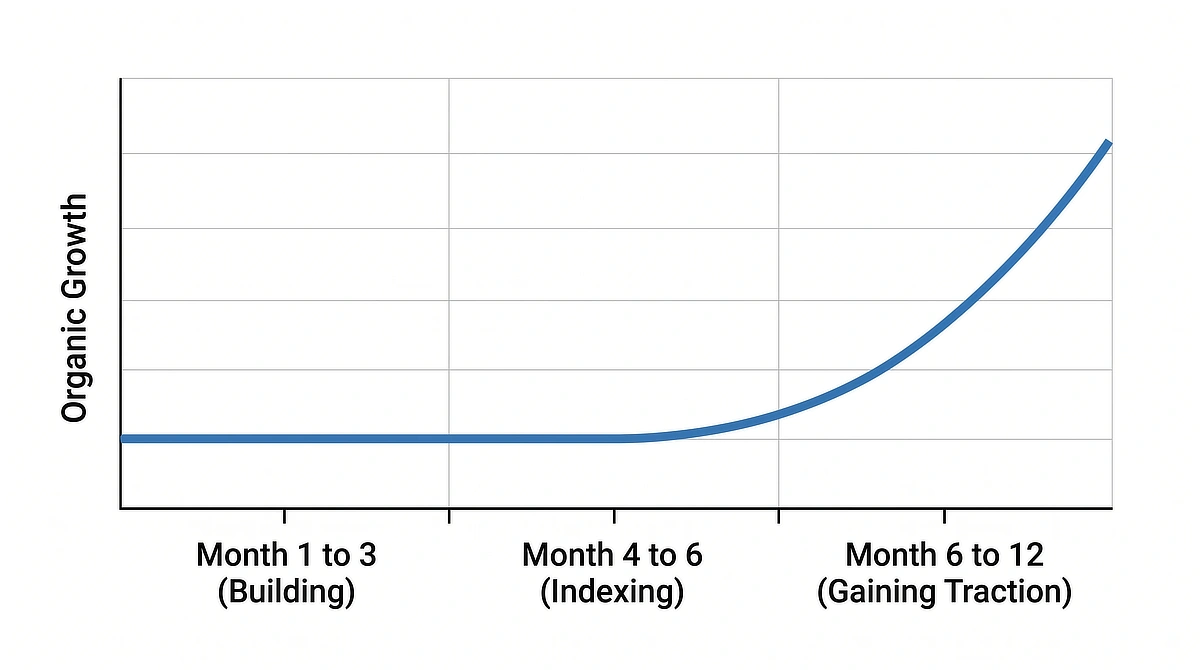
Here’s what “normal” looks like in your first 90 days:
- Post count: 10 to 15 posts published
- Organic traffic: minimal to zero
- Affiliate commissions: zero
What’s actually happening: you’re building the foundation that month seven depends on.
Publishing four posts and watching the traffic counter sit at zero is not a sign that something is broken. It’s the process working exactly the way it’s supposed to.
The realistic affiliate marketing timeline for part-time builders covers the growth curve in more concrete terms if you want to understand what the typical trajectory actually looks like month by month.
This is also the stretch where you’re most exposed to the claims that flood the make-money-online space. Guaranteed passive income. Six-figure months from a brand-new site.
Those claims exist because they sell, but they are not consistent with how organic affiliate marketing works. Knowing how to spot common online business red flags before they waste your time is worth five minutes of your attention now.
The part-time builder who makes it to month six intact, still publishing and still improving, is the one who understood the timeline from the start. That’s the only sustainable edge available to someone building around a full-time life: consistency, held over time, while most people quit in month two.
Starting affiliate marketing on five hours a week isn’t a compromise. It’s actually a constraint that forces the right behavior: skip the distractions, do the work that compounds, and stay consistent.
The beginners who build something real are rarely the ones with the most time. They’re the ones who stopped trying to do fifteen things at once and committed to doing one thing, week after week.
If the tool setup piece is what’s currently blocking you, that’s the most common sticking point and the most fixable one. Explore the unified platform that removes setup friction and see whether it fits your actual weekly schedule before you spend another evening debugging separate accounts.
If you’re currently trying to decide on your first niche, or if you’re stuck trying to connect your domain and hosting, leave a comment below. I read every comment and am here to help you unblock your setup.

Sonia Zannoni
Hi, I’m Sonia Zannoni, creator of Click to Prosper. I share practical tools, workflows, and honest guidance to help you build an online business with more clarity and less chaos.
About Sonia
Feeling stuck between too many tools and too much advice? Start with the beginner path.
View the Blueprint