
How to Choose a Profitable Niche Using AI (Using Free Tools Only)

There’s a good chance you’ve already tried using AI to choose a profitable niche. You typed something in, got a list back, and stared at “personal finance,” “health and wellness,” and “remote work productivity.” The ideas are not wrong, exactly. They are just the same ideas that showed up in every other beginner’s chat window this week.
That is not a problem with the tool. It is a problem with the prompt. When you ask AI a generic question, you get a generic answer. “Give me profitable niches” is the most generic question you can ask. Every beginner asks it. That is why everyone ends up with the same list.
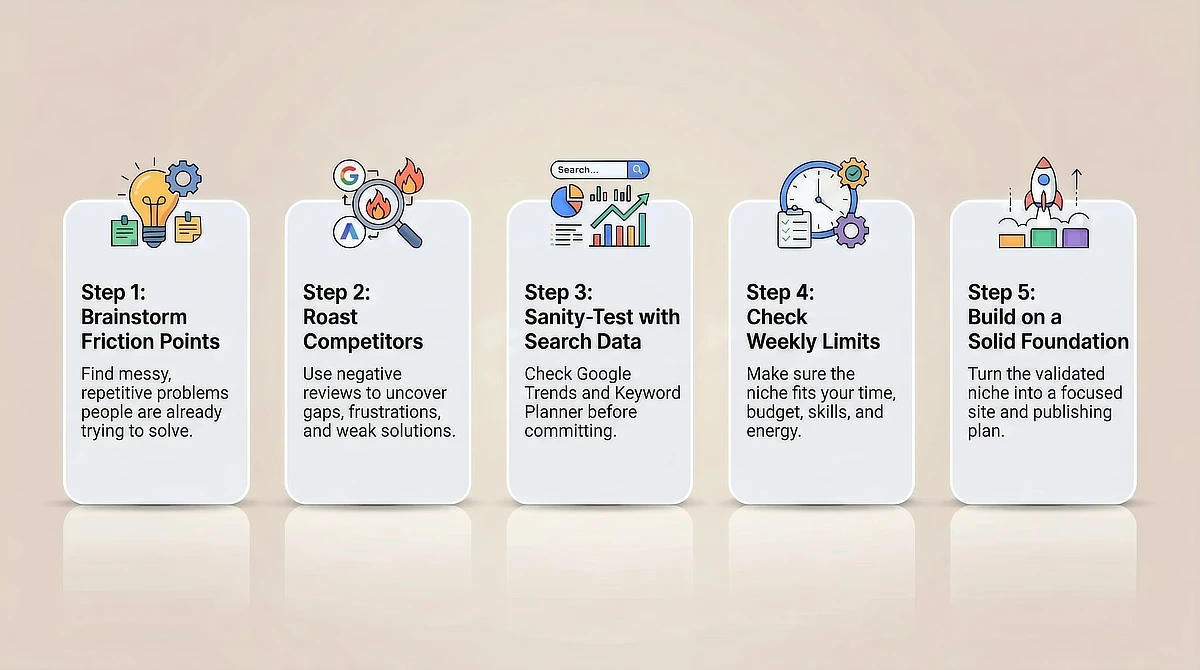
What actually produces a workable niche is using AI differently. Not as a search engine you query once, but as a thinking partner you push until it surfaces something specific, friction-heavy, and genuinely underserved. This guide gives you the five-step prompt sequence that makes that possible, using only free research tools.
Choose a Profitable Niche Using AI
The Trap of Generic AI Niche Lists (And Why They Fail)
The most common mistake beginners make is typing something like “give me 10 profitable niches for affiliate marketing” and treating the output as a starting point. It is not a starting point. It is a dead end dressed up as momentum. What you get back is a recycled version of the same broad categories every content farm has already claimed: fitness, budgeting, cooking, personal development, and travel hacking.
These lists fail for two compounding reasons. First, they surface markets already packed with established sites, some of which have been building domain authority (a metric representing how much trust and credibility a website has built with search engines over time) for a decade. Second, they point you toward topics that feel vague enough to be interesting for about three weeks before the content well runs dry. You cannot build a business on a list your AI assembled in four seconds without any context about your audience, your schedule, or the competitive landscape.
The shift that changes everything is treating AI as a conversational sparring partner rather than a search engine. You push back. You feed it context. You ask it to critique, stress-test, and challenge the ideas it surfaces. Before you open any tool, though, it helps to understand the fundational principles of niche selection that should guide your decisions regardless of what the AI suggests. The tool amplifies your strategic thinking. It cannot replace it.
Step 1: Brainstorming Friction Points (The Sequential Prompt Flow)
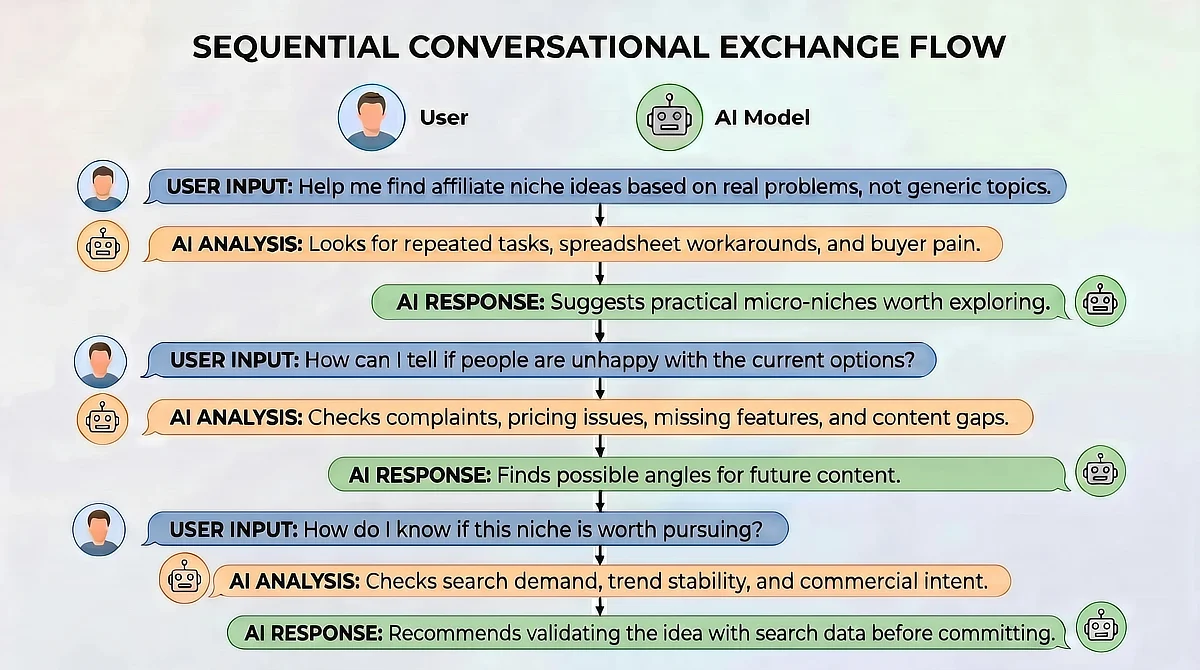
Most niche research starts in the wrong place: with what is interesting. A more reliable starting point is what is painful. Specifically, what are small business owners or professionals currently managing through clunky, jury-rigged spreadsheet systems because the right software either does not exist or costs more than they can justify? That is the “unhappy path,” and it is where the real demand lives.
Spreadsheet workarounds are a particularly useful signal because they carry a pre-validated budget. If someone is spending three hours a week fighting a spreadsheet to manage something that should be automated, they have already demonstrated that the problem is worth their time. They are not browsing. They are stuck, and they are looking for a way out. That is the posture of a buyer.
Before you run the prompt below, here is a quick rule of thumb to protect your limited side-hustle hours: watch out for prompt fatigue. When you only have 5 to 10 hours a week, it is easy to spend your entire evening drafting, tweaking, and over-optimizing AI prompts in a single night. Do not do that. Copy this template directly into your AI chat, run it once, capture the outputs, and force yourself to move to Step 2 within 20 minutes to keep your momentum.
Here is the first prompt to run:
“I want to start a part-time affiliate business. Identify 5 unglamorous, repetitive professional tasks that small business owners currently manage using complex, frustrating spreadsheets because standard software is too expensive or complex.”
The table below illustrates the difference between a generic brainstorming approach and a friction-focused, sequential one. The gap in business viability is significant.
Niche Search Approach
Typical Prompts Used
AI Output Result
Business Viability
Generic “vending machine” approach
“Give me 10 profitable affiliate niches”
Broad categories: fitness, finance, travel, productivity
Very low. Saturated markets dominated by established sites with years of authority.
Friction-focused sequential prompting
“Identify 5 tasks small businesses manage in spreadsheets because software is too expensive”
Specific process gaps: contractor invoicing, subscription tracking, employee PTO logging, vendor comparison
High. Audience has demonstrated pain, budget, and active buying intent.
Generic “vending machine” approach
Typical Prompts Used: “Give me 10 profitable affiliate niches”
AI Output Result: Broad categories: fitness, finance, travel, productivity
Business Viability: Very low. Saturated markets dominated by established sites with years of authority.
Friction-focused sequential prompting
Typical Prompts Used: “Identify 5 tasks small businesses manage in spreadsheets because software is too expensive”
AI Output Result: Specific process gaps: contractor invoicing, subscription tracking, employee PTO logging, vendor comparison
Business Viability: High. Audience has demonstrated pain, budget, and active buying intent.
The difference is not subtle. The first approach gives you a topic. The second gives you a problem that needs solving, which is the only starting point worth building a business around.
Step 2: Prompting Your AI to Roast Competitors
Once you have a shortlist of friction-heavy micro-niches from Step 1, the next move is to find out exactly where the existing solutions are falling short. You are not going to find that by reading competitor websites. You are going to find it by reading what their customers say when they are frustrated enough to write a public review.
Go to the app stores, the Reddit threads, the G2 or Capterra review pages for the software tools operating in your candidate niche. Pull three to five of the most pointed negative reviews: the ones where people are specific about what is broken, what is confusing, or what forced them to abandon the tool entirely. Copy that raw text into your AI and run this prompt:
“Here are negative reviews for current solutions in [Insert Niche]. Roast these competitors. What are the top 3 structural flaws, qualitative blind spots, or user frustrations they are ignoring?”
What comes back is the foundation of your content strategy. Every gap the AI surfaces is a problem your future posts can address directly. You are not writing generic “what is X” content. You are writing “why every current X solution gets this wrong, and what to look for instead.” That is a completely different value proposition, and readers who are already frustrated with existing tools can feel the difference immediately.
This step is where your site starts to look like an authority resource rather than another affiliate blog. The roast reveals the holes. Your content fills them.
Step 3: Sanity-Testing AI Ideas with Free Search Data
This is the step most beginners skip, and it is the step that saves you from spending months writing content no one is looking for. Your AI does not have access to real-time search data. It cannot tell you what 40,000 people typed into Google last month. When you ask it to confirm that a niche has search demand, it will sound confident and be wrong.
Verification requires two free tools, used in a specific order.
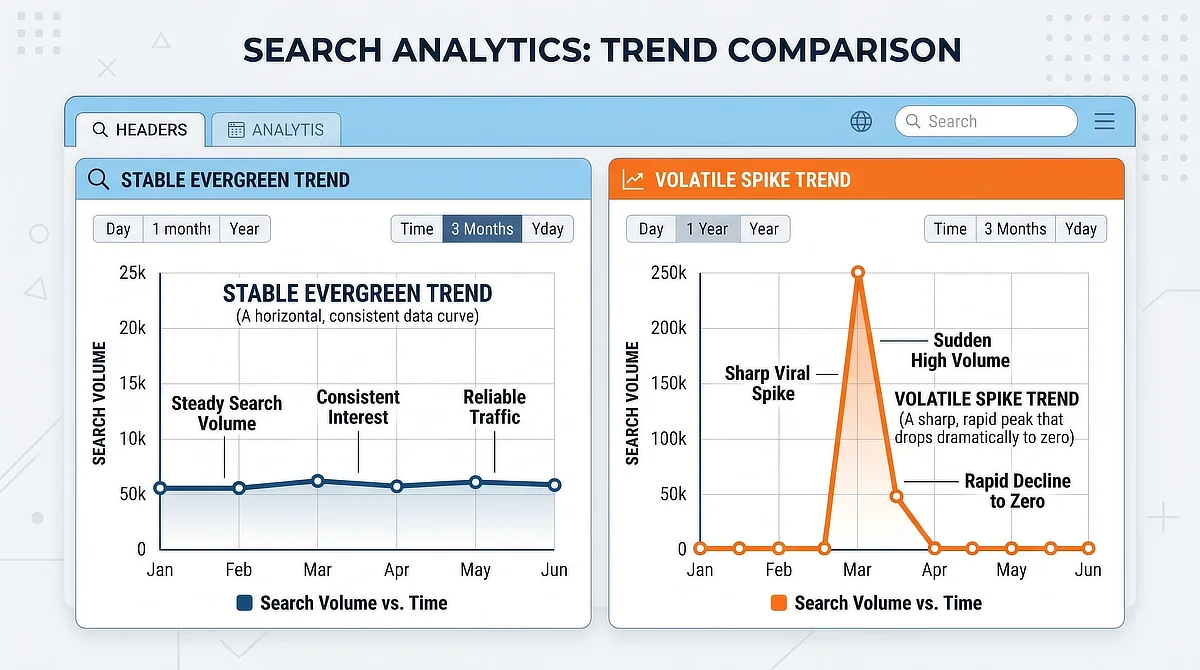
Start with Google Trends. You are not looking for a spike. You are looking for stability: a search curve that has held reasonably steady over three to five years with no signs of a permanent decline. A niche with a massive peak that has since collapsed is not a sustainable business. A niche with a boring, flat line of consistent interest is exactly what you want.
After Trends confirms multi-year stability, move to Google Keyword Planner. Here, you are checking two things: that real monthly search volume exists at the keyword level, and that advertisers are actively bidding on related terms. Active bidding signals that commercial intent exists and that other businesses believe people in this niche are willing to spend money. That is the confirmation you need before committing.
An important onboarding warning here: when you first sign up to access the Keyword Planner, Google will aggressively attempt to funnel you into creating a paid Google Ads campaign, complete with billing and credit card details. This is a massive friction point where most beginners freeze and quit. You do not have to spend any money or enter a credit card. Simply look for a tiny, easily missed link that says “Create an account without a campaign” or “Switch to Expert Mode” during the sign-up setup. This lets you bypass the payment screens entirely.
Keep your tool budget in mind throughout this process. For a part-time operation running on 5 to 10 hours a week, keeping software spend under roughly 80 dollars a month is a reasonable ceiling. Both Google Trends and Google Keyword Planner are free. That is the entire toolset you need at this stage.
If you find yourself adding more paid tools to the stack instead of committing to a direction, staying free at this stage actually helps: fewer tabs, clearer decisions. When you are ready to turn this into a repeatable habit, a simple 15-minute keyword research routine will be worth bookmarking.
Step 4: Assessing Your Weekly Limits for the Long Haul
A niche that passes every research test still fails if you cannot produce content in it week after week with the time you actually have. This step is not about motivation. It is about operational honesty.
You have five to ten hours a week. That is the working constraint. The question is not whether a niche is theoretically profitable. It is whether you can build topical authority (demonstrating to search engines that you are a highly trusted, go-to expert on a narrow, specific subject) within 6 months using highly streamlined, focused content outlines. Run this prompt with your shortlisted micro-niche filled in:
“Evaluate [Insert Micro-Niche]. If I only have 10 hours a week, what are the primary writing challenges I will face? Provide a realistic plan to build topical authority (meaning deep, comprehensive coverage of this single tight subject so search engines trust me as an expert) within 6 months using highly streamlined, focused content outlines.”
What you are looking for in the AI’s response is honesty about difficulty. If the niche requires specialized credentials, hands-on equipment testing, or sustained access to paid platforms you cannot justify, that is important to know before you publish your first post.
There is also what I think of as the two-year test. Not a formal framework, just a practical question: can you write about this topic consistently for two years without burning out or running out of things to say? Enthusiasm fades. Interest has to be durable enough to survive the months when publishing feels like a grind. If you cannot answer yes with reasonable confidence, keep shortlisting.
Step 5: Launching Your Niche on a Solid Foundation
At this point, you have a validated micro-niche with confirmed search demand, a content angle built on real competitor gaps, and a realistic sense of the weekly workload. What many beginners do next is freeze. They open a new browser tab and start comparing hosting providers. Then, the domain registrars. Then, site builders. Three hours later, they have spent the whole session on logistics and have nothing to show for it.
This is where technical overwhelm kills good niche research. The problem is not a lack of information. It is too much information from too many disconnected sources, with no clear sequence for what comes first.
What actually moves you from a validated niche concept to a live, functioning website is a structured environment that consolidates the pieces: hosting, keyword tracking, training, and community support in one place with a defined path through them. That is what eliminates the 14-browser-tab problem.
If you want to see how one platform approaches this, the structured step-by-step affiliate business training I cover in my Wealthy Affiliate review walks through exactly what that environment looks like in practice, and whether it makes sense for someone starting with limited evenings.
The research you have done through these five steps does not need a perfect technical setup to be useful. It needs a working website and a publishing schedule. The sooner you get that in place, the sooner the content starts compounding.
The five steps in this guide are designed to run in sequence, but they are not a one-time sprint. Niche research is more like a conversation than a checklist. You return to it, refine it, and let your early publishing data tell you whether the market is responding the way your research predicted.
Start with the friction-focused prompt. See what comes back. Run the roast on two or three competitors. Verify in Trends and Keyword Planner. Then commit to a niche and build.
Are you currently stuck in the niche selection loop, or have you tried validating a concept with ChatGPT or Claude? Let me know which micro-niche step feels the most challenging, or share your prompt results in the comments below. I read and answer every single message.

Sonia Zannoni
Hi, I’m Sonia Zannoni, creator of Click to Prosper. I share practical tools, workflows, and honest guidance to help you build an online business with more clarity and less chaos.
About Sonia
Feeling stuck between too many tools and too much advice? Start with the beginner path.
View the Blueprint