Kre8or.AI Review: Does This New Creator Platform Fit a Part-Time Schedule?

Most AI image tools make the same promise: describe what you want, hit generate, done. That holds up fine for a one-off illustration. It falls apart the moment you need consistent visual assets across a blog, a Pinterest account, and an affiliate promotion campaign.
The characters drift between sessions. The style shifts. You run the same prompt six different ways and still end up with nothing you can actually brand. If that is the consistency problem you are trying to solve, this Kre8or.AI review is written for you.
The frustration is real, and it is common. The AI image tool market has been flooded with generators that all work roughly the same way: blank prompt box, generate, hope for the best. They handle one-off creative requests fine. They were not built for repeatable, brand-consistent output across a full content calendar. Adding another monthly tool to that stack only makes sense if this one solves the problem differently.
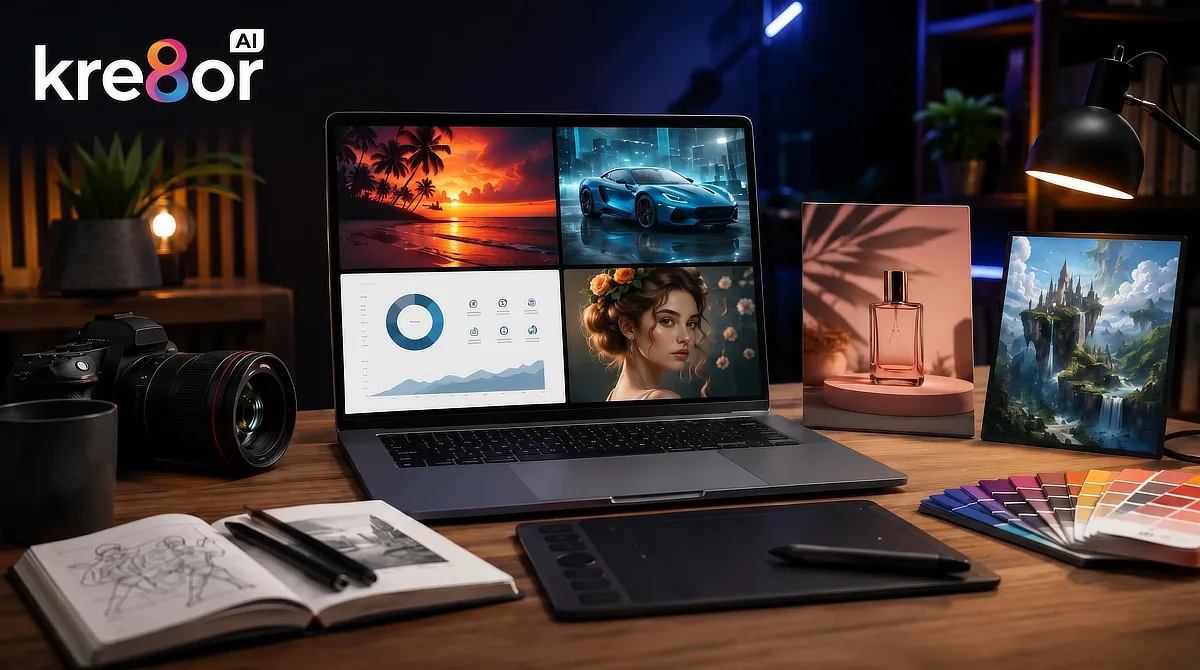
Kre8or.AI positions itself as structurally different from the standard generation sandbox. Kre8or.AI organizes creation around guided workshops, remixing, referral sharing, and upcoming character tools.
Whether those architectural differences actually solve the consistency problem, or just add another tool to manage, is what this review examines.
TL;DR: Kre8or.AI Review
Kre8or.AI is a standalone creator environment combining guided design workshops, remixing, sharing tools, and upcoming character features.
The Transition from Isolated Generators to Connected Creator Environments
Early AI art generators operated as black boxes. You typed a description, the model produced something, and if it was not quite right, you typed a different description and hoped for better.
There was no template system, no way to lock down visual consistency across multiple pieces of content, and no connection between the generation tool and the business goals driving the content. For a single illustration, that was workable. For a content publisher building a recognizable brand identity across dozens of posts and social channels, it was a lottery.
The problem ran deeper than interface design. Early generative models were optimized for novelty, not repeatability. Every output was fresh, which meant every output was also different, even when you wanted them to look the same.
Affiliate marketers maintaining visual identity for a niche site, or social media managers building a recognizable character across a campaign, quickly found that these tools were not designed for their actual use case.
Kre8or.AI addresses this by embedding image generation inside a structured business environment rather than presenting it as a standalone generation window.
The platform organizes creation around guided workshops, upcoming character tools, and a collaborative remix layer, moving the creative process from isolated prompt guessing toward an organized production system.
For anyone building content at volume, that shift changes what the tool can reliably deliver across multiple sessions and channels.
Practical Utility Across Five Core Creator Use Cases
The platform organizes its workflow around five content tasks that most digital marketers regularly encounter: blog visuals, social media content, Pinterest graphics, infographics, and affiliate promotional materials.
That categorization changes the experience from “generate something and see if it works” to “generate for a specific purpose, with presets calibrated to that purpose.”
The most direct way to see what that means in practice is to look at what the platform produces from a minimal prompt. A short instruction like “create an image of a sunset in Hawaii” generates a polished, finished visual without any complex prompt construction.
Prompt Used: “Create an image of a sunset in Hawaii”

That output quality from a short, plain-language instruction is worth noting. Most AI image tools at this price point require significant prompt engineering to reach a usable result.
Kre8or.AI handles the technical weight behind the scenes, which lowers the skill barrier for new users who are still working through choosing an affiliate niche while managing everything else on a part-time schedule.
The infographic use case follows the same logic. A plain-language instruction like “Make a detailed infographic explaining how to make an espresso step by step” produces a structured, multi-step educational visual without requiring the user to specify layout parameters manually.
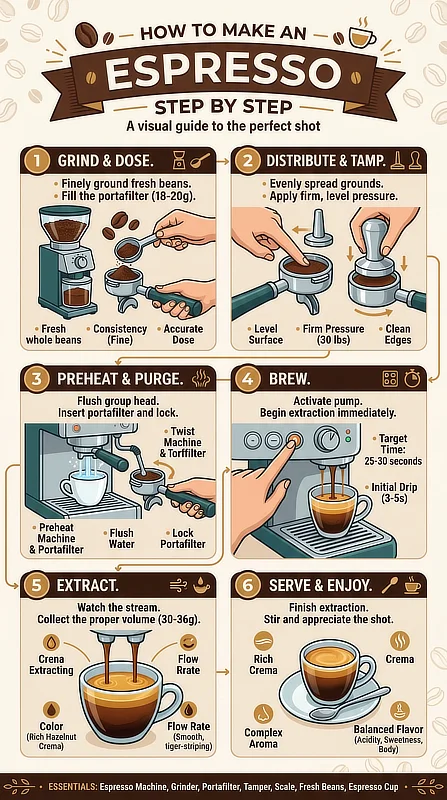
One limitation worth naming directly: while the layout engine handles clean, straightforward infographics well, complex data visualizations with multiple chart types or highly specific text relationships will likely need manual adjustments after generation.
AI generation is not a replacement for design judgment when the data structure is genuinely complicated. What it handles well is the foundational layout work that would otherwise require design software fluency or a freelancer budget.
Here is how the platform addresses each of the five use cases across practical creator scenarios:
Creator Use Case
Platform Solution
Operational Impact
Blog Visuals
Guided workshop templates and contextual graphic presets
Eliminates layout inconsistency and reduces image generation time
Social Content
High-fidelity cinematic rendering and dynamic visual presets
Supports multi-channel branding without requiring separate tools
Pinterest Graphics
High-aspect-ratio canvases and vertical orientation presets
Drives organic discovery and improves pin click-through rates
Infographics
Clean layout engines and multi-step sequential diagrams
Translates subject matter into structured visual guides
Affiliate Promotion
Built-in promotional templates and referral link integration
Connects visual output directly to affiliate revenue
Blog Visuals
Platform Solution: Guided workshop templates and contextual graphic presets
Operational Impact: Eliminates layout inconsistency and reduces image generation time
Social Content
Platform Solution: High-fidelity cinematic rendering and dynamic visual presets
Operational Impact: Supports multi-channel branding without requiring separate tools
Pinterest Graphics
Platform Solution: High-aspect-ratio canvases and vertical orientation presets
Operational Impact: Drives organic discovery and improves pin click-through rates
Infographics
Platform Solution: Clean layout engines and multi-step sequential diagrams
Operational Impact: Translates subject matter into structured visual guides
Affiliate Promotion
Platform Solution: Built-in promotional templates and referral link integration
Operational Impact: Connects visual output directly to affiliate revenue
For blog publishers building out early content frameworks, the guided templates remove one of the more time-consuming decisions in the production workflow: starting from scratch on image layout.
Instead of spending 45 minutes tweaking prompt variables late on a Tuesday night, these guided presets let you drop your asset in, apply the correct layout, and move on to your writing within five minutes. The presets give you a functional starting point already calibrated to the content type.
To test whether the platform fits your specific content needs before committing, Kre8or.AI offers 10 free trial creations. Run your actual content types through the trial and evaluate the output quality against your real workflow before deciding.
Under the Hood: Workshops, Remixing, and Features Still Rolling Out
To understand what sets Kre8or.AI apart from a standard generation interface, the workshop system is the right place to start. Rather than presenting users with a blank prompt box, the platform organizes creation around guided transformation categories.
Each workshop defines the type of transformation being applied, so you are working within a structured creative direction rather than guessing at which prompt phrasing will produce a useful result.
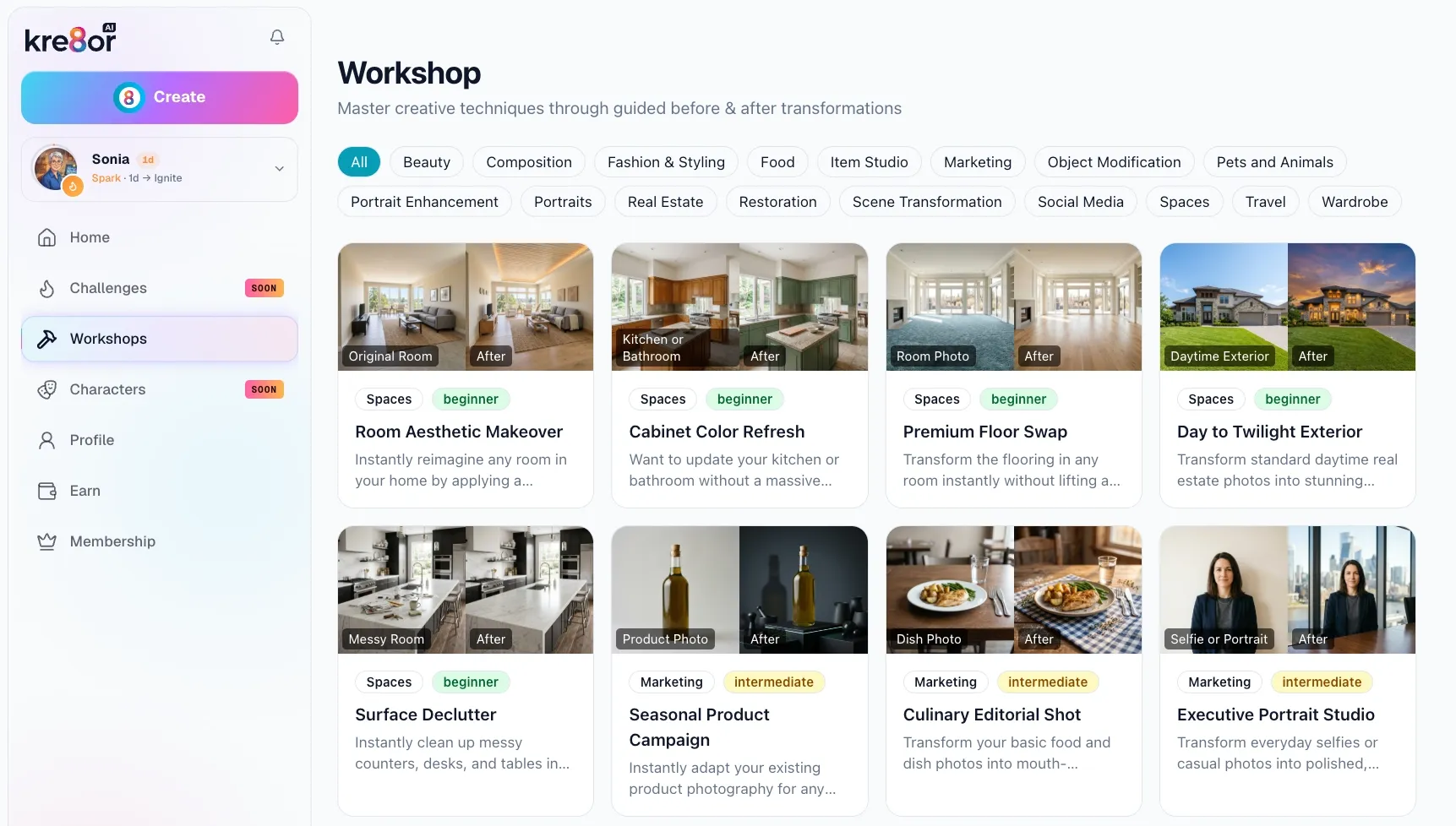
That organizational approach addresses one of the most common friction points in AI image work: the gap between what a user wants and what an open-ended prompt delivers.
When the workshop category is already defined, the generation model can optimize toward a specific output type. The Day to Twilight Exterior workshop is a concrete example: it takes a daytime property photograph and transforms it into a twilight-style image, which is a high-value use case for anyone producing real estate content or dramatic editorial visuals.


Workshop Used: Day to Twilight Exterior
The question worth asking before committing to any AI image platform is not just “can it generate good images?” but “can it generate consistent images across multiple sessions?” That is where character tools could address a specific technical problem.
Early generative models did not retain visual reference between sessions, so every generation started fresh. A character, logo, or branded visual element would look different each time it was recreated.
Character tools are still marked as coming soon in my dashboard, so I am not treating them as a fully reviewed feature yet. If they work as intended, they could help solve one of the biggest problems with AI image tools: keeping the same visual identity across multiple generations.
The evaluation criteria that matter most for these upcoming features are accuracy across pose variations and consistency of styling details when the framing changes. Those two factors determine whether these character tools will be genuinely useful for your production workflow once they are live, or just conceptually appealing on paper.
The remixing protocol adds a third layer. The system tracks when a user’s original design is modified by another creator on the platform and triggers automated attribution, meaning the original creator receives a financial kickback when their design is built upon.
The practical workflow is visible in a concrete example: an original coffee mug image, when presented with a built-in remix suggestion (“Move the coffee mug to a rain-streaked window sill”), produces a distinct new composition while maintaining attribution back to the original creator.

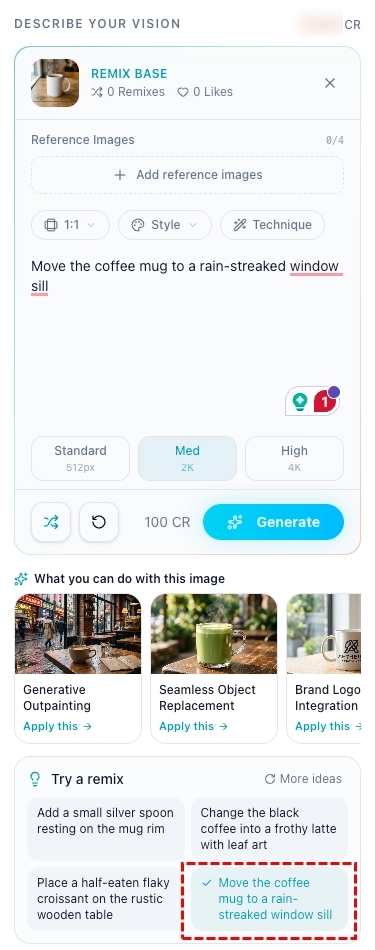

The combination of workshops, upcoming character tools, and remix attribution is what separates Kre8or.AI architecturally from a standalone generator. Whether that structure fits your workflow depends on how much design consistency and collaborative monetization matter relative to your current production goals.
The Economics of Kre8or.AI (Subscriptions and the Referral Structure)
The pricing structure removes most of the financial risk from the evaluation process. Ten free trial creations let you work through the platform’s core features before any subscription begins, so the first practical question is not “should I pay” but “does this tool fit what I need in a real workflow.”
After the trial, the entry subscription is $9 per month. For context, most dedicated AI image platforms at this price point either limit output quality, restrict commercial use, or operate without the kind of structured design framework Kre8or.AI provides.
Here is a breakdown of the platform’s full financial structure:
Financial Parameter
Structural Detail
Revenue Contribution Type
Entry Subscription Price
$9.00 per month
Stable user subscription base
Free-Tier Allotment
10 initial creations
Promotional conversion asset
Referral Commission Rate
10% lifetime recurring
Recurring affiliate commissions
Payout Infrastructure
9 integrated payout methods
Global financial flexibility
Derivative Revenue
Automated remix kickbacks
Intellectual property monetization
Entry Subscription Price
Structural Detail: $9.00 per month
Revenue Contribution Type: Stable user subscription base
Free-Tier Allotment
Structural Detail: 10 initial creations
Revenue Contribution Type: Promotional conversion asset
Referral Commission Rate
Structural Detail: 10% lifetime recurring
Revenue Contribution Type: Recurring affiliate commissions
Payout Infrastructure
Structural Detail: 9 integrated payout methods
Revenue Contribution Type: Global financial flexibility
Derivative Revenue
Structural Detail: Automated remix kickbacks
Revenue Contribution Type: Intellectual property monetization
For affiliate marketers, the referral layer is worth examining separately from the subscription value. A 10% lifetime recurring commission means earnings from a referred subscriber continue for as long as that subscriber stays active, not just at the point of initial sign-up.
That structure rewards early adoption because the value compounds as your referral base grows over time. Nine integrated payout methods broaden global access, which matters for builders operating outside of markets where a single payment rail might not be reliable.
The platform’s referral share panel connects image sharing with campaign tags, custom messages, and direct referral tracking.
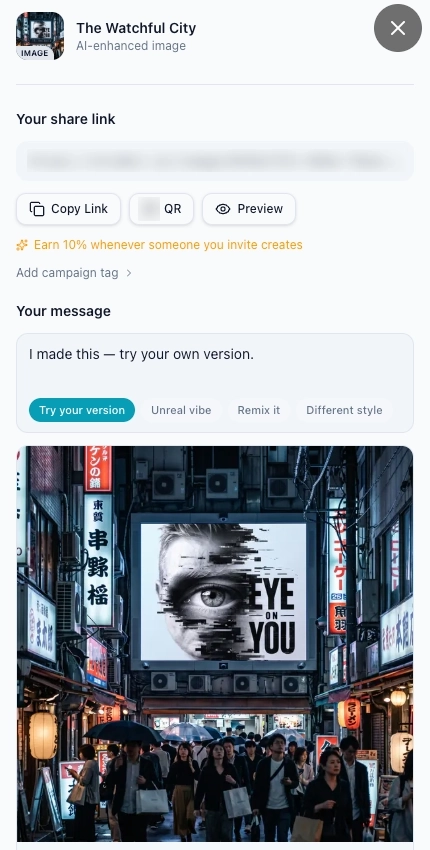
A few practical notes on the economics worth stating directly. The $9 entry tier comes with a credit allocation suited to moderate production volume. For a part-time creator publishing two posts and five pins a week, this baseline allocation easily covers your monthly production without needing immediate top-ups.
Heavy users running high-output content calendars will hit those limits and need to budget for credit top-ups or a higher tier. That is a standard limitation of credit-based generation systems, not a hidden flaw. Know your monthly image output needs before selecting a tier, and verify current credit allotments on the Kre8or.AI platform page before committing.
One compliance point: if you plan to promote Kre8or.AI through its referral program, standard affiliate disclosure requirements apply. The FTC affiliate disclosure guidelines are the baseline reference for structuring that disclosure correctly.
Kre8or.AI vs WA Image Studio (Which Tool Fits Your Workflow?)
These two platforms are not competing for the same use case, which is the most useful frame for this comparison. WA Image Studio is a utility built into the Wealthy Affiliate business hub, designed for someone publishing SEO content to a WordPress site using integrated platform tools.
Kre8or.AI is a standalone design environment oriented toward social media branding, campaign consistency, and collaborative creation across a public creator network.
The clearest way to see the difference is at the infrastructure level. When you build a website on Wealthy Affiliate, you are working within a system where the image studio shares credits, workspace, and workflow context with your keyword research, site management, and training resources. Everything lives in one dashboard.
Kre8or.AI operates outside that context, as a separate tool you access independently and integrate manually into whatever publishing workflow you are already running.
Here is how the two platforms compare across the dimensions that matter most for a part-time builder:
Feature Dimension
Kre8or.AI Platform
WA Image Studio
Operational Setting
Standalone public web application
Built-in Business Hub utility
Billing and Resource Cost
$9.00 monthly subscription
Deducted from monthly membership credits
Direct Referral Program
10% lifetime recurring commissions
Managed through the WA affiliate program
Design Methodology
Advanced workshops and user-guided prompts
Rapid generation aligned with SEO content
Collaboration Layer
Active remix tracking and peer-to-peer sharing
Private, single-user workspace folders
Earning Opportunities
Remix kickbacks and direct affiliate links
Increased website search traffic and ad clicks
Asset Consistency
Guided workshops, remixing, and upcoming character tools
Logo models and simple visual adaptations
Operational Setting
Kre8or.AI Platform: Standalone public web application
WA Image Studio: Built-in Business Hub utility
Billing and Resource Cost
Kre8or.AI Platform: $9.00 monthly subscription
WA Image Studio: Deducted from monthly membership credits
Direct Referral Program
Kre8or.AI Platform: 10% lifetime recurring commissions
WA Image Studio: Managed through the WA affiliate program
Design Methodology
Kre8or.AI Platform: Advanced workshops and user-guided prompts
WA Image Studio: Rapid generation aligned with SEO content
Collaboration Layer
Kre8or.AI Platform: Active remix tracking and peer-to-peer sharing
WA Image Studio: Private, single-user workspace folders
Earning Opportunities
Kre8or.AI Platform: Remix kickbacks and direct affiliate links
WA Image Studio: Increased website search traffic and ad clicks
Asset Consistency
Kre8or.AI Platform: Guided workshops, remixing, and upcoming character tools
WA Image Studio: Logo models and simple visual adaptations
If your primary need is consistent, branded character visuals for social media campaigns, or advanced promotional graphics that need to hold up across multiple formats, Kre8or.AI addresses that more directly.
If your need is clean, fast blog graphics published to a WordPress site as part of an integrated affiliate workflow, WA Image Studio fits that use case without adding another tool to your stack.
For anyone still evaluating whether Wealthy Affiliate is the right business foundation before deciding which image tools to layer on top, read my complete Wealthy Affiliate review for a full breakdown of the platform’s business model, pricing, and what it actually delivers across the first year.
Human Capital vs Token Capital (Why Your Judgment Is the Real Multiplier)
There is a pattern developing across the AI tool space worth naming explicitly. As raw generation capability becomes less differentiated between platforms, the actual value in the ecosystem shifts toward what the tool enables humans to do rather than what the tool produces in isolation.
A generation engine accessible to anyone at $9 per month has commoditized the token side of the equation. What has not commoditized is the judgment layer: knowing which creative direction to take, which character to lock, which template fits the actual audience, and which remix adds something the platform’s creator network will build upon.
Kre8or.AI structures its economics around this reality. The remix attribution system and the referral commission are both designed to reward human creative input, not just usage volume.
An automated model running without direction generates output in circular loops because there is no business context to organize what gets produced. A creator who understands their niche, their audience’s visual expectations, and the content gaps they are filling can direct those same generation tools toward assets that hold real commercial value.
That principle applies directly to the affiliate marketing context. The creators who will get the most out of Kre8or.AI are not the ones who generate the highest image volume. They are the ones who generate the right images: consistent with their brand identity, calibrated to their distribution channels, and tied to content goals that have been thought through in advance.
The platform provides a structured environment. The judgment about what to build still belongs to the person directing it.
The Final Verdict (Is Kre8or.AI Worth Your Time and Budget?)
Kre8or.AI solves a specific problem. If that problem is yours, the platform earns its $9 per month. If it is not, adding it to your tool stack creates management overhead without proportional output benefit.
Here is the decision framework that makes that evaluation clear:
Add Kre8or.AI if:
- You want to build template-driven content across multiple channels and plan to use upcoming character features once they are fully rolled out and reviewed.
- You produce content for Pinterest, social media campaigns, or any distribution channel where visual variety and high-fidelity output matter more than basic blog graphic generation.
- You want a referral income stream tied to a platform you are already using to generate content assets.
- You are running promotional campaigns where template consistency across different formats is a regular production requirement.
Skip It (for Now) if:
- Your current image needs are primarily basic hero images for blog posts inside a unified business platform.
- You are still in the early stages of building your affiliate site and do not yet have a consistent visual production workflow to improve upon.
- Adding a standalone tool requires management bandwidth that your current production volume cannot support.
The 10 free trial creations remove the commitment risk from the initial evaluation. Test the workshops and preview upcoming features against your actual content type before deciding.
If the outputs match your production needs across those 10 trials, the entry price is low enough to warrant a month of real use before making any longer-term call.
Kre8or.AI works best as a standalone addition to an established business system, not as the business system itself. The foundation of a sustainable affiliate income model is still a well-structured site, keyword-targeted content, and a consistent publishing workflow.
If that foundation is not in place yet, the better next step is to sort out your business system before adding another standalone tool.
If you already have your niche, website, and content workflow in motion, use the free Kre8or.AI creations to test the platform with your own blog visuals, Pinterest graphics, and affiliate promotion ideas before paying for a plan.
If you have questions about Kre8or.AI’s workshops, remixing, referral sharing, or how it compares to WA Image Studio, leave them in the comments below. I read and answer every message.

Sonia Zannoni
Hi, I’m Sonia Zannoni, creator of Click to Prosper. I share practical tools, workflows, and honest guidance to help you build an online business with more clarity and less chaos.
About Sonia
Feeling stuck between too many tools and too much advice? Start with the beginner path.
View the Blueprint