

How to Write an Affiliate Product Review That Ranks and Still Tells the Truth

You finish the first draft of your review, read it back, and something is off. Every feature is a highlight. The only drawback you managed to include is that you wish the dashboard had a dark mode. It reads like a press release with your name on it, and you already know a skeptical reader would see through it.
That instinct is worth trusting, and the fix is not writing with less conviction. Most advice on how to write an affiliate product review quietly assumes honesty and commission pull in opposite directions, so you either soften the truth or accept fewer clicks. They do not pull in opposite directions.
The quality standards search engines publish for review content ask for the same things a doubtful reader wants: evidence you actually evaluated the thing, real tradeoffs, and a stated reason behind the verdict.
So the job is not to sound nicer about the product. It is to make the post genuinely useful for one decision. Here is the five-part structure a review needs, where the disclosure has to sit, how to turn real flaws into a filter that qualifies buyers instead of scaring them off, and how to write a verdict for a tool you only partly recommend.
TL;DR: How to Write an Affiliate Product Review
The Decision Tool Mindset: Why Honest Reviews Outrank Sales Pitches
The standard affiliate review template fails for a reason that has nothing to do with writing skill. It is built to persuade someone who has already decided to buy, but almost nobody arrives in that state. They arrive holding a question, and a post that answers a different question loses them.
Search engines evaluate review content on whether it shows evidence of actual evaluation. Google’s guidance on writing high quality reviews asks for firsthand evidence, a discussion of both benefits and drawbacks, comparison against alternatives, and the decision-making factors you weighted.
A thin promotional summary contains none of those signals, which is why it competes badly against a review that does the work, even when the thin one is better optimized.
Readers apply a similar filter faster than any algorithm does. Uniform praise reads as a paid placement, and once the reader tags the post that way, every remaining claim gets discounted. You lose the sale not because you were too negative, but because you were not credible.
The shift that fixes this is small to describe and hard to actually do. Stop writing to convince someone to buy. Start writing to help one specific person work out whether this thing solves their specific problem.
That reframe changes what belongs in the post. You stop counting features and start explaining what each one removes from a week of work. You stop hiding the friction and start naming it precisely enough that the right reader recognizes it as acceptable.
And because the reader is deciding rather than being sold to, checking search intent before drafting matters more here than on almost any other post type. Someone searching “[product] review” wants a verdict. Someone searching “[product] vs [product]” wants a comparison table. Same product, different post.
Here is the contrast in one line. A sales pitch asks “why should you buy this?” A decision tool asks “who is this actually right for, and are you that person?” The second question is the one your reader is already asking.
Affiliate Disclosures That Protect Your Site Without Losing Reader Trust
Before any of the structure matters, the compliance piece has to be right, because getting it wrong is the one mistake on this list with legal consequences attached.
The FTC’s endorsement guides require your disclosure to be clear, conspicuous, and positioned so that readers encounter it before they act on your recommendation. Proximity is the operating principle.
If the review and the link sit together on screen, one disclosure near the recommendation can do the job. If they are separated, a reader can reach a link without ever having seen the disclosure, and that is the failure the rules exist to prevent.
In practice, that means the top of the post, above the fold (the part of the page a reader sees before scrolling), before the first affiliate link. Not the footer. Not a line inside your privacy policy. Not a tooltip the reader has to hover to see.
A footer disclosure technically exists on the page while doing nothing the rule actually asks for, and the same is true of vague labels: the FTC has been explicit that terms like “affiliate link” or “commissionable link” do not tell an ordinary reader that you get paid.
The wording matters less than most people assume, as long as it is plain. Compare these two.
Weak: “This site may contain affiliate links. See our disclosure policy for details.” Hedged, passive, and it sends the reader somewhere else to find out what you meant.
Strong: “Some links in this post are affiliate links. If you sign up through one, I earn a commission at no extra cost to you. It does not change what I recommend or what I say about it.”
The strong version works because it answers the question the reader is actually holding, which is not “are there affiliate links” but “does the money change what you are telling me.” Answer that directly, and the disclosure stops reading as a legal notice and starts reading as a reason to trust the rest of the page.
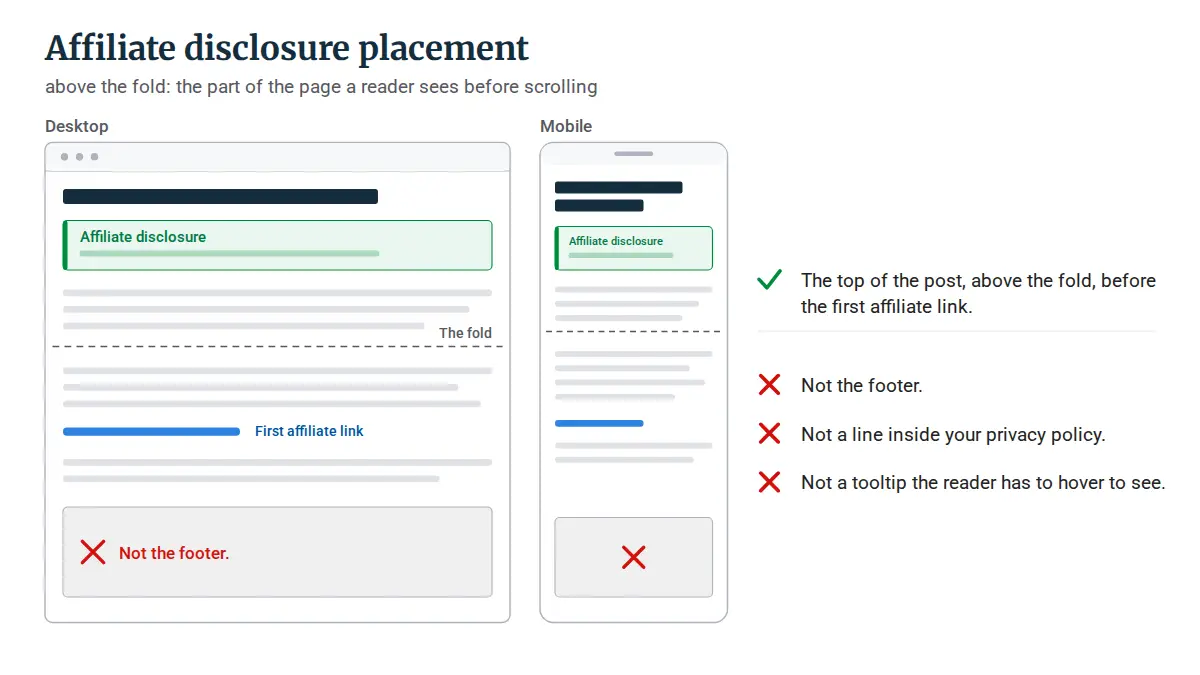
Write that line once and save it as a reusable block in WordPress. You will use it on every review you publish, and rewriting it each time is how inconsistencies creep in.
The 5-Part Review Architecture: Structuring for Skimmers and Deep Researchers
A review has to serve two readers at once. One wants the verdict in fifteen seconds and will scroll to find it. The other is going to read every word before spending money. A general blog post structure serves the second reader and loses the first, which is why reviews need their own architecture.
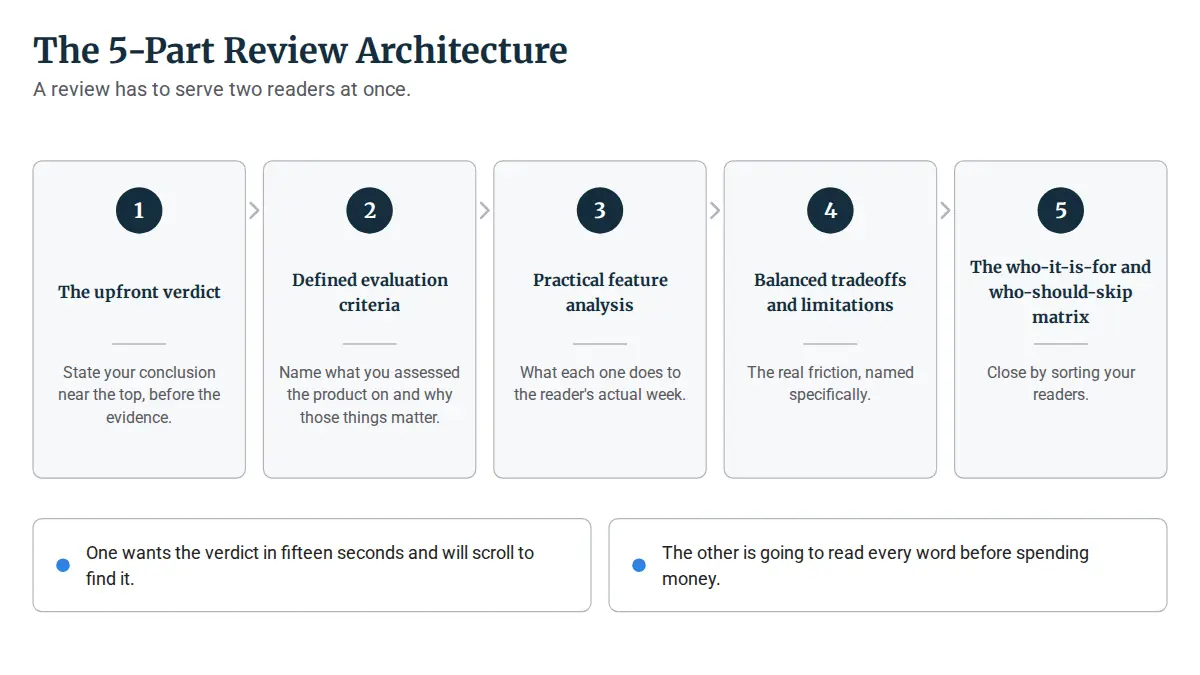
- The upfront verdict. State your conclusion near the top, before the evidence. This feels backwards if you are used to building an argument, but commercial search intent is impatient. The reader who gets the verdict immediately and then keeps reading is reading to confirm, which is a far better state than reading to find out whether you will ever get to the point.
- Defined evaluation criteria. Name what you assessed the product on and why those things matter, before you assess anything. Three or four criteria is plenty. This is the single element most affiliate reviews skip, and skipping it is why their verdicts feel arbitrary. Criteria are what let a reader disagree with your weighting and still trust your analysis.
- Practical feature analysis. Go feature by feature, but write about what each one does to the reader’s actual week rather than what the sales page calls it. “Keyword tool included” is a feature. “You stop paying separately for keyword research and stop exporting lists between two tools” is what the reader is buying.
- Balanced tradeoffs and limitations. The real friction, named specifically. This section gets its own treatment below, because it does more work than any other part of the post.
- The who-it-is-for and who-should-skip matrix. Close by sorting your readers. Two short lists, or a small table, naming the situations where this is the right call and the situations where it is not.
For pricing and specifications, use a table rather than prose, and give the table one sentence of setup so the reader knows what they are comparing. Anything a reader might want to compare across options belongs in rows and columns. Anything that needs explaining belongs in a paragraph.
Here is how the same five elements look depending on which post you are writing.
Review element
Standard sales pitch approach
Objective decision tool approach
Introduction focus
Opens with enthusiasm about the product
Opens with the decision the reader is trying to make
Drawback treatment
One cosmetic complaint, buried near the end
Real operational friction, named early enough to matter
Evaluation metrics
Undefined, so the verdict arrives with nothing behind it
Stated before the verdict, so the reader can weigh them
Affiliate disclosure
Footer link or a line in the privacy policy
Plain sentence above the first recommendation link
Recommendation style
One universal best pick for everyone
Conditional verdict naming who should buy and who should skip
Introduction focus
Standard sales pitch approach: Opens with enthusiasm about the product
Objective decision tool approach: Opens with the decision the reader is trying to make
Drawback treatment
Standard sales pitch approach: One cosmetic complaint, buried near the end
Objective decision tool approach: Real operational friction, named early enough to matter
Evaluation metrics
Standard sales pitch approach: Undefined, so the verdict arrives with nothing behind it
Objective decision tool approach: Stated before the verdict, so the reader can weigh them
Affiliate disclosure
Standard sales pitch approach: Footer link or a line in the privacy policy
Objective decision tool approach: Plain sentence above the first recommendation link
Recommendation style
Standard sales pitch approach: One universal best pick for everyone
Objective decision tool approach: Conditional verdict naming who should buy and who should skip
The Qualification Filter: How Honest Negatives Increase Conversion Rates
Watch what a reader does the moment they decide they want something. They go looking for what is wrong with it. That search happens whether or not your post gave them anywhere to do it, and if your review contained nothing but praise, they run the search somewhere else and finish their decision on a competitor’s page.
This is the mechanism behind the whole section, so it is worth being plain about it. The drawback section is not a concession you make to seem fair. It is the part of the post that keeps the reader on the page during the exact moment they were going to leave it.
Token cons defeat this completely. “I wish it had more themes” or “the interface could be prettier” tells the reader you either did not look hard or you did look and decided not to say. Both readings damage the rest of your analysis, because a reviewer who will not name a real flaw has just told you their positives are unverified.
Real limitations sound different. The search volume data is directional rather than precise. The training is sequential, so you cannot skip ahead to the part you need. Support answers within a day, not within an hour. Each one is specific enough that a reader can hold it against their own situation and decide.
That is what turns a drawback into a qualification filter. A reader who needs precise volume data reads that first limitation and correctly rules the tool out, which saves them money and saves you a refund.
A reader who does not need that precision reads the same sentence, decides it does not apply to them, and now believes your positives in a way they did not two paragraphs earlier.
The objection here is predictable, so let me name it. Will publishing real negatives cost you sales? Yes, some. It costs you the sales that were going to end in a refund or an angry email, and it buys credibility with everyone who stays.
Whether that trade nets out in your favour depends on your program, but for recurring-commission products where the reader has to stay subscribed for you to get paid, filtering out bad fits is not a sacrifice at all. It is the entire business model working correctly.
One caution. This only functions when the limitations are true and observed. Inventing a flaw to look balanced produces the same hollow effect as the cosmetic con, just from the opposite direction.
How to Handle Products You Only Partially Recommend
Most software is genuinely good at one thing and mediocre at three others. The all-in-one platform with excellent training and an average keyword tool. The page builder that is fast to learn and slow to load. If your review can only produce a yes or a no, you will end up misrepresenting most of what you write about.
The fix is a conditional verdict, written in two halves.
Yes, if: name the specific situation where this tool is the right call. “Yes, if you are starting from zero and the sequenced training is worth more to you than best-in-category individual tools.”
No, if: name the specific situation where it is not. “No, if you already have a keyword workflow you trust and you are only shopping for hosting, because you would be paying for training you will not open.”
Both halves have to be concrete enough that a reader can place themselves in one of them without guessing. A vague “great for beginners, maybe not for advanced users” gives them nothing. The reader does not know which label applies to them, which is usually why they are reading a review in the first place.
When the honest answer is that this reader should buy something else, say so and point them at the better fit. Two things happen. The reader gets a correct answer, which is the only durable reason anyone returns to a site in this niche. And if the alternative is also a program you are part of, the revenue follows the reader instead of evaporating, so you were never actually choosing between integrity and income.
Where you do not have an alternative to offer, still say it. A reader who is told “this is not for you, here is what to look for instead” remembers the site that told them the truth. That is worth more than one commission from someone who was going to cancel in week three anyway.
The Pre-Publish Review Routine: Polishing for Tone, SEO, and Links
The last pass on a review is different from the last pass on a tutorial, because the failure modes are different. Three checks, in this order.
Strip the promotional adjectives. Search your draft for words like “revolutionary,” “game-changer,” “seamless,” “powerful,” and “must-have.” Each one is a verdict with no evidence attached, and stacked together they produce exactly the infomercial tone you were trying to avoid.
Replace each one with the specific thing it was standing in for. “Powerful keyword tool” becomes “returns competition data for long-tail terms without a separate subscription.” The same discipline applies to anything you drafted with AI, and the editing routine that removes promotional fluff is worth running here even if you wrote every word yourself.
Check the link attributes. Every affiliate link needs rel=”sponsored” (or rel=”nofollow”, which Google still accepts for this purpose) so search engines can tell a paid link from an editorial one. Unmarked affiliate links across a site of reviews are a pattern search engines are specifically looking for.
While you are in there, confirm your buttons and text links actually point where you think they do, because a broken affiliate link is invisible in analytics and costs you every click.
Connect the review to the rest of the site. A review sitting on its own gets crawled slowly and converts poorly, because a reader who is not ready to buy has nowhere to go except back to the search results. Link out to the educational posts that answer the questions your review raises, and link back from those posts to the review.
If you have not set that up yet, the internal linking structure is a short job that pays off across every post you publish afterwards.
One expectation to set before you hit publish. A new review does not rank next week. Commercial keywords are the most competitive terms on any affiliate site, and the honest, realistic indexing timeline is months, not days. Write the post, connect it properly, and go write the next one rather than refreshing Google Search Console.
If the tooling side of this is where you keep stalling, and you are running keyword research in one tab, drafting in another, and hosting somewhere else entirely, that fragmentation is a solvable problem rather than a personal failing.
An integrated platform workspace like Wealthy Affiliate exists specifically to collapse those tabs into one, and the review covers what it consolidates well and what it does not.
Start With the Review You Are Avoiding
You now have everything you need to write a review that survives a skeptical reader: a disclosure that sits where the rules require, an architecture that serves both the skimmer and the researcher, real limitations doing the work of qualifying your buyers, and a conditional verdict for the tools that deserve one.
Pick the review you have been putting off, most likely the one for a product you only half like, and write the “Yes, if” and “No, if” lines first. Before the intro, before the feature breakdown. If you can write both halves specifically, you have a review worth publishing.
If you cannot, you have not evaluated the product carefully enough yet, and now you know exactly what to go look at.
Browse the Content Creation workflow guides for the drafting and editing routines that sit either side of this one.
Are you currently drafting a product review for a tool you only partly like, or struggling to find the right balance between honesty and affiliate conversions? Leave a comment below with the product type you are reviewing and let’s workshop the angle together.

Sonia Zannoni
Hi, I’m Sonia Zannoni, creator of Click to Prosper. I share practical tools, workflows, and honest guidance to help you build an online business with more clarity and less chaos.
About Sonia

Feeling stuck between too many tools and too much advice? Start with the beginner path.
View the Blueprint