
The Part-Time Affiliate Marketing Timeline: What to Expect in Your First 24 Months

There is a belief that kills more affiliate sites than bad niches ever do: if the traffic graph is still flat at 90 days, something must be broken.
So you open Analytics after three months of real writing, see a line sitting on zero, and start tearing the whole thing down. New niche. New keyword list. Sometimes a new domain entirely.
That flat line is genuinely discouraging, especially when the writing happened on the edges of a working week. But for many new sites built on fresh domains, minimal traffic at month three is a common pattern.
The affiliate marketing timeline that plays out for someone building around a full-time schedule rarely produces visible search traffic in quarter one, and reading month three as failure is what sends most beginners back to square one right before the useful part begins.
What follows is a month-by-month map of the first 24 months, built for a part-time pace. You will get the metrics that actually matter in each phase, why content aging compounds traffic instead of adding to it, when refreshing an old post beats writing a new one, and the specific data signals that indicate when to adjust course rather than wait longer.
TL;DR: Affiliate Marketing Timeline
The 90-Day Indexation Trap (Why Zero Traffic in Months 1 to 3 Is Normal)
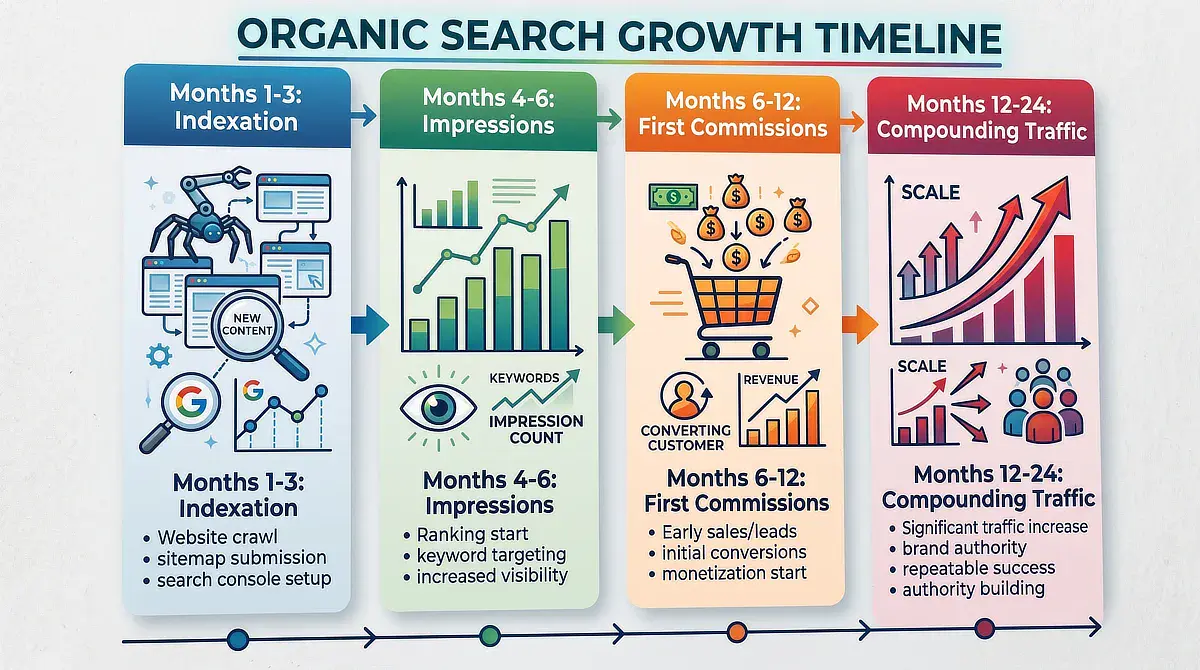
In the first 90 days, search engines are busy crawling the domain, discovering your URL structure, and evaluating how much trust to extend to a site with no history. Rankings generally follow that initial discovery phase, not run parallel to it. Near-zero traffic in quarter one is a typical output of that process, which is why measuring quarter one strictly by traffic tells you very little about whether the technical foundation is assembling correctly.
The data backs the need for patience. Ahrefs analyzed how long pages take to reach the top of search results and found that only a small fraction of newly published pages reach the top 10 within a year, with most top-ranking pages being considerably older.
You can read the Ahrefs study on organic ranking timelines if you want the full breakdown. The takeaway for a part-time builder is simple: the timeline in every “make your first $1,000 in 30 days” video is not the timeline the search index actually runs on.
The comparison that does the most damage here is comparing your output against full-time operations. A team publishing daily with an editor, a link-building budget, and an existing domain will move faster than a site built in the gaps of a working week.
None of that means quarter one has to be silent. Pinterest can send readers to a new post while Google is still deciding, which does not shorten the ninety days but does mean somebody is reading.
That is a resourcing difference, not a skill difference, and treating it as evidence you are doing something wrong is how viable sites get abandoned at month four. A realistic weekly publishing workflow is judged against its own pace, not against an agency’s.
What to Track When Analytics Shows Zero
Quarter one has metrics to evaluate. They are just not the revenue numbers you were hoping for.
- Published post count. A practical benchmark for building publishing momentum. A site with 10 to 12 indexed posts at month three gives search engines a real footprint to evaluate, whereas a site with only 3 offers a very limited dataset.
- Search Console coverage status. Check that your pages are actually indexed, not just published. In Search Console, click Indexing in the left menu, then Pages, to see which URLs are indexed. A post sitting in “Crawled – currently not indexed” is invisible, and finding that at month three gives you time to inspect technical formatting or search intent match.
- Sitemap submission and crawl frequency. If Google is returning to the site regularly, the crawl relationship is forming. That is progress you can see before traffic exists.
- Average time from publish to index. As Google discovers your publishing schedule, this delay often shrinks. Watching indexing time decrease is early evidence of established crawling patterns.
None of these metrics generate income directly. All of them tell you whether the technical machinery is assembling correctly. That is what quarter one is for, and it is why the asset requirements for a lean start matter more in this phase than any tactical shortcut.
Worth bookmarking this page, by the way. The phases below are easier to reference when you are standing inside one of them and want to check what is typical for that stage.
Months 4 to 6 (Reading Silent Growth Signals in Search Console)
Somewhere in this window, Search Console usually starts showing impressions. Your posts begin appearing in search results for real queries, often long, specific search phrases with three or four words. Clicks stay low initially because those early appearances occur on page two, page three, or lower positions where click-through rates are naturally small.
Here is the question that surfaces every time: if people are seeing my pages in search results, why isn’t anyone clicking? At lower ranking positions, position dictates clicks far more than title copy does.
A post sitting at position 24 can collect hundreds of impressions and produce only a single click. While title tags always matter, low click volume on page three is primarily a position constraint that improves as the domain accumulates ranking authority over time.
What impressions tell you is that search engines are actively matching your content to relevant user queries. It indicates expanding topical visibility, which is a necessary first step before rankings climb and clicks increase. Understanding how search ranking timelines work helps you interpret this early data accurately.
The mistake here is strategic churn. Impressions are rising, clicks are not, and the temptation is to change the niche, rewrite the keyword strategy, or chase a different content angle.
Every one of those resets the indexation process that just finished running. Keep publishing on the same core topic. Rising impressions signal that the system is building visibility, not stalling. They’re also evidence you can show, so when you’re ready, here’s how to use those impressions when you apply to programs.
Months 6 to 12 (First Commissions and the Search Traction Inflection)
The posts you wrote in month two start accumulating traction. As the site around them grows and internal links connect your content, a page’s ranking can improve over time. An article that sat on page three in month four can gradually climb toward page one as overall domain authority and topical coverage expand.
This is also when initial commissions typically show up. They are usually small and irregular, and the dollar amount itself is less important than what the transaction proves: a stranger found your post through search, read your reasoning, trusted the recommendation, and acted on it. That is the full conversion path validated end to end.
Evaluate that first commission objectively. Ask whether the traffic reached the post organically rather than through a direct link you shared. Ask whether the reader converted from the body of the article rather than a temporary widget.
Ask whether the post that converted is one you can build supporting content around. A commission that passes those checks tells you the conversion path works. A commission from a friend clicking a shared link tells you very little about search viability.
Internal linking accelerates this phase significantly. When you link an older, established post to a new article, you pass accumulated authority directly to the new page. Linking new articles back to older posts also reinforces your topical cluster and helps search engines crawl your content network efficiently.
Months 12 to 24 (The Compounding Effect of Content Aging)
An 18-month-old article carries something a brand-new page cannot buy: time in the index. It has been crawled repeatedly, maintained visibility through algorithm updates, and had time to accumulate internal link equity and user engagement signals. New posts start without that history, which is why older pages frequently outrank fresher drafts on the same topic.
The revenue math changes shape here too, depending on what you promote. A one-time retail commission pays once and resets to zero the next month, requiring new sales every 30 days. A recurring software commission renews with each billing cycle.
For example, if a recurring software program pays $15 per month per user, ten active subscribers generate $3,600 over two years (assuming steady retention). To equal that revenue with a $20 one-time retail commission, you would need 180 individual sales.
To be clear about the tradeoff: recurring programs usually convert more slowly, because asking someone to commit to an ongoing subscription requires higher buyer intent than a single purchase. You trade conversion rate for long-term revenue stability.
For a part-time builder, that trade is usually practical, because recurring revenue supports the business during weeks when writing time is limited. This compounding recurring commission trajectory creates a much more stable asset.
As a site reaches an illustrative benchmark of 30 to 40 indexed posts, it often develops a stable traffic floor. Some articles rise, others fluctuate, and the aggregate traffic holds steady even during low-output months. That floor makes a part-time business sustainable over time.
The Content Refresh Protocol (Compounding Authority at Month 12+)
Around month 12, an effective hour of writing time is often spent on an existing post sitting on page two rather than a brand-new draft. A page-two post has already been crawled, indexed, and recognized for the query. It needs refinement rather than initial discovery, whereas a new post must travel the full indexation journey from scratch.
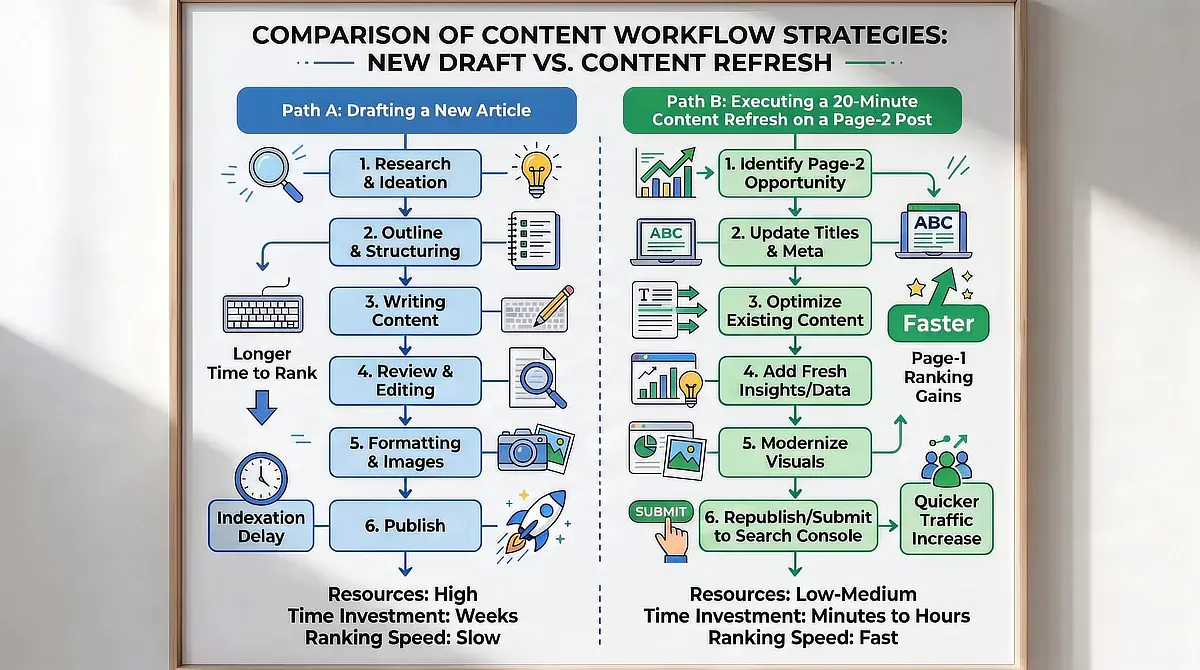
Not every old post qualifies for a refresh. In Search Console, filter Performance to the last three months and look for pages with meaningful impressions and an average position between 11 and 30. A post with near-zero impressions after a year is generally not a refresh candidate, as there is little demand signal to amplify.
The 20-Minute Article Refresh Checklist
- Check actual query data first. Search Console shows which terms a post earns impressions for. Click your page URL inside the Performance report, then switch to the Queries tab to inspect exact terms. Matching the post to the queries it is actually earning is a high-leverage update.
- Rewrite the title tag against that query. A quick update that sharpens how future impressions are presented in search results.
- Sharpen the first 100 words. If the opening does not answer user intent quickly, bounce rates rise. Cut filler and deliver the core response early.
- Add two or three internal links from established older posts to the refreshed page. Passing internal link equity directly supports ranking movement.
- Fix outdated details. Software interfaces evolve, pricing changes, and steps get renamed. Outdated steps undermine reader trust immediately.
The honest tradeoff: refreshing existing pages creates no new indexed URLs. A site that only refreshes stops expanding its keyword footprint. A practical starting ratio for part-time builders is roughly three new posts for every one refresh session, adjusting toward more refreshes as your published library grows.
This is also where tool fragmentation creates unnecessary friction. Managing schedules, keyword lists, refresh queues, and link targets across separate apps eats valuable time.
Some builders consolidate their workflow into an integrated training and workspace platform, while others maintain a disciplined spreadsheet and calendar. Systematizing the process matters far more than the specific software.
When to Refresh vs. When to Pivot (Data-Driven Decision Rules)
Every builder hits moments where quitting feels tempting. The key is determining whether Search Console data supports the emotion.
Here is the reference map for what each phase is actually for, and what tends to go wrong in it.
Timeline Milestone
Primary Focus
Key Non-Financial Metric
Action to Avoid
Months 1 to 3
Publishing volume and indexation coverage
Indexed post count in Search Console
Rebuilding the niche over early flat traffic
Months 4 to 6
Maintaining publishing rhythm as visibility builds
Search Console total impressions
Abandoning strategy because clicks are low
Months 6 to 12
Internal linking and conversion validation
Average position movement on older posts
Judging long-term viability by first small sale
Months 12 to 24
Content refreshes and recurring offer stacking
Traffic floor stability across low-output months
Stopping new post creation entirely
Months 1 to 3
Primary Focus: Publishing volume and indexation coverage
Key Non-Financial Metric: Indexed post count in Search Console
Action to Avoid: Rebuilding the niche over early flat traffic
Months 4 to 6
Primary Focus: Maintaining publishing rhythm as visibility builds
Key Non-Financial Metric: Search Console total impressions
Action to Avoid: Abandoning strategy because clicks are low
Months 6 to 12
Primary Focus: Internal linking and conversion validation
Key Non-Financial Metric: Average position movement on older posts
Action to Avoid: Judging long-term viability by first small sale
Months 12 to 24
Primary Focus: Content refreshes and recurring offer stacking
Key Non-Financial Metric: Traffic floor stability across low-output months
Action to Avoid: Stopping new post creation entirely
Evaluating a strategic pivot requires looking at multiple diagnostic signals rather than a single metric. Around month nine, if a site has 15 to 20 published posts, inspect Search Console over the previous 90 days.
If total impressions show a steady upward trend, search engines are expanding your visibility. If impressions remain flat near zero across 20 articles after nine months, inspect technical indexation, Search Console coverage errors, and keyword difficulty before deciding whether to adjust your niche focus.
3 Red Flags That Signal a True Strategy Failure
- Near-zero impressions across 20+ posts after nine months. This points to an upstream issue: either targeting keywords dominated by high-authority sites, technical indexation blocks, or poor search intent match.
- Impressions arriving strictly for queries unrelated to your monetization focus. Visibility that cannot convert indicates topical categorization landed away from your target commercial intent.
- Every ranking post sits on informational queries with zero commercial intent across the niche. If no buying intent exists in the topic, content traffic cannot convert into revenue.
A pivot is an adjustment, not a complete teardown. Retain your domain, existing articles, and indexed history. Shift your keyword selection toward lower-competition terms in the same broader category, allowing your published library to support the revised direction. Deleting the site and starting over throws away the one thing that took the longest to acquire.
If you are at month three, understand that a flat line is part of early indexation. If you are at month nine with flat impressions, run a diagnostic check on keyword competition and indexation status. Let objective data guide your next step.
If you are in the initial phase, explore the practical guide to starting affiliate marketing around a full-time life to establish a sustainable publishing rhythm.
If you have questions about reading Search Console impressions, knowing when to refresh older posts, or managing your weekly publishing schedule, leave a comment below. I read and answer every message.

Sonia Zannoni
Hi, I’m Sonia Zannoni, creator of Click to Prosper. I share practical tools, workflows, and honest guidance to help you build an online business with more clarity and less chaos.
About Sonia

Feeling stuck between too many tools and too much advice? Start with the beginner path.
View the Blueprint