
Legendary Marketer Review: What Happens When a High-Ticket Platform Closes

Affiliate Disclosure: This post contains affiliate links. If you purchase through one of my links, I may earn a commission at no additional cost to you. Read the full Affiliate Disclosure for details.
You are standing in front of a four-figure decision. A program is telling you that one training package, one pre-built funnel, and one high-ticket commission structure will put you in business, and finding out whether that is true costs thousands of dollars up front.
That is a hard call to make from the outside, because nearly every review ranking for these programs was written by somebody earning a commission on your purchase.
If you came to this Legendary Marketer review trying to work out whether the money buys skills you keep or access you rent, you are asking the right question. Legendary Marketer answered it for everyone on February 16, 2026, when the company shut down permanently.
Here is what closed, what it did to the people who had built their businesses inside it, and the durability check to run on any high-ticket program before you hand over the money.
TL;DR: Legendary Marketer Review
What Actually Happened to Legendary Marketer
Founder David Sharpe announced the permanent closure in a video on the company’s Facebook page on February 16, 2026, after nine years of operation. This was not a rebrand, a pause, or a migration to a new platform. The training, the funnels, and the affiliate program all ended together.
For anyone still working inside it, the practical damage arrived fast. Hosted video lessons stopped loading. The shared funnel pages that members had been sending traffic to no longer resolved to a working offer. Those pages were pre-built landing pages and email sequences that lived on Legendary Marketer’s own software, not on anything the member owned.
Affiliate tracking and commission payouts ended too, which means promotional work already published, and traffic already paid for, stopped converting into anything at all.
I want to be careful with the word scam here, because the comment sections are full of it and the distinction changes what you should do next. A company closing its doors is not the same thing as a company taking money it never intended to earn.
Information marketing businesses wind down legally all the time, and a closure announced openly by the founder reads as a wind-down rather than a disappearance.
That precision matters for one reason. If this had been outright fraud, the lesson would be easy: learn the fraud signals, avoid the fraud. But a legal, well-known, nine-year-old company can close and still take your income with it, and no amount of scam-spotting protects you from that outcome. What protects you is where your business assets physically live.
There is also a detail worth sitting with. When a platform closes, whatever you get back depends entirely on the terms that company chooses to publish during the wind-down.
There is no guarantee sitting behind it, no regulator issuing refunds, and no obligation to keep your lessons online while you finish them. That exposure was baked into the purchase from day one, and it was invisible at the point of sale.
The Staged Funnel: How a Cheap Entry Point Becomes a Four-Figure Pitch
The pricing was never really the front end. The front end was a filter.
Legendary Marketer ran a stepped ladder that started around a two-dollar eBook and a seven-dollar 15-Day Business Builder Challenge, then moved buyers toward Business Blueprints priced roughly between $2,500 and $9,500, with a mastermind tier reported near $30,000 at the top.
The cheap entry point was not there to make money. It was there to identify people willing to spend, and to get them on a call.
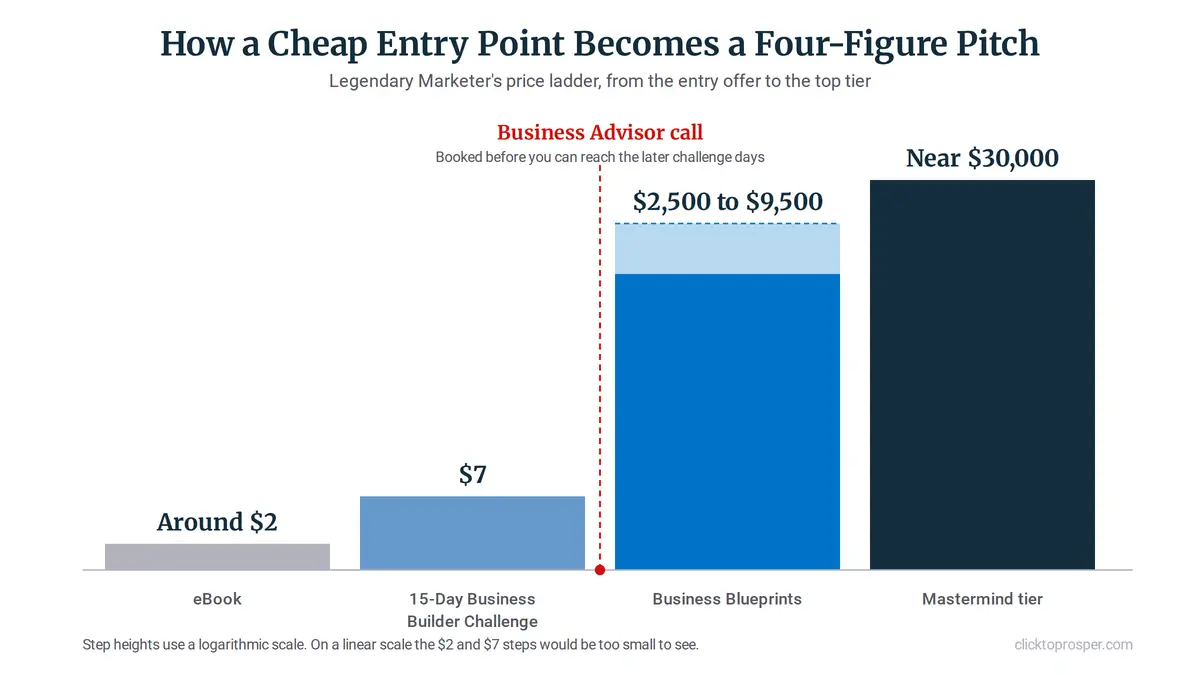
The mechanism that did the work was the Business Advisor call. Progress through the challenge was gated, so reaching a later day (Day 5 is the one most commonly described) required booking a one-on-one session first.
On paper, that is coaching. In practice, the advisor was a commissioned salesperson, and the checkpoint that looked like an educational milestone was a sales appointment the student had already been conditioned to attend.
Here is why that sequencing matters more than the price. A student on day four of a fifteen-day challenge has not yet built a site, has not published anything, and has no way to judge whether a $2,500 blueprint is a fair price for what it contains. They are being asked to make an expert purchasing decision at the exact moment they know the least. That is not an accident of scheduling. It is the point of the schedule.
The affiliate side ran on the same logic. Until 2022, reaching the higher commission rates, reported in the 40% to 60% range, meant paying around $29.95 a month for a Pro affiliate account. Dropping that fee opened the higher rates to every approved affiliate, but it did not remove the deeper pressure, because promoting a blueprint credibly still meant owning one.
So the program created a quiet financial pull to keep buying up the ladder, not because the next tier taught you more, but because it improved what you could earn from selling the tier below it. That structure is closer to how closed-loop recruiting models shift risk onto participants than most buyers realize when they sign up.
None of this is illegal, and it is worth saying so plainly. Selling expensive training is legal, and some expensive training is genuinely worth the money.
What regulators do care about is what you are told before you pay, and the FTC’s guidance on endorsements and earnings claims sets a clear standard: income representations have to be substantiated and typical, not cherry-picked. Read a high-ticket sales call against that standard and you will notice how much of it is testimonial and how little of it is disclosure.
The 72-Hour Refund Window and What It Is Really For
Refund policy is where a program tells you the truth about its own confidence.
Legendary Marketer offered a 30-day money-back guarantee on the seven-dollar challenge, which is generous, and a strict 72-hour right of rescission on the Business Blueprints, which cost thousands. Right of rescission is the legal name for a cancellation window: three days to change your mind, and then the sale is final.
Read those two policies next to each other, and the asymmetry is the whole story. The company was relaxed about refunding pocket change and tight about refunding the money that mattered.
Three days is not an evaluation period for marketing training. It is barely enough to watch the modules once. You cannot register a domain, build a site, publish content, run traffic, and see whether any of it works inside 72 hours, which means the window closes long before the only test that counts has started.
Complaint records collected on the Better Business Bureau profile for Legendary Marketer describe a recurring shape to the disputes: buyers who realized, days after purchase, that actually executing the blueprint required a stack of paid services nobody had spelled out on the call, from a domain and a funnel subscription to LLC registration through a partner agency. By the time the real cost of implementation became visible, the refund window had already expired.
That is the mechanism behind short windows, and it is not unique to this company. High-ticket digital programs use them because revenue recognized inside three days is revenue that survives the buyer’s second thoughts. The longer the window, the more likely the student discovers the gap between what was sold and what the work actually demands.
So use the refund window as a diagnostic before you buy anything expensive. A program that genuinely expects you to succeed can afford to let you try for a month, because a student who is succeeding does not ask for a refund. A program that needs your decision locked in 72 hours is telling you what it expects to happen on day four.
It also helps to know realistic timelines for building an independent affiliate audience going in, because almost every high-pressure pitch depends on the buyer having no reference point for how long this actually takes.
The Closed Loop: Why Affiliates Lost Everything at Once
Here is the part that turned a business closure into a personal wipeout for a lot of people.
Real affiliate marketing means you build an audience around a subject, and then you connect that audience to products from many different merchants. If one merchant closes, you swap in another and your traffic never notices.
Closed-loop opportunity marketing means you build an audience around the platform itself, and the only product you can sell them is the platform. Those two things look identical from the outside. They behave completely differently the day the merchant disappears.
Most Legendary Marketer affiliates were in the second category, and often without realizing they had chosen it. Their YouTube channels, TikTok accounts, and email sequences were built around one topic: how to make money with Legendary Marketer. Every piece of content pointed at the 15-Day Challenge.
When the challenge stopped existing, the content did not become less profitable. It became unusable, because there was no longer anything at the other end of the link.
The funnels made it worse. Members were sending traffic into shared, vendor-hosted funnel templates tied to proprietary webinars, which is a different thing from owning a site. You cannot export a funnel you do not control, you cannot redirect it to a new offer, and you cannot keep the email list warm on a page that no longer loads.
This is the same fragility problem that shows up when you rely on pre-built affiliate funnels instead of assets you own, just at a larger scale and with a harder ending.
The table below compares the two structures on the dimensions that decide what survives a shutdown.
Evaluation Dimension
Closed High-Ticket Ecosystems
Independent Asset Model
Asset ownership
The vendor controls the software, hosting, and funnel pages
You own the WordPress site, the domain, and every published post
Product independence
Revenue is tied to reselling the host platform
You can monetize with any affiliate merchant or digital product
Traffic strategy
Heavy reliance on paid ads and short-form hype funnels
Diversified organic search plus direct audience trust
Financial risk
High upfront entry in the thousands, with a 72-hour refund limit
Low entry cost, standard hosting and software subscriptions
Impact of platform closure
The business and the commission stream vanish together
The site and the audience stay fully operational
Asset ownership
Closed High-Ticket Ecosystems: The vendor controls the software, hosting, and funnel pages
Independent Asset Model: You own the WordPress site, the domain, and every published post
Product independence
Closed High-Ticket Ecosystems: Revenue is tied to reselling the host platform
Independent Asset Model: You can monetize with any affiliate merchant or digital product
Traffic strategy
Closed High-Ticket Ecosystems: Heavy reliance on paid ads and short-form hype funnels
Independent Asset Model: Diversified organic search plus direct audience trust
Financial risk
Closed High-Ticket Ecosystems: High upfront entry in the thousands, with a 72-hour refund limit
Independent Asset Model: Low entry cost, standard hosting and software subscriptions
Impact of platform closure
Closed High-Ticket Ecosystems: The business and the commission stream vanish together
Independent Asset Model: The site and the audience stay fully operational
The honest counterpoint is that the independent model is slower. Nobody sells a four-figure blueprint on the promise of publishing steadily for eight months before the search traffic compounds, because that promise does not convert.
But slow assets that belong to you keep working when a company folds, and fast assets that belong to somebody else do not. That difference is also what separates legitimate affiliate marketing from business opportunity schemes, and it is worth understanding before you spend anything.
The 5-Point Platform Durability Checklist
None of this is only about one company. Legendary Marketer is now a case study, and the useful output of a case study is a test you can run on the next program that shows up in your feed.
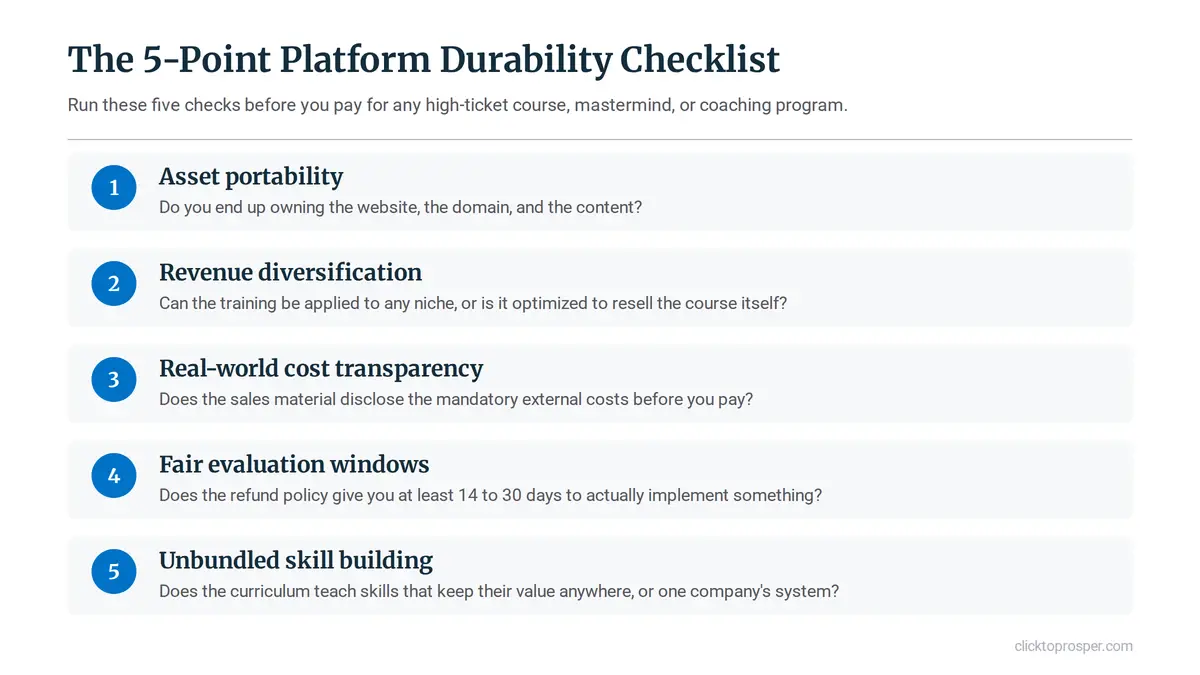
Run these five checks before you pay for any high-ticket course, mastermind, or coaching program.
- Asset portability. Do you end up owning the website, the domain, and the content, or does everything live on the vendor’s proprietary software? If you cannot export it and point it somewhere else, you are renting a business, not building one.
- Revenue diversification. Can the training be applied to any niche, or is it optimized to resell the course itself? Read the case studies. If nearly every success story is about selling the program, that tells you what the program actually teaches.
- Real-world cost transparency. Does the sales material disclose the mandatory external costs, meaning ad spend, hosting, email software, and any required tooling, before you pay? Undisclosed implementation costs are the single most common reason buyers feel misled after the fact.
- Fair evaluation windows. Does the refund policy give you at least 14 to 30 days to actually implement something? Three days tests whether you watched the videos. Thirty days tests whether the method works.
- Unbundled skill building. Does the curriculum teach foundational skills like SEO, content writing, and copywriting that keep their value anywhere, or does it teach one company’s system? Skills follow you to the next project. Systems do not.
If a program fails two or more of these, the risk is not that it is a scam. The risk is that you have no way to recover if the company behind it changes direction. And the same logic applies to how you assess anything you plan to recommend later, which is why it helps to treat product reviews as objective decision tools rather than sales assets.
There is one caveat worth naming. A program can pass all five checks and still be mediocre training. Durability is a floor, not a guarantee of quality. What the checklist does is stop you from losing the entire business when the vendor’s situation changes, which is a different problem from getting poor value, and the more expensive one.
What to Build Instead
The lesson from a nine-year-old company closing is not that paid training is a bad idea. It is that the container matters more than the curriculum.
If your site is on your own domain, your posts are yours, your email list is exported and portable, and your income comes from several merchants across one or more niches, then any single company can fail, and your business keeps running. You lose one revenue line and replace it. That is the whole design goal, and it is unglamorous on purpose.
What that looks like in practice is narrower than most beginners expect. Pick a subject you can write about for two years. Publish for real search intent, meaning questions people actually type when they are trying to decide something. Recommend products you can evaluate honestly, from programs that let you leave.
The compounding is slow at the start, and then it stops being slow, and none of it depends on a founder’s decision to keep the lights on.
If you want the integrated route without the closed loop, the practical version is building an independent affiliate business on an integrated platform with included hosting and training. The site sits on your own domain, and the training points outward at whatever niche you choose rather than inward at reselling the platform.
It is not the only way to do this, and it will not suit you if you already have a hosting setup and a keyword tool you trust. But it removes the specific failure this post is about, because what you build is yours to move.
Before you spend anything on the next program that promises four-figure commissions, run the five checks on it. Then, whatever you decide, register a domain and publish one post this week on a topic you could still be writing about in two years. That single asset is worth more than any blueprint you do not get to keep.
Have you evaluated a high-ticket affiliate program recently, or did you experience the Legendary Marketer shutdown firsthand? Share what evaluation criteria you prioritize when assessing online business training in the comments below.

Sonia Zannoni
Hi, I’m Sonia Zannoni, creator of Click to Prosper. I share practical tools, workflows, and honest guidance to help you build an online business with more clarity and less chaos.
About Sonia

Feeling stuck between too many tools and too much advice? Start with the beginner path.
View the Blueprint