
Is Affiliate Marketing a Scam? The Honest Truth Behind the Hype

You’ve seen those posts. Someone standing next to a rented sports car, holding up a phone showing a payment notification, captioning it with something about financial freedom. And maybe you know someone who lost a couple of thousand dollars on a coaching program that turned out to be one long upsell pointing to an even more expensive next level.
So when you search “is affiliate marketing a scam,” that’s not a paranoid reflex. That’s pattern recognition.
Your skepticism is smart. The make-money-online space is genuinely loud with predatory noise, and treating the whole category as suspect is a reasonable default. But the question you’re actually asking goes one layer deeper: is the underlying business model legitimate, or is the entire structure built on fraud? That’s a fair question, and it deserves a real answer before you trust any advice pointing you toward a specific platform or program.
Here’s what this guide covers: the verified legal structure of affiliate marketing, the actual math behind the 95 percent failure statistic, and exactly where the real scams are hiding.
By the end, you’ll have a concrete filter to tell the difference between a sustainable business model and a coaching program designed to extract money from people who just want a genuine part-time income.
TL;DR: Is Affiliate Marketing a Scam?
How Legitimate Affiliate Marketing Actually Works (No Hidden Traps)
The affiliate marketing model has three parties. A merchant sells a product. A publisher (you) refers customers to that product through a website, a review, or a recommendation. When a customer clicks your tracking link and completes a purchase, the merchant pays you a commission for the referral.
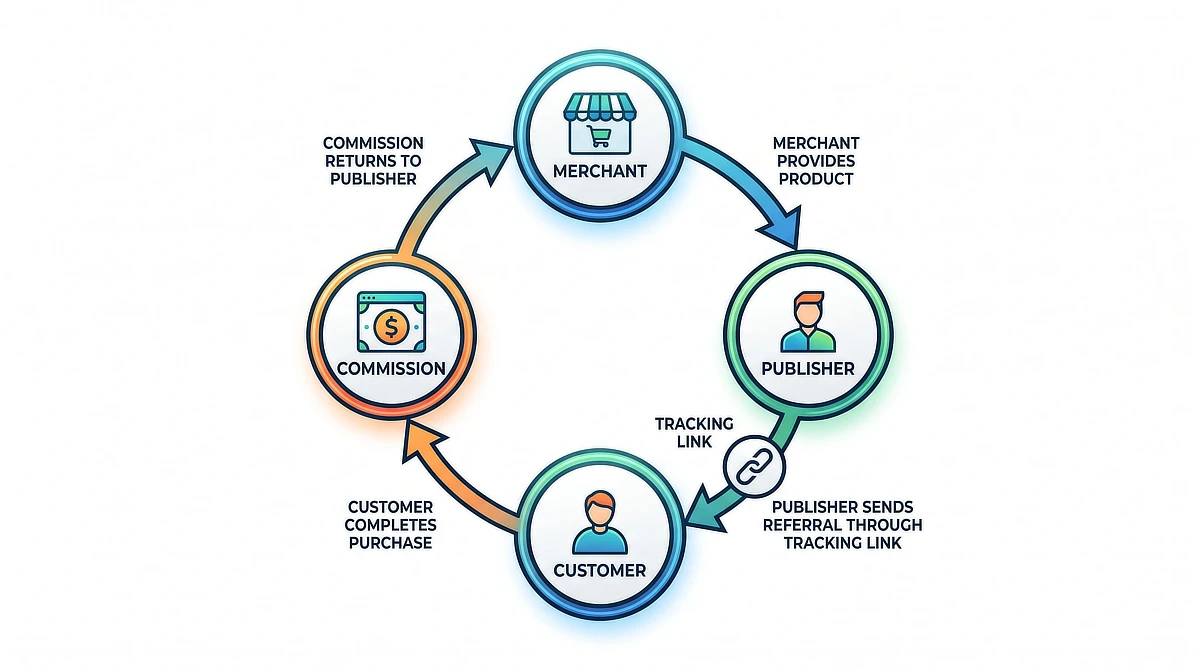
The technology behind this is not exotic. Tracking links and cookies are standard web infrastructure used across commercial e-commerce. Every major retailer uses cookie-based tracking to record sessions, attribute transactions, and manage promotions.
Affiliate commissions operate on the same foundation, with one specific purpose: confirming that a referral happened so the publisher gets credited for the sale they sent.
This is not a fringe or underground mechanism. Target runs an affiliate program. Apple runs one.
Even Wirecutter, owned by The New York Times, generates most of its revenue through affiliate commissions on product recommendations. When a major media outlet links to a product and earns a commission if you buy, that’s affiliate marketing operating in plain sight, at scale, in a context most people consider entirely trustworthy.
If you want a clearer picture of how this plays out technically, our guide on the foundational mechanics of performance-based tracking covers the full link-to-commission structure step by step.
Why Most Beginners Quit Before Affiliate Marketing Has a Chance to Work
The 95 percent failure estimate circulates widely in this niche, sometimes deployed to warn people away from the model, sometimes to motivate them with survivor framing. The honest answer is that the number is plausible, and the reason behind it is the part that actually matters.
Affiliate marketing has an unusually low barrier to entry. With no inventory, no employees, and no licensing requirements, starting costs run close to zero for most people. That accessibility is genuinely valuable for anyone who wants to build something without startup capital.
But low barriers to entry carry a structural byproduct: the same people who start easily also quit easily. When results don’t appear in the first few months, most beginners treat that absence as evidence that the model doesn’t work, rather than as evidence that a standard business-building timeline is still running on schedule.
That misread happens faster when the roadmap you’re following was built for someone with forty hours a week. Building affiliate marketing around a full-time life starts from a different set of constraints entirely.
Think of it this way. The early months are when quitting costs nothing and feels completely justified. No content is ranking yet, no audience exists, and the work feels like shouting into an empty room.
Most people exit right here, and they exit fast, because nothing is stopping them. The people who push through that window don’t suddenly get lucky. They just stopped being part of the same statistical group as everyone who left.
The 95 percent figure includes all of them. It counts the person who published three posts and walked away after six weeks the same as someone who built 80 articles over 18 months. Those are not the same experiment.
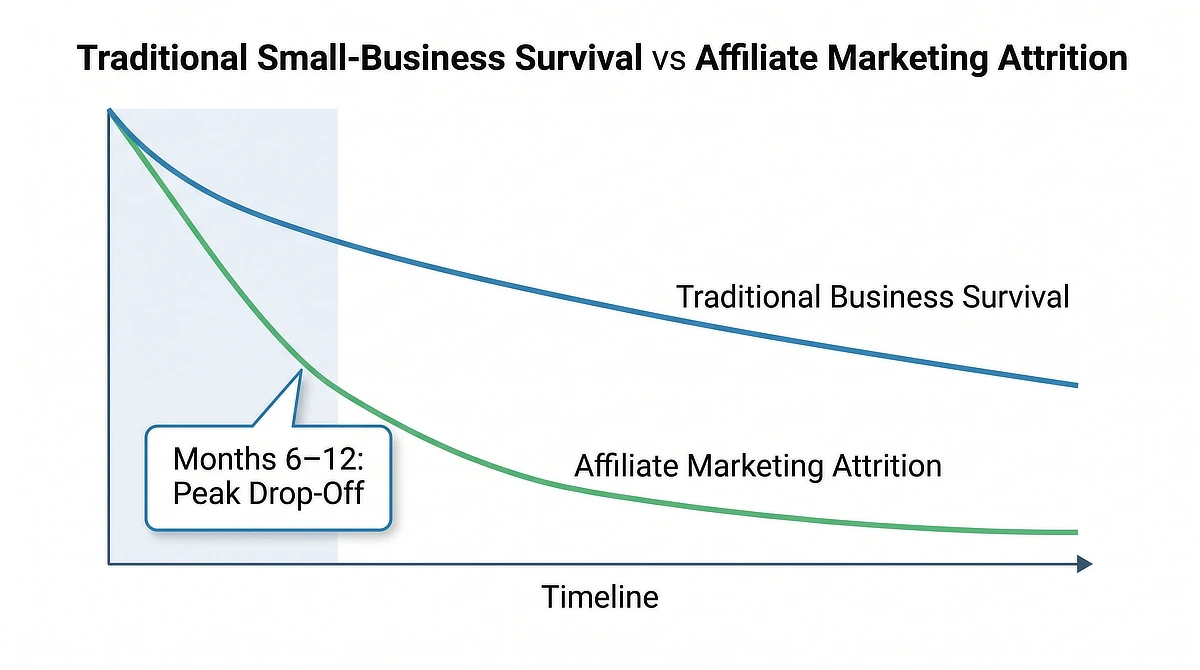
The table below places affiliate marketing attrition estimates alongside U.S. Bureau of Labor Statistics small business survival data. The comparison puts the numbers in context.
Business Type
Year 1 Survival
Year 3 Survival
Year 5 Survival
Traditional Small Business (BLS)
~80%
~55%
~45%
Affiliate Marketing (Estimated)
~30%
~12%
~5%
Traditional Small Business (BLS)
Year 1 Survival: ~80%
Year 3 Survival: ~55%
Year 5 Survival: ~45%
Affiliate Marketing (Estimated)
Year 1 Survival: ~30%
Year 3 Survival: ~12%
Year 5 Survival: ~5%
The affiliate attrition rate is steeper. But what the raw comparison hides is that a traditional small business requires capital, legal structure, and ongoing overhead that creates financial pressure to persist.
An affiliate site costs almost nothing to abandon. That’s not evidence that the model is fraudulent. It’s evidence that when something costs nothing to walk away from, more people walk away from it.
Why the Average Income Numbers Tell You Almost Nothing
Even setting aside the attrition numbers, the income figures that circulate in this niche are misleading in a specific way. When you see a claim about the “average affiliate marketer’s monthly earnings,” that average is hiding more than it reveals.
Here’s why. Affiliate income is not spread evenly across participants. A small group of established, high-authority site owners earns a large share of total revenue, while the majority earn modest amounts.
When you calculate an average across that kind of gap, the top earners pull the number upward, and it stops describing what most people actually experience. The average isn’t lying exactly. It’s just answering a question nobody at the beginner stage is actually asking.
The table below breaks down how income typically distributes across active affiliate marketers. Read it as a realistic framework, not as a projection of what you will personally earn or how fast.
Income Tier
Monthly Earnings
Annual Earnings
Est. % of Active Affiliates
Entry / Hobby Level
Under $500
Under $6,000
~65%
Part-Time Income
$500 to $1,000
$6,000 to $12,000
~20%
Side Business
$1,000 to $5,000
$12,000 to $60,000
~10%
Full-Time Replacement
$5,000 to $20,000
$60,000 to $240,000
~4%
Elite / Authority Sites
$20,000+
$240,000+
~1%
Entry / Hobby Level
Monthly Earnings: Under $500
Annual Earnings: Under $6,000
Est. % of Active Affiliates: ~65%
Part-Time Income
Monthly Earnings: $500 to $1,000
Annual Earnings: $6,000 to $12,000
Est. % of Active Affiliates: ~20%
Side Business
Monthly Earnings: $1,000 to $5,000
Annual Earnings: $12,000 to $60,000
Est. % of Active Affiliates: ~10%
Full-Time Replacement
Monthly Earnings: $5,000 to $20,000
Annual Earnings: $60,000 to $240,000
Est. % of Active Affiliates: ~4%
Elite / Authority Sites
Monthly Earnings: $20,000+
Annual Earnings: $240,000+
Est. % of Active Affiliates: ~1%
What separates the tiers is not luck or access to a secret method. It’s the depth of topical authority a site has built, the quality of content answering real search queries, and the consistency of production over time.
Moving between tiers requires real skill development, particularly in SEO, content strategy, and understanding what your reader is actually searching for. Anyone claiming to sell you a fast path to the top is describing a different product than what affiliate marketing actually is.
Where the Real Scams Actually Hide
Here’s where the real scams live, and why the affiliate marketing label gets dragged into it.
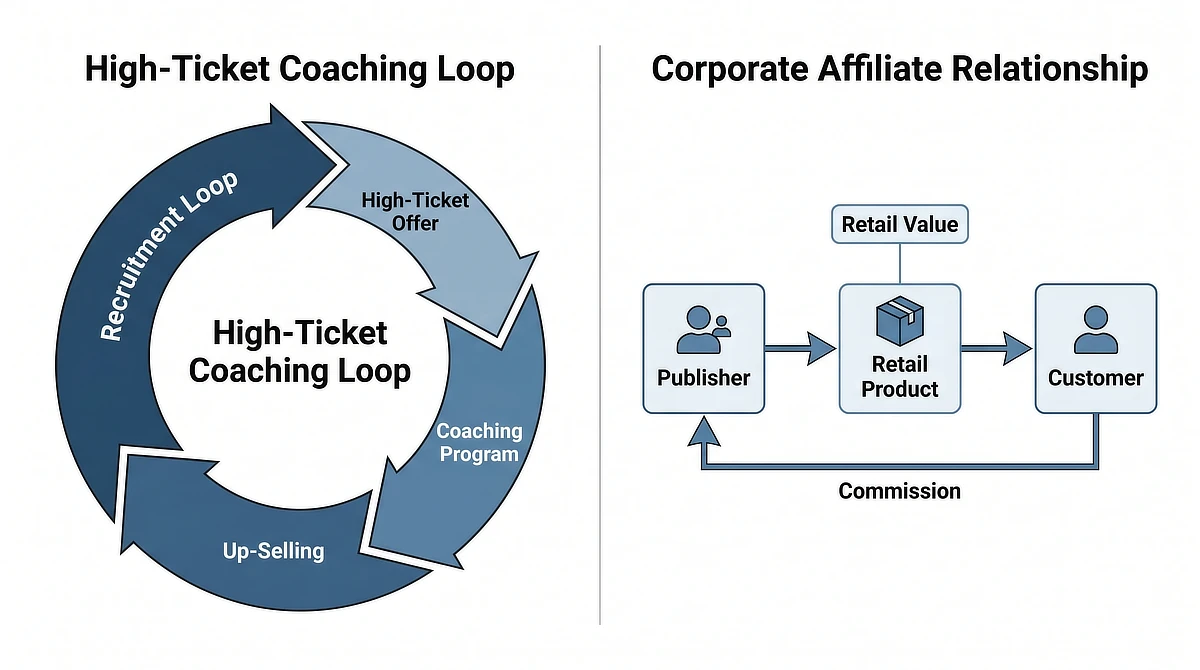
The predatory version of “affiliate marketing” is not the tracking link and commission model described above. It’s a specific business pattern: a company creates an expensive training program and charges a premium to enroll (sometimes between $2,000 and $60,000 across multiple tiers).
They then train participants primarily to earn commissions by selling that same program to other people. The product being marketed is effectively the system itself. There is no underlying retail value outside of recruitment, making the income pathway a closed loop.
This is the pattern worth recognizing. It borrows affiliate vocabulary (commissions, referrals, digital products) to present itself as a legitimate online business.
In legitimate affiliate marketing, you earn commissions for referring customers to third-party products with real, independent value. In these schemes, the product you’re selling exists primarily so that you can sell others on selling the same thing.
The Federal Trade Commission (FTC) has taken direct action against programs operating this model. The table below summarizes two documented enforcement cases.
Program
Deceptive Claims
Consumer Losses
Regulatory Action
Promised six-figure incomes through tiered training programs priced up to $60,000
Over $125 million in reported consumer losses
FTC action in 2018; assets frozen, principals barred from the industry
Claimed participants could earn up to $40,000 per month through its tiered “Aspire” system
Tens of millions in consumer losses
FTC action in 2018; $1.5 million in consumer refunds secured
MOBE (My Online Business Education)
Deceptive Claims: Promised six-figure incomes through tiered training programs priced up to $60,000
Consumer Losses: Over $125 million in reported consumer losses
Regulatory Action: FTC action in 2018; assets frozen, principals barred from the industry
Digital Altitude
Deceptive Claims: Claimed participants could earn up to $40,000 per month through its tiered “Aspire” system
Consumer Losses: Tens of millions in consumer losses
Regulatory Action: FTC action in 2018; $1.5 million in consumer refunds secured
Four Red Flags to Spot a Deceptive Program Before Spending a Dollar
Separating legitimate programs from money-extraction schemes doesn’t require a legal background. It requires four specific questions, asked before you commit a dollar to anything.
1. Upfront Pay-to-Play Fees
Legitimate affiliate programs don’t charge you to promote their products. Amazon Associates, ShareASale, and CJ Affiliate are all completely free to join.
If a program requires you to purchase a product or a training tier before you can earn commissions, that fee structure is a major warning sign. A legitimate merchant wants your referrals, and they never charge you for the privilege of sending them.
2. Guaranteed Rapid Income Timelines
Building a search-optimized affiliate site takes time because your content needs to be indexed (recorded and validated by Google’s database) and topical authority (trust built with search engines by writing extensively on a single topic) must accumulate.
Realistic timelines for meaningful organic traffic run 6 to 18 months for most niches, assuming consistent effort. Any program guaranteeing income within weeks, or promising a specific dollar figure, is making a claim the data doesn’t support. These guarantees are marketing pressure, not business analysis.
3. Pure Recruitment Focus with No Retail Product
Ask this question directly: if you removed the recruitment component entirely, would the product still have independent value to someone who isn’t selling it? If the answer is no, or if the training exists primarily to teach you how to recruit other participants into the same system, the business model is a recruiting scheme regardless of the vocabulary used to describe it.
4. High-Ticket Upselling Systems Behind a Cheap Entry Point
Some programs advertise a low-cost entry tier specifically to get you emotionally committed before revealing the real cost structure. The income claims only apply to participants who’ve purchased the advanced tiers, which are priced in the thousands.
Look at the full pricing structure before you spend anything. A program that hides its real cost behind a $7 trial isn’t offering you a low-cost opportunity. It is managing your resistance before the pitch gets expensive.
Legendary Marketer built its funnel this way, with a $7 challenge that led to a mandatory sales call and blueprints priced from $2,500 to $9,500, until the company closed in 2026.
A Sustainable Five-Hour Weekly Workflow for Part-Time Builders
Here’s what legitimate affiliate marketing actually looks like when someone is working it seriously on a limited schedule.
The core activity is answering search queries that real people in a specific niche are typing into Google. You identify questions your target reader is asking, write a thorough and honest answer to that question, build a simple website that houses those answers, and link to relevant products when they genuinely serve the reader.
The monetization happens when someone reads your answer, clicks a link to a product you’ve recommended, and makes a purchase. That’s the workflow.
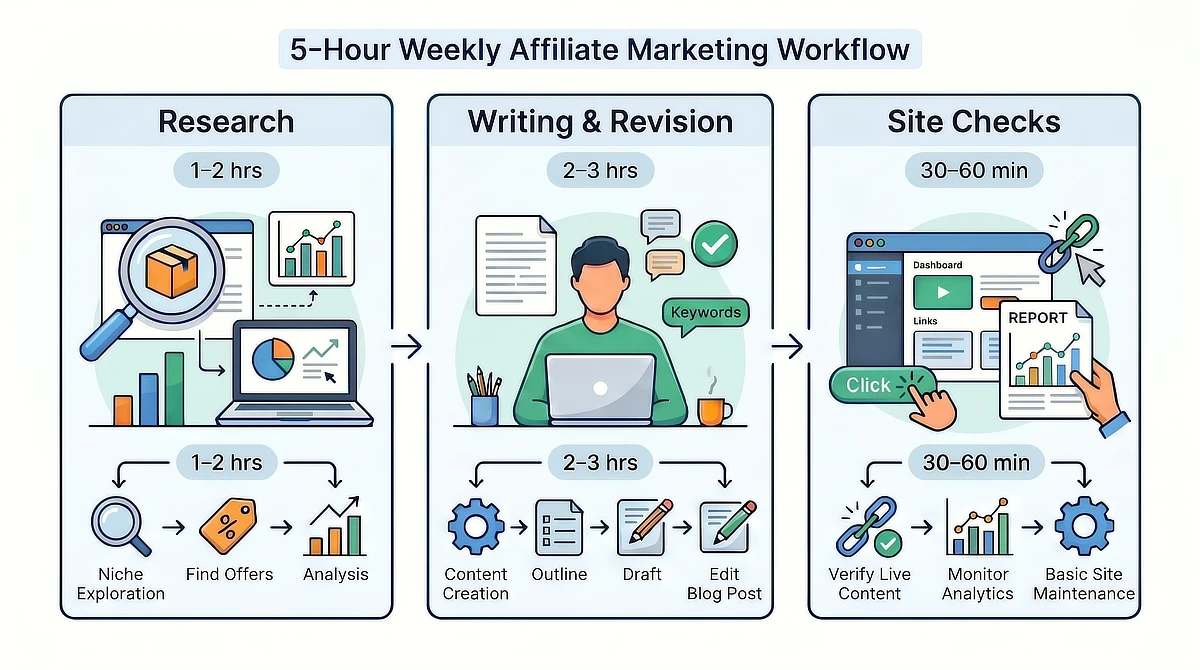
In a five-hour week, your time typically splits into three core activities:
- Keyword and search intent research (1 to 2 hours): Find the right questions to answer before you write anything.
- Writing and revising content (2 to 3 hours): Ensure your answers are comprehensive, thorough, and helpful.
- Basic site maintenance and technical checks (30 to 60 minutes): Keep your website optimized and running smoothly.
The content you produce compounds over time. An article published six months ago can generate commissions today without any additional effort. That compounding effect is real, but it requires enough content volume to become meaningful, and that volume takes time to build.
To make this schedule work without burnout, don’t try to squeeze all 5 hours into one evening. Block out two 2-hour writing slots on weekday nights, and save the remaining 1-hour block on Saturday morning for technical checkups and keyword research.
The most common failure point for part-time builders isn’t a lack of effort. It’s fragmentation. Too many tools, too many conflicting methodologies, too many open browser tabs on a Tuesday night with no clear next step forward. If you want to understand how a unified platform removes that friction before committing to anything, our Wealthy Affiliate review covers what it does well and where it has real limitations.
Unified training that teaches the workflow in the right sequence, on a platform that brings hosting, keyword research, and structured instruction into one place, removes that fragmentation and lets the hours you do have go toward the work that compounds.
You can start the free Starter tier and outline your first post this week to see how the system operates firsthand.
If you have questions about separating legitimate programs from coaching schemes, or if you want me to look over a program you’re considering, leave a comment below. I read and answer every message.

Sonia Zannoni
Hi, I’m Sonia Zannoni, creator of Click to Prosper. I share practical tools, workflows, and honest guidance to help you build an online business with more clarity and less chaos.
About Sonia

Feeling stuck between too many tools and too much advice? Start with the beginner path.
View the Blueprint