
Why Done for You Affiliate Marketing Systems Fail

You have somewhere between five and ten hours a week to build something real online. You have looked at what it actually takes: picking a niche, setting up a website, learning keyword research, building an email list, and publishing content consistently.
And then a done for you affiliate marketing system appears in your feed, promising that someone has already handled all of that. The appeal makes sense. So does walking away from it, once you understand what is actually included and what the sales page deliberately skips.
Wanting to bypass a steep technical learning curve is not a character flaw. It is a rational response to limited time and an overwhelming number of moving parts. But what these turnkey systems sell and what they deliver are two different things. The gap between them is where beginners lose several thousand dollars, often before they understand what happened.
TL;DR: Done for You Affiliate Marketing
Why a Pre-Built Funnel Possesses Zero Commercial Value
The sales pitch for a typical done for you system focuses on what you are receiving: a configured landing page, a pre-written email sequence, a product already selected, a funnel already mapped and connected. What the pitch omits is everything that would convert that infrastructure into revenue. That omission is not accidental. It is the premise the entire business model depends on.
A landing page is a technical shell. Handing you a fully built funnel means handing you something that will produce zero revenue until the right people arrive at it in volume. Traffic is not included in the purchase price. It is not a line item in the package. It is the entire unsolved problem, and it is the hardest part of affiliate marketing by a substantial margin.
This is the misconception these vendors depend on. Buyers see technical completion and interpret it as commercial readiness. A finished funnel looks like a finished business because it resembles one on the surface: pages, copy, an offer, an autoresponder in place. What it does not have is a single visitor who needs what it sells.
Every one of these packages fails the same revenue-readiness test. Traffic. The foundational principles of sustainable affiliate marketing make that distinction plain: a system that skips audience development is not a shortcut to an affiliate income. It is a shortcut to an empty funnel.
The Hidden Software Tax Required to Keep Your System Online
Vendors advertise the entry price prominently. A flat fee, typically positioned somewhere between one thousand and three thousand dollars, covering the setup work completed on your behalf before you arrive. What vendors do not advertise is what comes due the morning after the purchase goes through.
The system does not run on goodwill. It runs on software subscriptions. The funnel builder hosting your pages bills monthly. The email autoresponder sending your sequences bills monthly. Depending on the package tier, there may be a separate recurring charge for the proprietary training portal.
Consumer Reports has documented this structure as a recognized consumer harm pattern. Ongoing platform costs buried in the fine print, while a flat entry fee headlines the advertising, is not a quirk specific to one or two bad actors. It is the operating model.
Understanding what tools an affiliate campaign actually requires puts those monthly costs in a different light. When you own the infrastructure yourself, the math changes completely.
This structure creates a financial trap with real psychological weight. Once you have spent two thousand dollars on a system, canceling the forty-dollar-per-month autoresponder feels like abandoning the investment. So the subscriptions continue. Month after month, with no traffic arriving and no commissions generating, you are running a subscription-only operation.
The table below maps what a typical done for you system actually costs against what gets disclosed at the point of sale.
Expense Category
Advertised Entry Cost
Hidden Monthly Requirement
Realistic First-Year Cost
System Purchase Fee
$997 to $2,997 one-time
None disclosed
$997 to $2,997
Email Autoresponder
Not disclosed
$30 to $100 per month
$360 to $1,200
Funnel Builder Platform
Not disclosed
$97 to $297 per month
$1,164 to $3,564
Minimum Ad Budget
Not disclosed
$200 to $500 per month
$2,400 to $6,000
Realistic First-Year Total
$997 to $2,997 disclosed
Not advertised
$4,921 to $13,761
System Purchase Fee
Advertised Entry Cost: $997 to $2,997 one-time
Hidden Monthly Requirement: None disclosed
Realistic First-Year Cost: $997 to $2,997
Email Autoresponder
Advertised Entry Cost: Not disclosed
Hidden Monthly Requirement: $30 to $100 per month
Realistic First-Year Cost: $360 to $1,200
Funnel Builder Platform
Advertised Entry Cost: Not disclosed
Hidden Monthly Requirement: $97 to $297 per month
Realistic First-Year Cost: $1,164 to $3,564
Minimum Ad Budget
Advertised Entry Cost: Not disclosed
Hidden Monthly Requirement: $200 to $500 per month
Realistic First-Year Cost: $2,400 to $6,000
Realistic First-Year Total
Advertised Entry Cost: $997 to $2,997 disclosed
Hidden Monthly Requirement: Not advertised
Realistic First-Year Cost: $4,921 to $13,761
The Fatal Mathematics of Paid Traffic Acquisition
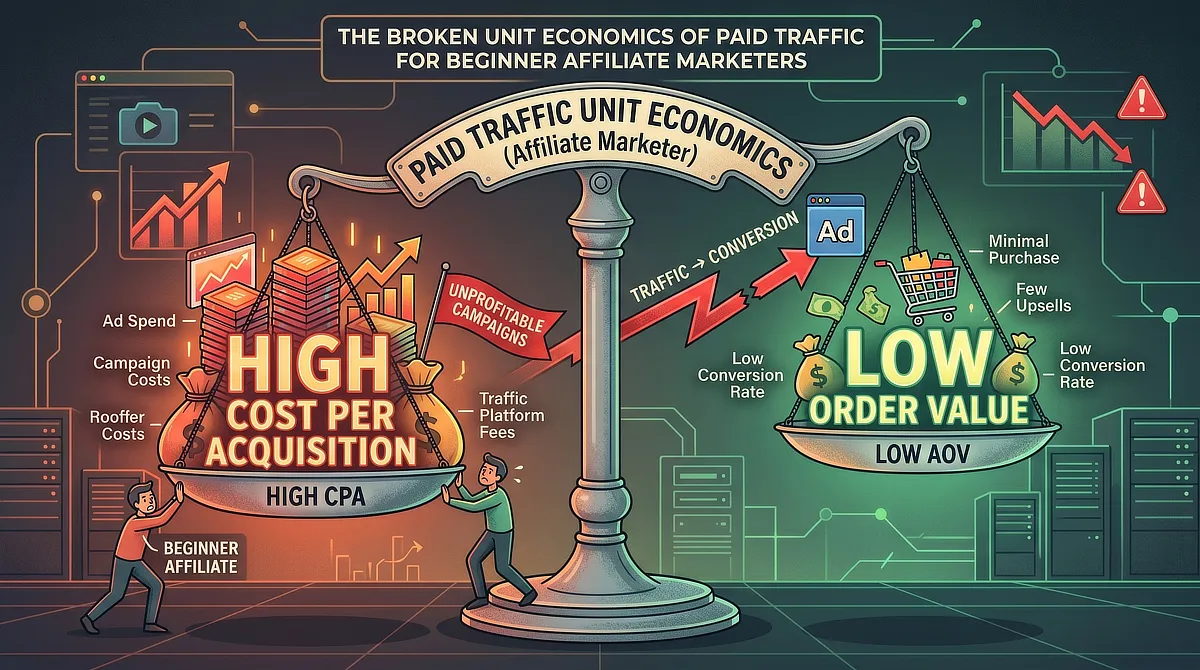
Paid advertising is a precision instrument. It rewards advertisers who know their conversion rates, their cost per acquisition, and the average order value of the product they are promoting. It penalizes everyone else, consistently and without exception.
Here is the unit economics at its most basic. A competitive click on a standard paid advertising platform costs between 50 cents and $2 per visitor, depending on the niche and audience targeting. At one dollar per click, fifty visitors costs fifty dollars. If one of those fifty converts into a sale, generating a $20 affiliate commission, the campaign loses $30. The email sequence does not change that number. The landing page design does not change it.
The only variables that can shift the outcome are a higher commission, a lower cost per click, or a dramatically better conversion rate, and beginners control none of those on day one. Most done for you systems do not teach you how to develop them either.
The metric that determines whether any paid campaign is viable is Cost Per Acquisition (CPA, which is how much money you spend on advertising to secure a single buying customer) relative to Average Order Value (AOV, which is the total commission you actually earn from that sale).
When I evaluate a done for you model against that single test, the result is the same every time: CPA exceeds AOV for most beginners, and the system loses money by structural design. Done for you models default to paid traffic because organic traffic requires original content, consistent publishing, and months before search engines begin distributing it.
None of that fits a sales pitch. So the model uses paid traffic, the beginner absorbs the losses, and the vendor has already recorded the sale.
The Algorithm Problem with Duplicated Templates
Search engines have one function: surface the most relevant and original content for any given query. When ten thousand affiliates publish the exact same landing page text, the same headline structure, the same copy blocks, and the same offer, every version competes against every other version of itself.
Search engines resolve this by selecting one instance (typically the oldest domain or the most authoritative source) and suppressing the rest. The buyer who deployed the template in month seven is not ranking. The buyer who deployed it in month twelve is not ranking. Neither ever will, with that asset.
Social media platforms operate on similar logic. An advertisement that has already reached millions of users gets flagged as low-quality creative. Algorithms reduce distribution and raise cost per impression in response. A template deployed by thousands of previous buyers before you arrived is not a fresh creative asset. It is stale inventory with a performance record that signals low-quality creative to the platform before your first campaign even runs.
This is not a situation that recovers through additional effort or optimization. The template is the product, and the template is the problem. There is no SEO technique that resolves duplicate content at scale.
There is no creative testing approach that restores organic reach once an asset has saturated the platform. Deploying a mass-market done for you asset sets an effective ceiling of zero on organic growth from the moment the campaign goes live, and it stays there.
High-Ticket Upsells and the Illusion of Ownership
The entry-level package in most done for you systems is not the intended product. It is the introduction to the intended product. The revenue model depends on a percentage of buyers converting into premium coaching programs, elite masterminds, or done-with-you acceleration packages priced between five thousand and fifty thousand dollars.
The entry tier is specifically engineered to produce frustration on a timeline that makes the premium upsell feel like the necessary and logical next step.
Refund policies in this category require close reading before any purchase. Many vendors build in a precondition: before you can file a claim, you have to prove you spent money on advertising first. You must demonstrate attempted traffic generation, which means running paid campaigns.
Given the unit economics from the previous section, those campaigns will almost certainly lose money. By the time you meet the refund threshold, you have spent more than the original purchase price getting there. These conditions are not buyer protections. They are structural barriers designed to make refunds practically inaccessible once you have crossed the threshold.
The ownership problem adds a separate layer of risk entirely. Pages hosted on a vendor’s proprietary servers are not assets you control. Email lists integrated with vendor software are not infrastructure you own.
If the vendor shuts down, restructures their terms, or decides to monetize their user base differently, the business you purchased disappears without recourse. That risk is not hypothetical. Legendary Marketer closed in February 2026 after nine years, and the affiliates who had built on its hosted funnel pages were left with nothing they could move.
This structural dependency carries the same risks present in aggressive recruitment and multi-level marketing structures, where the viability of your operation is entirely contingent on the continued goodwill of the organization above you in the chain.
Federal Enforcement Actions Against Turnkey Systems
The standard explanation for failure in done for you systems is user error. The buyer did not follow the steps precisely. The buyer did not scale advertising aggressively enough. The buyer did not act on the coaching fast enough. Federal regulators have a different explanation on record.
The Federal Trade Commission has pursued enforcement actions against vendors running turnkey ecommerce and affiliate-style systems, including companies like Ascend Ecom. The basis in those cases was consistent: income representations were deceptive, and the operational design of the systems made success mathematically implausible for ordinary buyers.
The FTC’s position is that failure at this statistical scale is not a buyer behavior problem. It is a product design problem. When the overwhelming majority of buyers cannot produce the advertised outcome, the income claims used to sell it enter legally indefensible territory.
The AARP Foundation’s research on MLM participation is not specific to done-for-you affiliate systems, but the pattern it documents is worth noting here. In their study of network marketing participants, nearly half lost money and about a quarter made no money at all, producing a combined failure rate of roughly 73 percent.
Any business model that leads with income promises, charges significant entry fees, and leaves the hardest problem unsolved will tend toward similar outcomes. At that failure rate, the conversation stops being about buyer education and starts being about whether the product should be sold at all.
Six Questions to Ask Before You Buy Any Done-for-You System
Not every done-for-you system is built the same way, and a few operators do disclose costs and limitations more honestly than most. The questions below are not designed to help you find a better version of the same model. They are designed to help you see the model clearly before you hand over money.
- Does the vendor disclose every monthly software cost upfront? Not in the fine print after purchase. Before. If the sales page leads with a flat entry price and leaves autoresponder, funnel builder, and platform fees for after you buy, that structure is a deliberate choice.
- Do they explain specifically where your traffic will come from? A funnel without traffic is a shell. If the answer involves paid advertising, ask what the expected cost per click is, what conversion rate is realistic, and what commission the offer pays. If they cannot tell you, the math has not been run.
- Do they provide written earnings substantiation? The FTC requires sellers of covered business opportunities to provide documented support for income claims. Ask to see it. If they respond with testimonials instead of verified data, that is your answer.
- Do you own the domain, the pages, the email list, and the content outright? If assets sit on a vendor’s proprietary platform, you cannot take them with you if you leave.
- Can you export your assets if you decide to leave? Full ownership means portability. If your pages, your list, and your content cannot be moved to infrastructure you control independently, you are renting, not building.
- Does the refund policy require you to spend money on advertising first? If yes, that condition is designed to make leaving expensive, not to protect you.
If any of these questions produces a vague answer, a deflection, or a condition you did not know about before you asked, that is the relevant information.
The Sustainable Alternative to Cloned Digital Shortcuts
Done for you systems appeal for the exact reason they fail. They promise to eliminate the learning curve. The learning curve is not a technical obstacle to route around.
It is the process through which you develop the skills that generate organic traffic, and removing it removes the only mechanism that produces results without a permanent, escalating ad budget to sustain them.
Here is what the alternative actually looks like for someone with five to ten hours a week. You pick one niche. You publish one to two posts per week based on low-competition keywords your audience actually searches. You can find these easily without buying expensive software by typing your topic into a search bar and looking at the auto-suggested questions real people are already asking.
You do not buy traffic. You do not rent funnels. You own the content and the domain from day one. The honest window before meaningful search traffic begins to appear is six to twelve months. That timeline is achievable. Most beginners who quit do so in month three because they expected results by month two, not because the model does not work.
None of that requires software you rent from a vendor month to month. None of it requires borrowed templates that thousands of other affiliates are also deploying this week.
It requires a clear training sequence, a workflow that fits a real schedule, and the discipline to publish before the numbers justify it. Paid traffic is something you can explore eventually, once you know your content is working and you understand how to read the numbers behind it.
The strategic roadmap for building an online business looks substantially different from what turnkey systems describe. The math also lands differently. You own the content. You own the infrastructure. The asset builds over time rather than evaporating the moment a subscription lapses or a vendor changes terms.
If you have questions about a specific system you are looking at, drop them in the comments. And if you have already been through one of these, I would genuinely like to hear what the experience was actually like.
Real accounts from people who have been there tend to be more useful than anything I can write.

Sonia Zannoni
Hi, I’m Sonia Zannoni, creator of Click to Prosper. I share practical tools, workflows, and honest guidance to help you build an online business with more clarity and less chaos.
About Sonia
Feeling stuck between too many tools and too much advice? Start with the beginner path.
View the Blueprint