

Do You Need an Email List Before You Have Traffic?

Affiliate Disclosure: This post contains affiliate links. If you purchase through one of my links, I may earn a commission at no additional cost to you. Read the full Affiliate Disclosure for details.
You’ve probably heard that skipping an email list is the worst mistake a beginner can make. So every week without a signup form feels like losing visitors you’ll never get back, and Analytics says about forty people visited your site last month.
That worry makes sense. The advice comes from courses, podcasts and YouTube all at once, and it’s true for the people giving it. Feeling torn means you’re listening, not that you’re behind.
So here’s the question you actually want answered: is an email list for affiliate marketing worth starting now, at your traffic? You don’t need another guide to building one. For most new sites, the honest answer is probably not yet.
I’ll show you the arithmetic behind that, the few cases where starting early does make sense, where those hours go instead, and the signal that tells you it’s time to look again.
TL;DR: Email List Timing for New Affiliate Sites
Why “The Money Is in the List” Is True for Someone Else’s Site
The advice is accurate. It just describes a site that already has readers. The people who repeat it already have steady traffic, and a signup form on a site like that turns a share of those visitors into subscribers week after week.
Here’s the mechanism, because the rest of this post hangs on it: list growth is a percentage of traffic. A form doesn’t create readers. It catches a small share of the ones already arriving, so the same form that fills up nicely on an established site collects almost nothing on a new one.
There’s one part of the argument I wouldn’t push back on. A list is an audience no platform can take away from you, and that’s worth having eventually. This post is about the timing.
So why does it feel so urgent? A lot of the loudest voices belong to courses and coaches who already have big audiences.
Some programs also sell a funnel (a set of pages built to collect emails and make a sale) or an autoresponder (a tool that sends emails automatically) right alongside the training. That’s the same pattern behind most done for you systems: the tools arrive before there’s a working site to use them on.
For a new affiliate site, then, the advice describes a later stage rather than a step to take this month, and the easiest way to see that is to run the numbers on your own traffic.
What a Signup Form Collects at Forty Visitors a Month
Let’s work it out the way I would if you were sitting across the table from me. An email marketing company analyzed 1.24 billion popup displays and found an average signup rate of 2.1 percent. It described anything under 1.5 percent as underperforming, and 5 percent or more as excellent.
Now take your forty visitors. Forty times 2.1 percent is 0.84, so that’s under one subscriber a month, or about ten in a whole year. Even if your form hit the excellent rate, forty times 5 percent is two people a month.
One honest caveat: that data counts popup displays rather than unique visitors, and it leans toward online stores, so treat it as an order of magnitude and never as a forecast for your site.
Forty visitors a month is normal at this stage. New sites usually take months to start getting steady search traffic, which is why early traffic stays near zero, and it’s also why a list has almost nothing to grow from yet.
Here’s the same rough arithmetic at three traffic levels. It’s a published average multiplied out, so read it as rough guidance for your own numbers.
Monthly visitors
At about 2% (average)
At about 5% (excellent)
40
Under 1 a month, about 10 a year
About 2 a month
200
About 4 a month, roughly 1 a week
About 10 a month
1,000
About 21 a month
About 50 a month
40
At about 2% (average): Under 1 a month, about 10 a year
At about 5% (excellent): About 2 a month
200
At about 2% (average): About 4 a month, roughly 1 a week
At about 5% (excellent): About 10 a month
1,000
At about 2% (average): About 21 a month
At about 5% (excellent): About 50 a month
Look at the top row for a second. On a new site, the number holding a list back is traffic, and no amount of tweaking the form will change that.
What Changes the Day Your Signup Form Goes Live
The subscriber count starts small, but the obligations don’t, and they’re the part most list-building guides leave out.
First, there’s the promise. Someone who gives you their email address expects to hear from you, so the moment a form goes live, you’ve committed to sending something and to keep sending it.
Then there are the rules for every marketing email you send. Using U.S. rules as the example, the FTC’s CAN-SPAM compliance guide says each one needs:
- Accurate header information, so the “from” and “reply-to” details honestly show who’s sending
- A subject line that honestly reflects what’s in the email
- A clear disclosure that the message is an ad (the CAN-SPAM Act itself waives this one for people who agreed to get your emails, such as by signing up through your form)
- A valid physical postal address
- A clear way to opt out, with every opt-out honored within 10 business days and the opt-out still working for at least 30 days after you send
The address can be a street address, a post office box registered with the U.S. Postal Service, or a private mailbox registered with a commercial mail receiving agency. If you run your site from home, that means either your home address in every email or a paid mailbox. Other countries have their own rules, so check the ones that apply where you live.
Your site changes too. Once a form collects email addresses, you’ll need to update your privacy policy so it tells visitors you’re collecting them.
There’s one more cost, and it’s easy to miss. The quickest way to push a signup rate up is a full-screen popup, but Google’s guidance on interstitials and dialogs says intrusive ones can make content hard to use and may hurt how a page performs in search.
Google suggests a small banner instead. On a new site, search is where your traffic has to come from, so that’s not a trade you want to make early.
None of these tasks is hard on its own: a mailbox, a policy update, a footer with your address and an opt-out link. What matters is that they all start on day one, before your first subscriber shows up.
Why Starting Early Rarely Buys a Head Start
The objection I hear most often from beginners goes like this: “If I start now, at least I’ll have a head start.” It sounds sensible, so it’s worth checking against the numbers.
At forty visitors a month, the head start is about ten people a year. In exchange, the obligations from the last section begin immediately, and so does a whole second project:
- Which tool to use, which means comparing options and learning one
- What to give away for signing up, which is a small piece of content in its own right
- What to write in a welcome email, so new subscribers know why they’re there
- How often to send, and then keeping to it
That’s a lot to carry next to a site that isn’t getting found yet. Some people who’ve tried it at zero traffic describe the same ending. One of them said they had zero traffic when they started their email list, and still zero when they gave it up eight months later.
That’s one person’s account, not a statistic, but the reasoning behind it holds up. A handful of subscribers who signed up and then heard nothing for months isn’t much of an asset, because by the time you have something worth sending, many of them may not remember who you are.
So the trade rarely favors starting now. You’d be taking on the full weight of running a list to collect a very small slice of what it could become later.
When Starting a List Before Traffic Does Make Sense
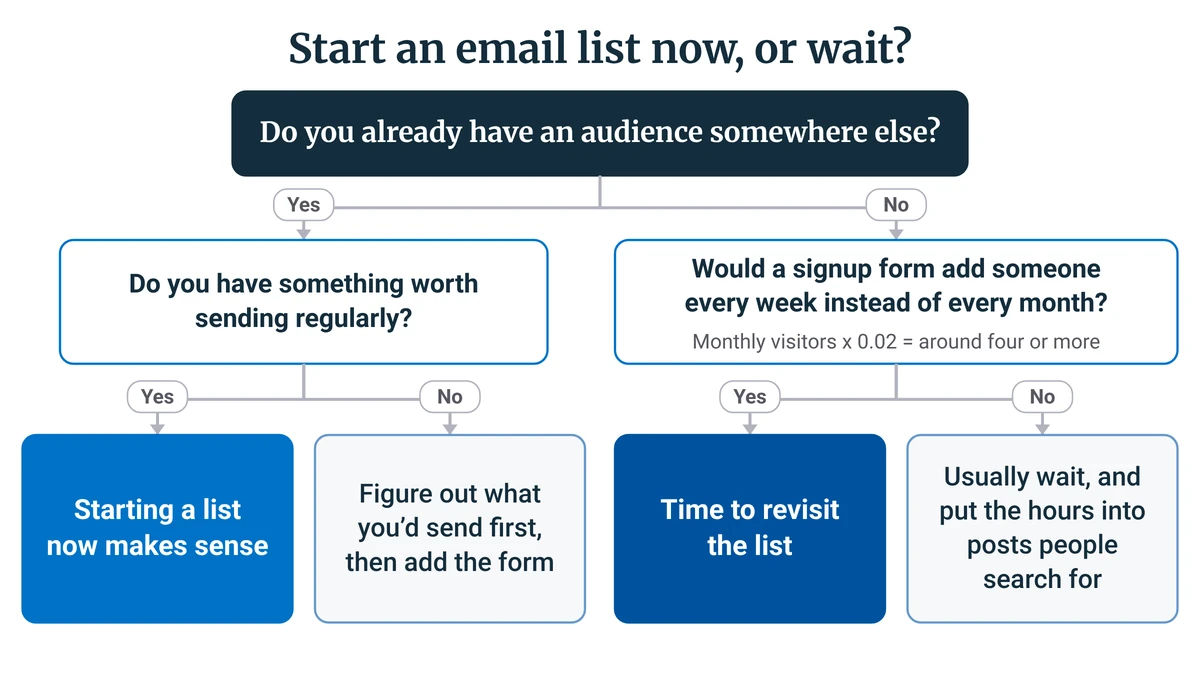
“Not yet” isn’t the right answer for everyone. Before the verdict, here are the three questions that decide it for your situation:
- How much traffic does your site already have? This sets how fast a form can grow, using the arithmetic above.
- Do you already have an audience somewhere else? People who follow you elsewhere can join a list without your site having to find them first.
- Do you have something worth sending regularly? A list only stays useful if the people on it keep hearing from you.
The real exception is the second question. If you already have a social following or run a community, a list collects people who already exist, so the forty-visitor arithmetic doesn’t apply to you. You’d be moving an audience you’ve built into a place you control, and that’s a good reason to start early.
Whatever your answers, none of this means never. A list is still worth having later, and the timing is the only part that’s wrong for most readers right now.
Here’s how it sorts out. If people already follow you somewhere and you’ve got something worth sending regularly, starting a list now makes sense. If your new site is your only source of readers, the honest answer is usually to wait. And if you have an outside audience but nothing to send yet, figure out what you’d send first, then add the form.
Where the Hours Go Instead
If the list waits, the hours it would have taken don’t disappear. They go into posts people actually search for, because traffic is the thing a list will need later and the thing you can build right now.
When I’m deciding what to publish next, I start with the keyword before the idea. That’s where a short keyword routine earns its place, because it points you at searches a new site can realistically rank for.
It also helps to build and publish on one setup instead of adding a separate email system to learn, connect and keep running. Fewer moving parts means more of your week goes into writing, which is the same reasoning behind the setup I describe in my Wealthy Affiliate review.
The steady version looks plain, and that’s on purpose:
- Pick a keyword a new site can rank for. A keyword you can’t reach brings no traffic, however good the post is.
- Write the post that answers it properly. The reader who lands there should find what they searched for.
- Publish it. A finished post can start getting found, and a draft can’t.
- Repeat. Traffic builds as the posts pile up, so no single one has to carry it.
The list stays parked while you do this, and that’s fine. Every post you publish adds to the traffic a form will eventually grow from.
The Signal That Means It’s Time to Revisit Your List
So when does the answer change? Use the same arithmetic. Revisit the list when a signup form would add someone every week instead of every month.
At the average rate of about 2 percent, that’s roughly 200 visitors a month seeing the form, which is the middle row of the table earlier.
That 200 comes from the arithmetic rather than from any study, so run the same sum on your own traffic: multiply your monthly visitors (the visitors or users figure for the last 30 days in your analytics) by 0.02, and if the answer is around four or more, a list finally has something to grow from.
Two other things can change the answer sooner. If an audience shows up somewhere else, like a social account that starts to grow, or if you find you have something worth sending regularly, go back to the three questions and run them again.
Until then, check your traffic once a month, rerun the arithmetic, and pick the list back up when the numbers say so. For this month, that means choosing your next keyword and getting that post written.
If you’d like one place to do that work, the free Starter tier lets you look around before you decide anything.
How many visitors did your site get last month, and do you already have an audience somewhere else? Tell me in the comments. I read and reply to every one.

Sonia Zannoni
Hi, I’m Sonia Zannoni, creator of Click to Prosper. I share practical tools, workflows, and honest guidance to help you build an online business with more clarity and less chaos.
About Sonia

Feeling stuck between too many tools and too much advice? Start with the beginner path.
View the Blueprint