

Automated Affiliate Marketing With AI: What the System Still Leaves You to Do

Affiliate Disclosure: This post contains affiliate links. If you purchase through one of my links, I may earn a commission at no additional cost to you. Read the full Affiliate Disclosure for details.
One page selling AI Marketers Club says AI will write, post and monetize faceless content for you, the kind where you never appear on camera, in about 7 minutes a day. Another page selling the same course says most students spend 30 to 60 minutes a day working on their content. Those two numbers can’t both describe your day.
If you’re trying to work out whether automated affiliate marketing with AI actually works, you probably already use ChatGPT, and you know the first half of that pitch is true: it really can write. So you’re reading the sales pages looking for the catch.
That’s the right instinct. Most of these pages tuck what they leave you in an FAQ, a cons list or an upsell, so if you’ve struggled to find it, that isn’t on you.
What you really want to know is how much of the job the AI removes, and how much of your own evenings it quietly hands back. So here’s the affiliate job step by step: which steps these programs take off you, which they give back, why the edit isn’t optional, and how to use AI for drafting without buying a system that claims to do the rest.
TL;DR: Automated Affiliate Marketing With AI
What the Sales Pages Promise, Next to What Their Own Pages Admit
Looking at the pages selling these programs, the same thing keeps happening. The headline promises one thing, and somewhere lower down, the page admits something else. All three are sold on digital product marketplaces (ClickBank, WarriorPlus and JVZoo), where a low entry price, called the front end, is often followed by extra offers shown after you pay, called upsells. Here are the three programs, who sells them and where:
- AI Marketers Club, sold by John Crestani through a ClickBank checkout for $27.
- 6 Figure AI Affiliate System, sold by James Fawcett on WarriorPlus, with a front end of about $13 to $17 and a series of upsells behind it.
- Auto Affiliate, sold by Mike From Maine and Brett Rutecky on JVZoo, with upsells that include Pro, Unlimited, Done-For-You Pack and Traffic Booster.
This isn’t a full review of any of them. For each one, I’m setting what it claims next to what it hands back.
AI Marketers Club
On pages selling the course, the headline promises AI that writes, posts and monetizes faceless content in about 7 minutes a day. Another page selling the same course says most students spend 30 to 60 minutes a day working on their content.
Pages selling it also concede that results are not typical. When this post was written, the aimarketersclub.com address redirected to a page offering the domain for sale, which is worth knowing if you go looking for the course under that name.

Auto Affiliate
Pages selling Auto Affiliate say it “takes care of the hard parts”, content creation included. Several of those same promotional pages then list its cons: “not fully automated”, “traffic not included”, “AI content needs editing” and “too many upsells”.
The upsell names tell you which parts the front end leaves out. If the system really handled everything, there’d be nothing left to sell you as a Done-For-You Pack or a Traffic Booster. That’s why a system sold as automated ends up with a stack of upsells behind it.
6 Figure AI Affiliate System
Pages promoting the 6 Figure AI Affiliate System describe it as a “5 minutes a day” AI affiliate system. It’s the shortest daily figure of the three, so it’s the one worth holding hardest against the job itself.
It’s tempting to put all this down to badly written pages. I don’t think that explains it, because the pages selling these programs state both things: the big promise up top and the admission further down. That gap is the evidence: by the pages’ own account, the automation stops somewhere, and you’re the one left to find out where.
The Affiliate Job, Step by Step, and Which Steps Automation Removes
The way I’d test any of these pitches is to walk the job in order and ask two questions at each step. After you buy the system, who actually does this? And if it goes wrong, who answers for it? Those two questions matter more than any feature list, because a step the system skips is a step you’ll end up doing anyway.
Here’s the job, in the order it happens:
- Choosing a topic and checking that people search for it. This decides whether everything after it is worth doing. A well-written post on something nobody searches for earns nothing, however fast it was produced.
- Writing the first draft. This is the step AI really does well. You give it a topic and some direction, and a usable draft comes back in minutes.
- Editing the draft and adding what you actually know. The draft has to be checked for errors and given the detail only you can supply, like which part of a process tripped you up or what a product’s pricing page leaves out.
- Publishing with an affiliate disclosure. Any post carrying affiliate links needs a clear disclosure, and the person who publishes it is the one who has to get that right.
- Bringing readers to it. A post nobody reads makes no commissions, whoever wrote it.
- Keeping the accounts it posts from in good standing. A social profile, a marketplace store and your own site each have rules, and breaking them can cost you the account.
Here’s the honest part of the pitch: AI really does remove most of the drafting time. A first draft that used to eat an evening can take a few minutes, and I’m not going to pretend otherwise. If drafting was what held you back, that’s a real gain.
Here’s how each step lines up against what the pages selling these three programs claim:
Step
What the pitch says the system does
What stays with you
Who answers for it
Topic choice
Not addressed
Picking a topic people search for
You
First draft
Writes the content
Giving direction, a first read
You
Edit and first-hand detail
Takes care of the hard parts
Fact-checking, adding what you know
You
Publishing and disclosure
Posts it for you
Final approval, affiliate disclosure
You
Traffic
Monetizes it
Finding readers
You
Account standing
Posts it for you
Following each platform’s rules
You
Topic choice
What the pitch says the system does: Not addressed
What stays with you: Picking a topic people search for
Who answers for it: You
First draft
What the pitch says the system does: Writes the content
What stays with you: Giving direction, a first read
Who answers for it: You
Edit and first-hand detail
What the pitch says the system does: Takes care of the hard parts
What stays with you: Fact-checking, adding what you know
Who answers for it: You
Publishing and disclosure
What the pitch says the system does: Posts it for you
What stays with you: Final approval, affiliate disclosure
Who answers for it: You
Traffic
What the pitch says the system does: Monetizes it
What stays with you: Finding readers
Who answers for it: You
Account standing
What the pitch says the system does: Posts it for you
What stays with you: Following each platform’s rules
Who answers for it: You
The first draft is the only row where the pitch is honestly true. And the drafting these programs sell is usually built on the same kind of general AI you can open yourself, so it’s worth seeing what the free AI tiers already cover before you pay for a system wrapped around one.
How much comes back to you depends on what you’re publishing. A faceless short social post needs less editing than a search-driven blog post, which has to answer a question better than the pages already ranking for it. Both still hand you the edit and the responsibility for what goes out, which raises the question most buyers ask first.
Can You Post the AI Content as It Comes? Why the Edit Stays Yours
No, not if the post is meant to rank or to last. And the reason has less to do with AI than most people expect.
Google judges the value a page adds for the reader, not how the page was produced. Its spam policies on scaled content abuse name “using generative AI tools or other similar tools to generate many pages without adding value for users” as an example. That policy was introduced in March 2024, and it applies whether automation or people produce the pages.
So if you’re wondering whether Google will penalize you for AI content, the honest answer is that it doesn’t penalize AI as such. An unedited draft usually just doesn’t earn its place in the results, because it’s built from the same general patterns as every other unedited draft on the same topic. A system that publishes many of them is exactly what the scaled content policy describes.
Once you know the draft can’t go out as it is, the useful next skill is the edit itself. I’ve covered how to edit an AI draft so it sounds like you on its own, because doing it well takes more room than this section has.
Traffic and Accounts: What the System Hands Back Once You Publish
Publishing is where the system’s part ends and a different set of jobs begins. Two of them come straight back to you.
Traffic is the job these systems hand back most openly. Promoters of Auto Affiliate list it as not included, and one of its upsells is a Traffic Booster. That gap sits at the heart of why done-for-you systems fail, where the full traffic and cost picture is laid out.
The accounts your content posts from are the other job. Whether it’s a social profile, a marketplace store or your own site, the account belongs to you, so its standing does too. If the posts break a platform’s rules, the platform deals with the account holder, and the software that wrote the posts never hears about it.
Cloud tools like these often host your pages and campaigns on the vendor’s servers rather than yours, which is why it’s worth knowing what happens when the platform closes.
Responsibility for what’s published, affiliate disclosure included, stays with the person whose name and accounts it goes out under, and that’s you, whichever tool produced the words.
Minutes a Day and Passive Income: What the Timeline and the Regulators Say
The sales-page timeline goes something like this: a few minutes a day, money soon. Part-time affiliate progress doesn’t look like that. Most sites take 6 to 12 months or more of steady publishing before the income means much, and some never get there. If you want a realistic part-time timeline to plan around, that’s the one I’d use instead of the sales page’s.
Regulators have already looked at this kind of promise. In its Click Profit case, the FTC alleged that the company promised “passive income” from a proprietary system powered by artificial intelligence, and charged a management fee of at least $45,000 plus inventory. It also alleged that Amazon blocked, suspended or terminated about 95% of the company’s stores, and that consumers lost at least $14 million.
A court order halted the company’s operations in March 2025. In August 2025 the FTC announced settlements that permanently ban the company and its operators from selling business opportunities. The FTC’s claims were allegations, and the settlements are not findings of wrongdoing by a court.
Click Profit isn’t one of the three programs in this post. It’s here because it shows how regulators treat “passive income from AI”, and what happened to the stores buyers were paying to have run for them.
It wasn’t a one-off, either. In September 2024 the FTC announced Operation AI Comply, naming business opportunities built on AI hype as an enforcement focus. None of this is a verdict on the three programs above, but it’s a good reason to read any passive-income-from-AI claim slowly, fine print first.
Isn’t Wealthy Affiliate’s Ace the Same Thing?
Since I recommend Wealthy Affiliate, two objections are fair here. Wealthy Affiliate has its own AI, Ace, so isn’t that the same thing? And doesn’t this site teach AI workflows too?
Both get the same test as the job walk-through: who reviews it, who’s responsible for it, and who gets the traffic.
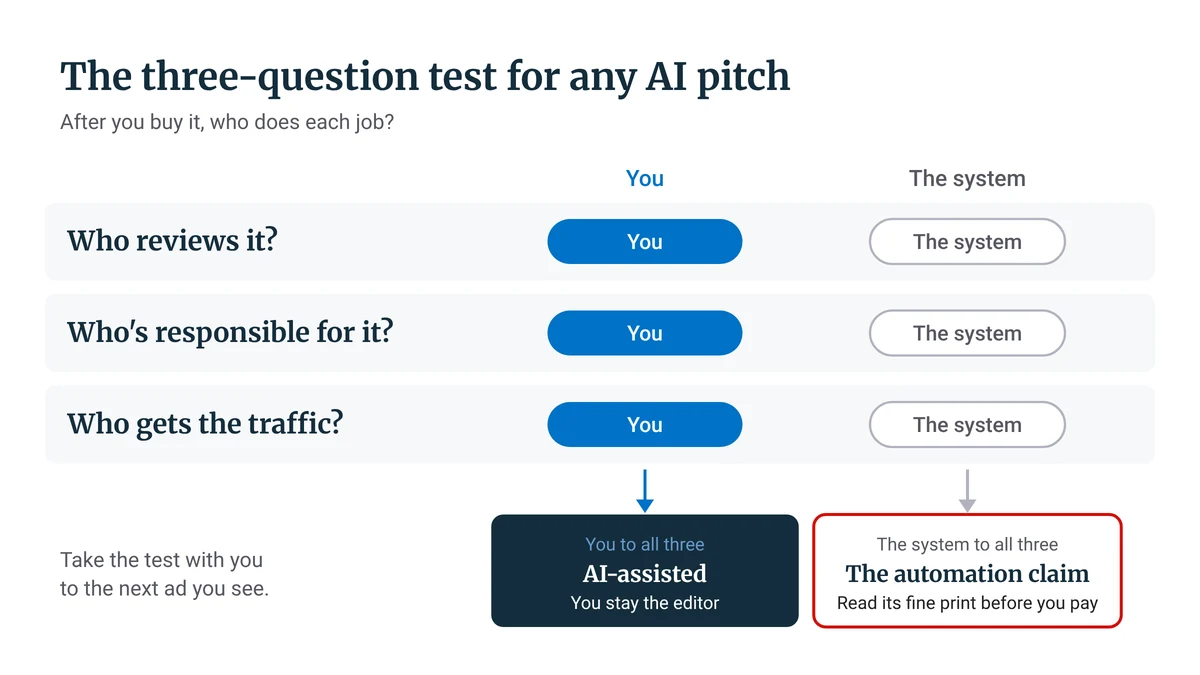
Ace and the Writer plan and draft. Wealthy Affiliate’s own terms say AI output can be wrong, repetitive or out of date, that members should review everything before publishing, and that the member is responsible for what goes out under their name, affiliate disclosure included. That answers the first two questions the way this post has been saying they should be answered: you review it, and you answer for it.
The homepage doesn’t promise “done for you” riches either. It says most businesses take months of real, steered work before they bring in real money. And since 6 November 2026, Ace also researches for you: it suggests keywords with an estimate of monthly searches and rates each one Great, Good or Stretch, then sends the ones you pick to your Gameplan, where you still make the post.
Wealthy Affiliate’s homepage does say its Agents do the heavy lifting, including posts for every channel, so the difference isn’t how much the AI drafts. Nothing publishes without your ok, and the homepage promises no traffic and no income, so bringing readers stays your job.
So the third question gets the same answer as the other two. That puts Wealthy Affiliate on the AI-assisted side of the line, with you as the editor, and the review goes into how Wealthy Affiliate handles AI drafting in more detail. If you expect Ace to run the business for you, Wealthy Affiliate isn’t for you either.
The same goes for the AI workflows taught here: every one of them keeps you as the editor of your own drafts.
The Honest Version: Let AI Save the Drafting Time and Stay the Editor
Take the test with you to the next ad you see. Who reviews it, who’s responsible for it, and who gets the traffic? When a pitch answers “the system” to all three, that’s the automation claim, and its fine print is worth reading before you pay.
What to do instead is simpler than any of these funnels. Use a general AI tool for your first drafts, keep the edit, the disclosure and the traffic plan for yourself, and expect the six-to-twelve-month timeline rather than the one on the sales page.
If you’d like planning, drafting and publishing in one account, with you as the editor, my full Wealthy Affiliate review shows what that looks like. If you’re hoping for something that runs without you, skip it.
The useful next step is a small one. Take one post idea, let AI draft it, and spend your time editing it into something you’d put your name on. A free Wealthy Affiliate Starter account doesn’t need a card, so it’s a low-stakes way to find out whether editing AI drafts is worth your time. It won’t run anything for you, and it isn’t meant to.
Which step of the job did an ad tell you was handled for you, and did the program’s fine print say otherwise? Tell me in the comments. I read and reply to every one.

Sonia Zannoni
Hi, I’m Sonia Zannoni, creator of Click to Prosper. I share practical tools, workflows, and honest guidance to help you build an online business with more clarity and less chaos.
About Sonia
Feeling stuck between too many tools and too much advice? Start with the beginner path.
View the Blueprint