
How to Make Money Within the Affiliate Marketing Niche (The Income Economics Guide)

Most affiliate income advice skips the part that actually decides whether your work compounds or resets.
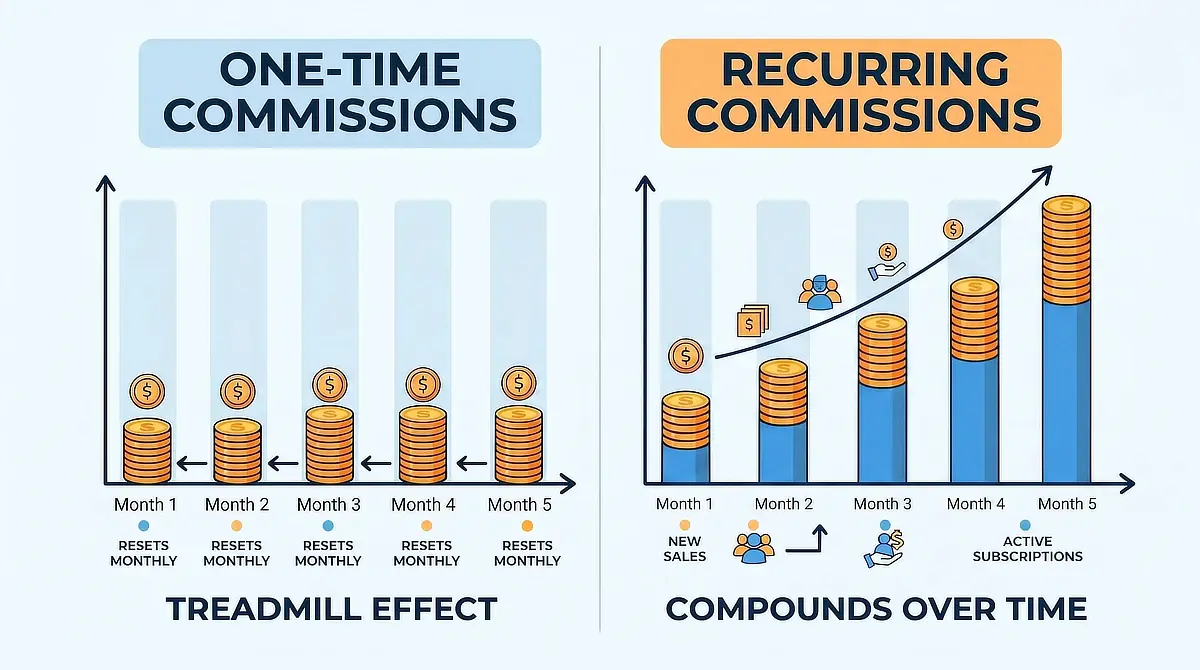
A $20 one-time commission and a $20 recurring commission look identical on your dashboard in month one. By month twelve, they are not even close to the same business model. One asks you to keep finding new buyers forever. The other lets yesterday’s work keep paying while you build the next post.
Understanding how to make money within the affiliate marketing niche starts with that difference. No hype, no income screenshots, and no six-figure origin stories. Just the actual income mechanics: which commission structures compound, which programs are worth your limited hours, and what a realistic growth curve looks like when you are building around a real life.
TL;DR: How to Make Money Within the Affiliate Marketing Niche
The Mathematics of Affiliate Income (Why Recurring Software Outperforms One-Time Sales)
Most beginner affiliate strategies default to retail programs with big, familiar brand names. But because commissions are typically small, often 1 to 5 percent on a physical item, you need massive volume to make the math work.
This model is a treadmill. Every month starts at zero, and your income depends entirely on generating a fresh supply of new visitors.
Software subscription programs work on a fundamentally different curve. When a reader signs up for a platform through your affiliate link, you earn a commission on that initial transaction and on every recurring billing cycle for as long as they stay subscribed.
A reader who converts in January may still be generating commission in September, without you writing another word about that product. If you’re still building your foundational understanding of the model, it’s worth getting clear on what affiliate marketing actually is before comparing the commission structures below.
Revenue Model
Monthly Predictability
Customer Lifetime Value (LTV)
Traffic Effort Required
Recurring Software Commissions
High (compounds each billing cycle)
High (full subscription lifetime)
Lower (income grows without constant new traffic)
One-Time High-Ticket Sales
Low (resets to zero each month)
Medium to High (single transaction value)
High (requires a consistent new visitor supply)
One-Time Retail Sales
Unpredictable (volume-dependent)
Low (small percentage of a small price point)
Maximum (income stops the moment traffic slows)
Recurring Software Commissions
Monthly Predictability: High (compounds each billing cycle)
Customer Lifetime Value (LTV): High (full subscription lifetime)
Traffic Effort Required: Lower (income grows without constant new traffic)
One-Time High-Ticket Sales
Monthly Predictability: Low (resets to zero each month)
Customer Lifetime Value (LTV): Medium to High (single transaction value)
Traffic Effort Required: High (requires a consistent new visitor supply)
One-Time Retail Sales
Monthly Predictability: Unpredictable (volume-dependent)
Customer Lifetime Value (LTV): Low (small percentage of a small price point)
Traffic Effort Required: Maximum (income stops the moment traffic slows)
The recurring model doesn’t just produce better math on paper. It changes the practical experience of building this business. When commission compounds rather than resets, your content output is an accumulation strategy, not a survival one.
One platform that consolidates hosting, keyword research, and training under a single login, while operating on a recurring affiliate commission structure, is Wealthy Affiliate. If reducing that tooling overhead seems worth a closer look, you can read my full Wealthy Affiliate review to see how the ecosystem works before committing.
The Strategic Filter (How to Evaluate an Affiliate Program Before Creating Content)
Selecting an affiliate program based on commission rate alone is one of the most common and most costly mistakes in this niche. A high percentage means nothing if the program’s cookie window closes before your readers get around to purchasing, or if the product has high churn that erodes your recurring income before it has time to compound.
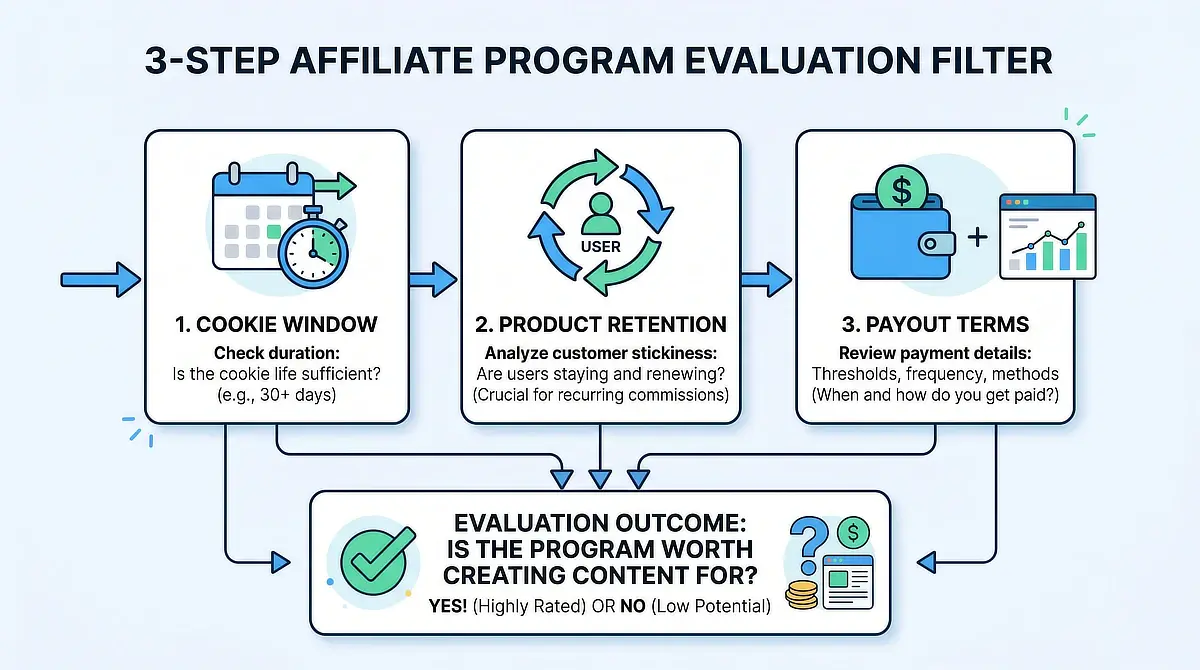
Before you write a single post targeting a program’s keywords, run it through three specific filters. You can easily find these details by scrolling to the footer of any software’s homepage, clicking their ‘Affiliates’ link, or searching ‘[Program Name] affiliate program terms’ before signing up.
- Cookie window length: The cookie is the tracking period between when a reader clicks your link and when a purchase is credited to you. Programs with 24-hour windows are nearly incompatible with organic search traffic, where a reader might consider a purchase for a few days before returning. A 30-day cookie window is the baseline standard worth holding to because it gives your content time to convert slow-moving readers.
- Product retention rate: In recurring programs, the commission you earn in month three depends on whether the customer stayed through months one and two. High-churn products, tools users cancel after a trial or a single project, erode recurring income as fast as you build it. Look for platforms with genuine ongoing utility, like a tool a user builds their daily workflow around and would face high friction replacing.
- Payout terms and thresholds: Some programs hold commissions until you reach a minimum balance of $100 or more. If your current earning pace puts that balance 18 months away, understand that reality before committing your content calendar. You want programs that payout reliably without forcing you to wait a year to see your first dollars.
Affiliate marketing also carries a compliance obligation that applies regardless of which programs you choose. The Federal Trade Commission requires that material connections between publishers and brands, including affiliate commissions, be disclosed clearly and conspicuously before the reader encounters any promotional content. The FTC Endorsement Guides set out exactly what that standard requires. Reading them once is a practical investment in building a publishing operation that doesn’t create legal exposure for itself down the road.
The 24-Month Trajectory (The Realistic Income Curve for Part-Time Builders)
The most useful thing to understand about part-time affiliate marketing timelines is that the income curve has three distinct phases, and each one calls for a different orientation. Treating month four the same as month 18 is one of the most reliable ways to abandon a strategy that was actually working.
- Months 1 through 6: The Foundation Phase. Traffic is flat and earnings are near zero. This is normal behavior for a site that hasn’t yet built domain trust or index history with search engines. The right measure of progress here isn’t revenue; it’s publishing consistency and output quality. Your job in this phase is to build the asset, not to watch the meter.
- Months 6 through 12: The Inflection Phase. Posts that were indexed but sitting below page-one positions begin to move. If the content is built around specific reader intent, some posts will start earning consistent click-through traffic. This is when your first commissions arrive. The curve is finally no longer flat.
- Months 12 through 24: The Compounding Phase. Domain trust accumulates and older posts continue to climb. Recurring commissions from readers who converted months ago keep arriving without additional content effort on your part. This is where the recurring commission structure shows its full structural advantage because income from earlier work doesn’t disappear when you shift focus to new projects.
When you’re ready to move from planning into execution, you need a structured plan for the early days. The practical guide to starting an affiliate marketing business on a part-time schedule covers how to organize your first 90 days without burning out.
One thing worth naming directly before moving forward: the 24-month curve above applies to legitimate content businesses built on organic search authority. It does not apply to MLM structures, done-for-you dropshipping setups, or courses promising to compress the timeline into weeks through paid traffic shortcuts or pre-built systems. Those programs don’t produce this compounding curve because they aren’t built on the same model. If a program’s pitch centers on bypassing the organic growth timeline, that’s the signal to do more research before committing.
Why Content Age Compounds Your Earning Power
There’s a counterintuitive reality in content-based affiliate marketing that most new publishers discover too late to take full advantage of it during their first year: older content almost always outperforms newer content on a per-hour-invested basis. It’s not that old posts are inherently better written. It’s that they’ve had time to accumulate what search engines actually use to assign rankings.
Search engines don’t extend full trust to a newly published page. There is an evaluation period where the system gathers behavioral data like how long readers stay and whether they find your answers useful.
A post that has been live for a year has twelve months of that signal history behind it. That accumulated trust is often what moves a piece from page two to page one without you changing a single word.
The practical implication is straightforward. Once you have a few posts that have been live for six months, optimizing an underperforming older page is a massive win. A twenty-minute refresh (tightening the title tag, which is the SEO title searchers see on Google, updating the intro, and adding a targeted internal link) often produces more ranking movement than writing a brand-new post from scratch.
You are compounding what is already built instead of starting from zero. To see how to transfer authority between your pages, my guide to a strategic internal linking structure covers the mechanics at a practical level.
The implication for new builders is straightforward: every post you publish right now is starting a clock. The content you write in month two will have nearly two years of aging behind it by month 24. That clock is one of the most valuable assets you’re accumulating during a phase that doesn’t feel particularly productive.
Publish consistently in the early months not just because output matters, but because each piece of content is starting a compound interest calculation that pays out later.
Surviving the AI Environment (Designing Content for True Information Gain)
Search engines used to reward pure volume. The default strategy was simple: publish more, rank higher.
That dynamic is dead. Today, search engines penalize thin content that simply repackages what competitor pages already say. If your post covers the same territory as the top three search results, you are competing against established sites that already hold years of authority.
What earns visibility now is information gain: content that answers questions with a level of specificity that generic aggregators can’t replicate. For affiliate content, that might mean a real screenshot of a platform dashboard, a comparison table built from live pricing pages, or a step-by-step workflow. The difference is between content that describes what to do and content that shows the reader precisely how to clear their exact bottleneck.
If you are building around a primary job, this doesn’t mean conducting academic-level research. It simply means taking a quick screenshot of a setting you adjusted, or showing the exact search query you ran to find an answer.
To make this easy on a limited schedule, create a dedicated folder on your desktop. Whenever you run a search, adjust a setting, or run into a software quirk during the week, take a quick, unpolished screenshot and drop it in. When you sit down to write on Tuesday night, your original visual assets are already waiting for you.
For a part-time affiliate publisher, this is structurally good news. You don’t need to out-publish media companies or AI content operations running dozens of posts a week. You need to out-answer them on a narrow set of specific questions. Depth on one focused reader problem beats breadth across ten crowded topics every time.
This is also why well-structured, specific affiliate content holds its search position longer than high-volume generic posts. A post that genuinely resolves a reader’s specific problem earns return visits, positive engagement signals, and bookmarks. Those signals reinforce the ranking. Content built for volume, without the depth to fully satisfy the reader, earns the click but doesn’t hold the position.
Taking Your Next Step in Affiliate Publishing
The income economics of affiliate marketing are straightforward once you see them clearly. Recurring commissions compound where retail sales reset.
A three-point program filter protects your limited hours from weak partnerships. At the same time, content age acts as a compounding asset, and true information gain keeps your rankings stable.
None of this requires a full-time schedule or a massive team. It just requires understanding the economics and applying them consistently with the time you actually have.
If you want to see how an all-in-one platform reduces the tooling overhead while keeping your affiliate work grounded in a recurring commission model, the full breakdown is waiting.
If you’re working through the commission math, figuring out which programs pass the three-point filter, or planning your first publishing stretch realistically, leave a question in the comments below. I read and answer every single one.

Sonia Zannoni
Hi, I’m Sonia Zannoni, creator of Click to Prosper. I share practical tools, workflows, and honest guidance to help you build an online business with more clarity and less chaos.
About Sonia

Feeling stuck between too many tools and too much advice? Start with the beginner path.
View the Blueprint