
What Is Affiliate Marketing and How Does It Actually Work?

You’ve probably spent at least one Tuesday evening typing “what is affiliate marketing” into a search bar after scrolling past a dozen YouTube thumbnails promising financial freedom in 30 days and Instagram reels with beachside laptop setups.
The explanations you found either pivoted into a sales pitch three sentences in or drowned the actual mechanics in so much marketing vocabulary that the real answer stayed completely invisible.
That skepticism is healthy. This niche rewards the people who ask “how does this actually work” before they spend a cent. Most of the content out there is built to convert you, not inform you, and the difference matters more than you might think.
Here’s what this post does instead. It walks through the literal mechanics: how affiliate links and browser cookies track your referrals, how commissions move from a merchant’s system into your account, what separates a legitimate business from the MLM and “done-for-you” pitches, and what a realistic first year looks like for someone working 5 to 10 hours a week. No shortcuts, no hype, and no vocabulary you will have to look up halfway through.
TL;DR: What Is Affiliate Marketing
The Digital Referral: What Affiliate Marketing Actually Is
Affiliate marketing is the digital version of something that has existed for decades in the physical world. A real estate agent earns a commission for connecting a buyer to a seller. A car salesperson earns a percentage on every deal they close. The digital version works the same way, except your “sales floor” is a website and your commission arrives through a tracking link instead of a handshake.
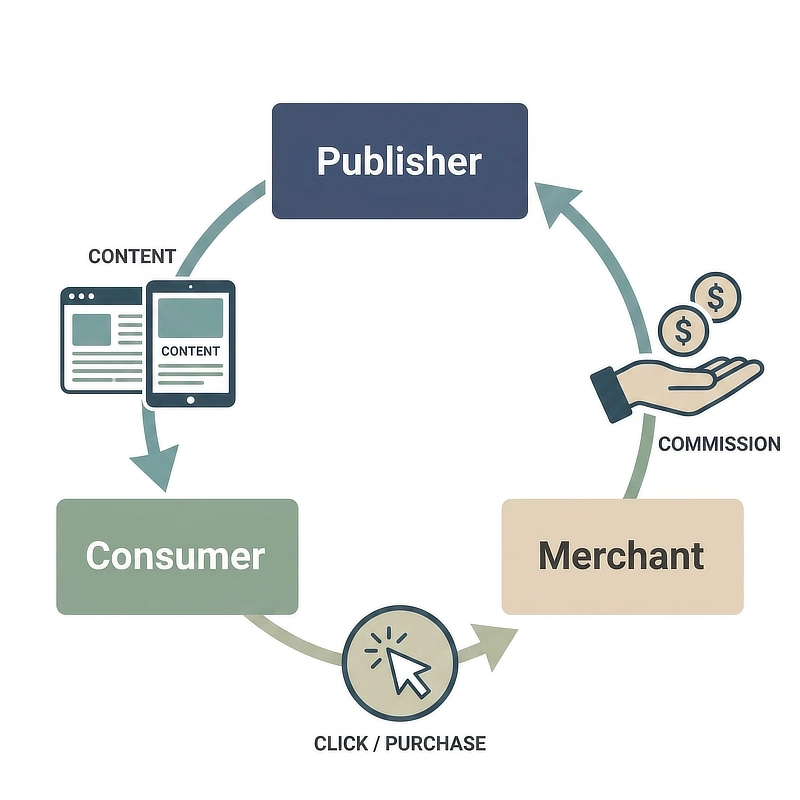
The business involves three active players. The consumer is the reader who lands on your content looking for an answer to a specific problem. The publisher (that’s you) creates the content that answers that problem and includes a tracking link to a relevant product. The merchant is the company that sells the product and pays you a percentage of the sale when the reader buys through your link.
Affiliate marketing is a problem-solving business, not a loophole-finding business. The sites that stay profitable for years are built around a specific topic, genuine recommendations, and content that actually helps someone make a decision. The sites that chase tricks and income shortcuts tend to last about as long as the algorithm update that catches them.
The Paper Trail: How Tracking Links and Cookies Work
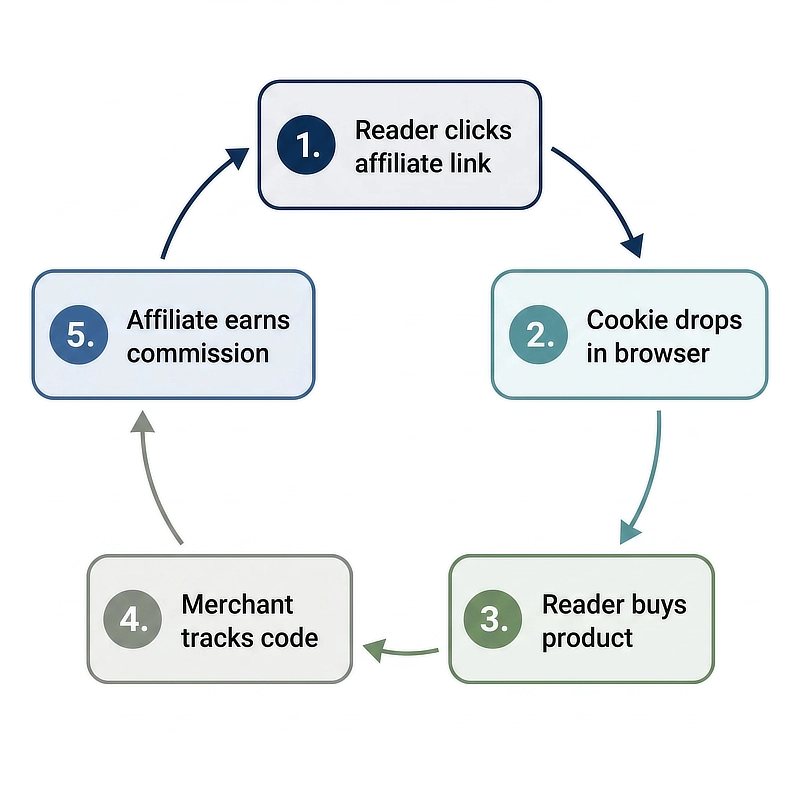
The tracking mechanic is simpler than most explanations make it sound. When a company sets up an affiliate program, they assign every publisher a unique URL. That URL points to their product page but contains extra text in the address, a string of characters that tells their system which publisher sent the visitor. That string is your tracking ID.
When a reader clicks your link, two things happen simultaneously. The reader lands on the merchant’s product page, and the merchant’s system drops a small text file into the reader’s browser called a cookie. That cookie stores your tracking ID and sits quietly in the reader’s browser until it either expires or the reader completes a purchase.
Anatomy of an Affiliate Link
A typical affiliate link looks something like yourproduct.com?ref=yourtrackingcode. The base URL is where the reader lands, while the ?ref=yourtrackingcode portion tells the merchant’s system to credit you. Some programs use ?tag= or ?aff_id= instead of ?ref=, but the mechanics are identical. Your unique code travels along with every click.
Nothing mysterious is happening in that URL. It’s accounting, not magic.
Keeping a simple spreadsheet or document to catalog your custom affiliate tracking links is a great, zero-cost way to save time on busy weekday evenings. Instead of logging into five different affiliate dashboards every time you write a post, you can grab what you need in five seconds.
Understanding Cookie Expiration
Cookie duration is one of the most important details to understand before joining an affiliate program, and most beginners overlook it completely. Amazon’s default cookie lasts 24 hours. If your reader clicks your link today and completes the purchase tomorrow, you earn nothing. A 30-day cookie, which is common in software and digital product programs, gives the reader a full month after clicking your link to make a purchase and still credit you with the commission.
The practical implication is straightforward. If you’re choosing between two affiliate programs with similar commission percentages, the one with the longer cookie window is almost always the better business decision for a content site where readers research carefully before buying.
The Bank Deposit: How You Actually Get Paid
The most common payment model in affiliate marketing is Pay Per Sale. You earn a percentage of the purchase price when a reader you referred completes a confirmed transaction. Pay Per Click programs, where you earn a small amount each time someone clicks your link regardless of whether they buy, exist in some niches, but they rarely make sense as a primary income model for a content site. The commission rates are too small, and they depend on a volume of traffic that beginners simply do not have yet.
Research from Search Engine Journal on affiliate monetization models highlights Pay Per Sale as the industry standard for content publishers. While this model shifts the conversion risk to you (since you only earn when a transaction is finalized), it aligns your incentives with the merchant’s. This alignment is why merchants are willing to offer significantly higher commission rates for PPS compared to the fractions of a cent typical of PPC models. This shared incentive structure tends to produce more stable, long-term program relationships.
Affiliate programs pay through two channels. Some companies run their own internal programs and pay you directly. Others use affiliate networks like ShareASale, Impact, or Commission Junction, which act as secure intermediaries, collecting commissions from multiple merchants and distributing payments to publishers on a set monthly schedule.
Getting paid is a methodical accounting process, not a sudden cash drop. Most programs hold commissions for 30 to 60 days after a sale to account for refunds and chargebacks. There are also payment thresholds, typically $50 or $100, that you need to reach before a payout is released. Knowing this in advance removes the confusion when your first small commissions take weeks to appear in your account.
Legit Business vs. The Scam Pitches: Spotting the Red Flags
Here’s the single most important distinction in this entire niche: legitimate affiliate marketing involves zero recruiting. You earn money when readers buy products you recommend. Your income has nothing to do with how many people you sign up, sponsor, or recruit into a program below you. The moment a “business opportunity” ties your earnings to how many people you bring in, you are looking at a multi-level marketing structure, not affiliate marketing.
“Done-for-you” systems are the second category that catches beginners off guard. The promise sounds reasonable until you look at what you’re actually purchasing: “We’ve already built the site, the content, and the traffic.” The problem is that the traffic component is almost never real. Legitimate organic traffic takes months to build through consistent content and search authority, meaning it cannot be packaged, pre-assembled, or handed to you at checkout.
The Federal Trade Commission publishes clear guidelines on endorsements and honest business practices. If you’re evaluating any affiliate program or online business opportunity, taking twenty minutes to read the FTC Endorsement Guides is well worth your time.
Red Flag 1: Paid Recruiting Tiers
If a program’s compensation plan requires you to recruit other members to unlock higher commissions, or if a meaningful portion of your potential earnings comes from the activity of people you’ve recruited, that is an MLM structure. It doesn’t matter how the program markets itself or what vocabulary it uses. Follow the compensation structure, not the branding.
Red Flag 2: The “Autopilot” Traffic Promise
Real affiliate income is tied to real content that ranks in organic search, which takes time and consistent work. Any system claiming it can deliver converting traffic without that foundation is selling a premise that does not hold up. Paid traffic can work, but it requires a real budget, testing experience, and a high-margin product. If someone tells you that the traffic problem is already solved, the warning sign is right in front of you.
Identifying these patterns early will save you thousands of dollars. For a broader look at what to watch for, read our honest breakdown of whether affiliate marketing is actually a scam.
The 5 to 10 Hour Stack: What You Honestly Need to Start
The most common mistake beginners make is spending their first month buying tools instead of creating content. The actual technical requirements to start an affiliate site are small: a topic you can write about with real knowledge, a WordPress site on solid hosting, and content that answers the specific questions your readers are already searching for.
The topic is where most people overthink things, and it is the decision that matters most. Ask yourself whether you can write about this general subject twice a week for two years without losing interest. If the answer is no, search volume doesn’t matter because you will burn out before building rank-worthy authority. If you want a structured niche selection framework before you move forward, work through that process first.
The technology side is simpler than the tutorial ecosystem makes it look. A clean WordPress install on reliable hosting is your only essential business asset in year one.
You do not need a landing page builder, an email service, a social scheduler, an AI writing suite, and a keyword research tool all running simultaneously on day one. That kind of tool fragmentation is where beginners lose three evenings a week managing software instead of writing content.
Do not waste your limited five to ten weekly hours tweaking WordPress themes, color palettes, or logos. A basic, clean, out-of-the-box layout is more than enough to start publishing content that actually ranks.
Consolidated platforms that combine hosting, training, and keyword research under one roof exist specifically to solve this problem. If you want to see what a unified platform workflow actually looks like for someone building on limited evenings, my Wealthy Affiliate review walks through it in full.
The Realistic Timeline: What Month 1 to 12 Online Looks Like
Most people quit by month three. It is not because affiliate marketing doesn’t work, but because they expected major results by month two, and the math simply does not support that timeline.
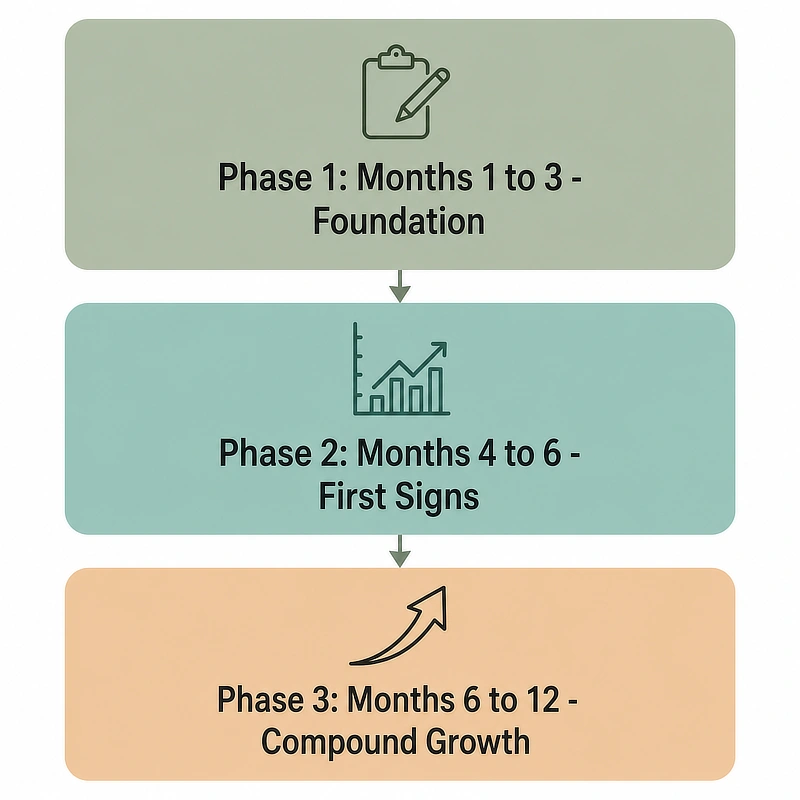
Months 1 to 3 are the foundation phase, where you build pages, publish content, and establish your presence. During this stretch, you will have almost no organic traffic and no commission income. This is normal and not a sign that you are doing something wrong. Search engines need time to crawl, index, and evaluate your authority, so your job is to keep publishing.
Months 4 to 6 are when the first real signs of life appear, as pages start indexing consistently (meaning search engines officially catalog your pages and add them to their search database) and a handful of posts begin pulling in early visitors. An occasional small commission shows up in your affiliate dashboard, sometimes for a post you half-forgot you had written two months earlier. These numbers are not exciting by any objective measure. They are simply confirmation that the underlying referral system is working.
Months 6 to 12 are the compound curve, where older posts accumulate authority and climb in rankings. You now have enough content on the site that internal linking (linking your own articles to one another to guide readers) is doing meaningful work, and new posts index faster because your domain has established credibility. This is the phase where going back to refresh and improve older posts starts paying off more than constantly chasing new topics.
The timeline is not a promise. It’s a realistic framework built around what consistently happens for part-time builders who publish regularly, avoid the common traps, and don’t try to shortcut organic search. If you go in knowing what month three actually looks like, the slow start won’t break you.
Ready to Start Building Your Own System?
If what you’ve read here matches the kind of online business you’re actually looking for, the next practical question is which platform or approach fits a part-time schedule without requiring you to manage five separate subscriptions.
That’s the analysis I’ve done in detail. Read our full analysis of the Wealthy Affiliate platform and see how the all-in-one workflow stacks up against building your own toolset piece by piece.
If you have questions about how tracking cookies work, how payment thresholds function, or how to separate a legitimate affiliate program from an MLM, leave them in the comments below. I read and answer everyone.

Sonia Zannoni
Hi, I’m Sonia Zannoni, creator of Click to Prosper. I share practical tools, workflows, and honest guidance to help you build an online business with more clarity and less chaos.
About Sonia

Feeling stuck between too many tools and too much advice? Start with the beginner path.
View the Blueprint