
Why Blogging Still Works: The No-Hype Business Math for Side-Hustlers

Every few months, a new thread appears explaining why blogging is dead. Sometimes it is because a creator just hit a million TikTok followers with a 30-second clip. Sometimes it is because Google rolled out another AI summary feature, and traffic projections start looking uncertain.
If you have been sitting on the idea of starting an affiliate blog and quietly wondering whether that window has already closed, that skepticism is completely reasonable. The online noise pushing you in that direction is loud, confident, and almost never includes the actual math.
The math behind why blogging still works is exactly what this post covers. Not a debate about which format is more entertaining, but a clean look at the business structure: what the brand preference data says, how owned assets compound differently than rented feeds, and what a realistic part-time build timeline actually involves.
TL;DR: Why Blogging Still Works
The Owned vs. Rented Math (Deconstructing the Social Feed Trap)
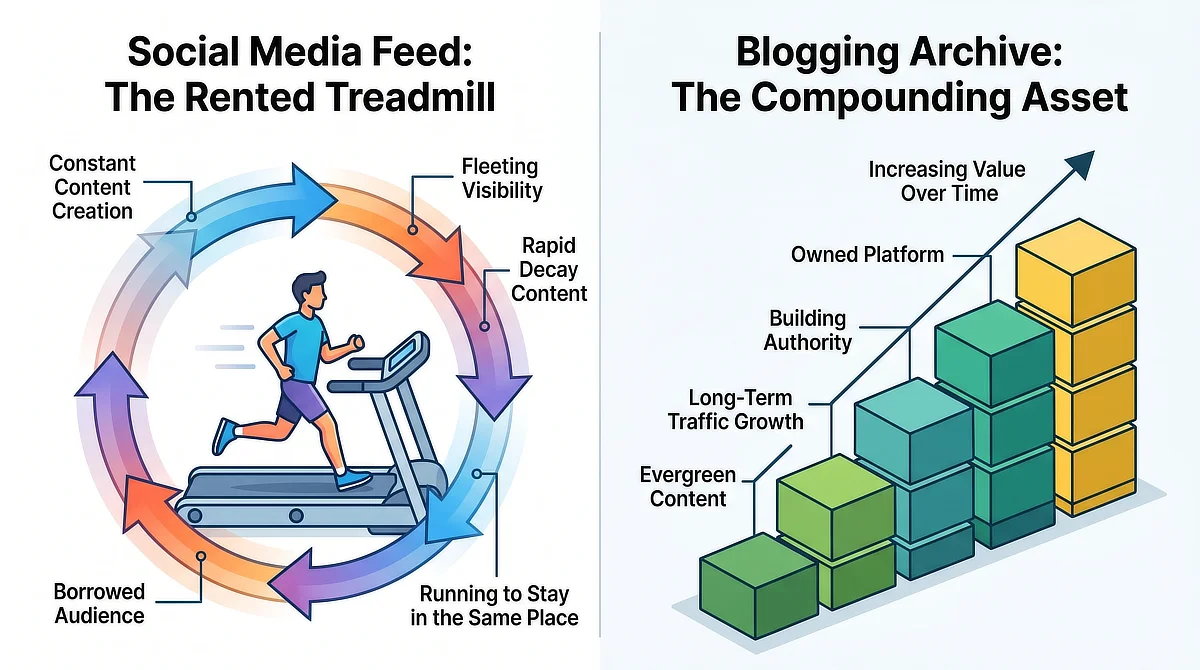
Every piece of content you publish has a half-life: the window during which it stays visible and keeps sending an audience your way. For a social post, that window is brutally short. Most platforms strip a post of the bulk of its reach within 24 to 48 hours.
One platform is worth separating out here. Pinterest indexes pins against search queries rather than running a chronological feed, so a pin keeps working for months instead of days. The account is still rented, which is exactly why every pin should point back at a page you own. The algorithm has a constant appetite, and staying visible means feeding it daily.
A search-optimized blog article operates on a completely different schedule. A post that earns a first-page position on a relevant search query does not disappear after two days. It holds its position, quietly generating traffic, for months and often years. You write it once, do a periodic refresh when the content needs updating, and let the rest run.
If you want a grounding in the underlying business mechanics, what affiliate marketing actually is, and how the mechanics work, it covers the full asset model that makes this comparison make sense before you start building anything.
One model demands constant input for volatile, unpredictable output. The other requires significant front-loaded effort in exchange for compounding, low-maintenance visibility. For anyone building around a full-time job, those two structures are not equally expensive.
The Conversion Reality: Why 27.8% of Brands Still Choose Blogs
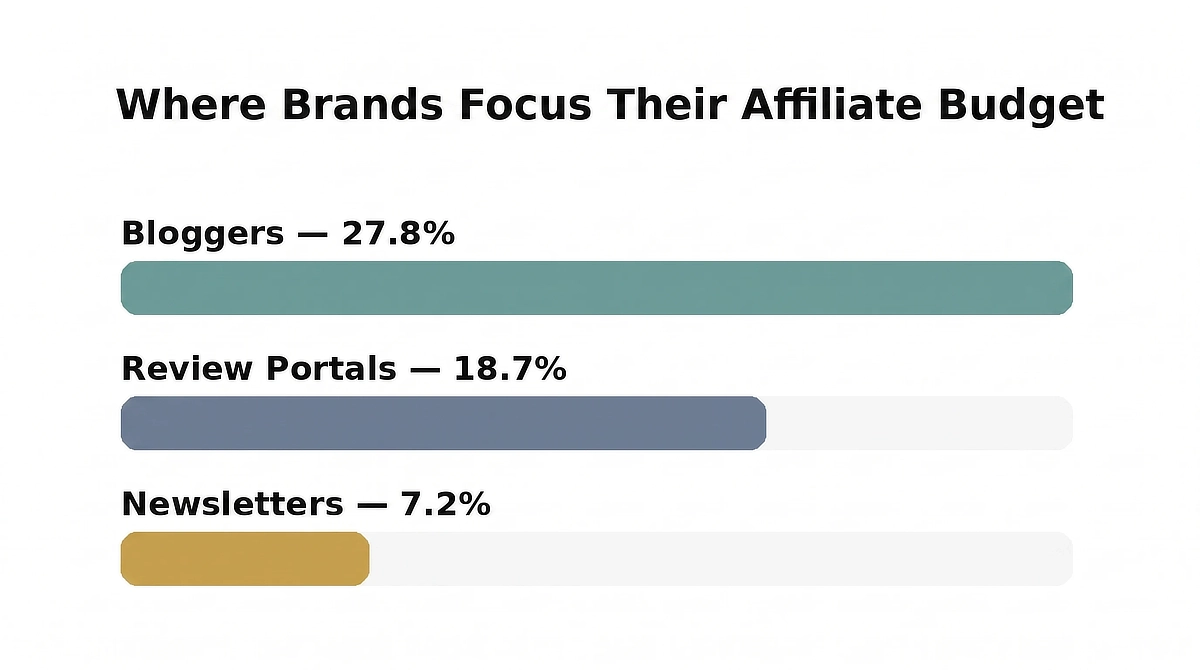
The “blogging is dead” framing almost never includes this number: 27.8% of active affiliate programs explicitly prioritize bloggers as their primary revenue drivers. This performance benchmark is documented in Statista’s global affiliate marketing channel tracking data, which shows where companies actually focus their spend. Review portals follow at 18.7%, while curated newsletters sit at 7.2%. Brands do not allocate affiliate budgets based on what looks exciting at a conference. They follow conversion data.
The reason comes down to search intent. Someone scrolling a social feed is in discovery mode, looking for entertainment or connection, and they are not making purchase decisions.
In contrast, someone who types a specific question into Google is in a completely different mental state. They have a problem, they want a solution, and they are often ready to act on it. That shift in intent is what makes search-based content convert at rates most social platforms cannot match.
The HubSpot 2026 State of Marketing Report has confirmed this structural advantage: Website, blog, and SEO optimization ranks as the single highest-ROI marketing channel overall, beating out both paid and organic social media. This long-form, structured text content delivers some of the most stable compounding value when measured over a 12- to 24-month window. It is not the fastest format to build, but it remains the most durable over a real timeline.
If you want to see what a well-built affiliate publishing model looks like in practice, the Wealthy Affiliate review walks through the full business structure. This breakdown shows how the integrated setup is specifically designed to remove the friction that stops part-time builders from getting started.
The Semicolon-Level AI Reality (Why Search Summaries Aren’t Killing Deep Text)
There is a useful distinction to make about what AI summaries are actually threatening. Not all content sits at the same level of complexity.
A summary box is genuinely effective at simple, definitions-based questions. Queries like “What is a conversion rate?” or “What does an affiliate link do?” get clean, direct answers. That kind of content was already low-margin territory, and AI handles it efficiently now.
What AI struggles with is semicolon-level content, where two or more things are true at the same time and the relationship between them is what the reader actually needs. Whether a specific niche is viable for a new blog, given current competition, seasonal intent patterns, and a particular monetization model, is a semicolon-level question. The answer requires connecting multiple variables with human judgment, not retrieving a definition. A summary box cannot do that reliably, and a reader who gets one in response to that question knows immediately that it did not actually help.
Google also has a structural reason to keep directing traffic to high-quality source content: the AI summaries need reference material to synthesize from. Deep, well-structured, human-edited articles are the inputs the systems pull from, and maintaining reliable source content in search rankings is how Google keeps those outputs trustworthy.
The practical angle is to use AI tools to speed up research, drafting, and structure, while keeping the judgment layer human. The writers who fold AI into their process without outsourcing their actual perspective and verification are not losing to summary boxes. They are outpacing the writers who are not using any tools at all.
The Tech Overwhelm Trap (Why Consolidated Systems Win)
Here is a pattern that stalls beginners before they publish a single article. You sit down after work with an hour to write, but instead you spend 40 minutes troubleshooting why your hosting and keyword tools show conflicting speed data. There is also a new tool someone recommended in a forum thread last Tuesday that you feel you need to evaluate before committing. Just like that, your writing window is gone.
This is the cost of tool fragmentation, and it is disproportionately expensive when you are building around a full-time job. Someone with a dedicated eight-hour writing day can absorb an hour of technical troubleshooting without derailing their output. Someone working in evenings and weekends cannot. The economics of a tight schedule require a different kind of infrastructure.
If your weekly window is tight, do not try to do everything at once. Divide it into three distinct blocks: 1 hour on keyword research, 3 hours of focused distraction-free writing, and 1 hour on formatting and publishing. Isolating these tasks protects your limited mental energy and guarantees steady progress.
The solution is not buying better individual tools. It is reducing the number of separate systems you need to manage. An integrated platform that handles hosting, site structure, keyword research, and training under one roof removes an entire category of friction from your workflow. If you want to see how a consolidated setup handles this in practice, see how an integrated hub handles this entire workflow for a concrete look at what that model actually covers.
The goal at this stage is not to master every piece of software in the affiliate marketing ecosystem. The goal is to publish articles consistently. Every tool decision should be evaluated by whether it makes it easier or harder.
The 24-Month Build (Why Slow Asset Growth Beats Volatile Hype)
Compare two models side by side. A social media account that stops posting loses its reach within days, because the visibility is tied directly to the activity. A search-optimized blog works in the opposite direction: each ranked article adds to a base that generates traffic independently of what you publish next. The articles from six months ago are still working.
For someone building part-time, that structure matters more than the starting speed. The first three to six months of a new blog are typically quiet in organic search, as new domains (essentially your website’s registered home address) need time to build authority. This slow start is not a sign that your blog is failing. It is simply the period during which you are building the foundation that eventually carries the load.
What progress looks like in the middle phase is a steady, quiet accumulation. A few early posts start earning backlinks (links from other websites pointing to your site as a trusted source), rankings consolidate, and traffic builds in a recognizable upward curve.
None of those steps feels dramatic in the moment, but the long-term compounding effect is massive. For a closer look at the reality of a 24-month part-time timeline without the optimistic projections, that breakdown covers each phase honestly.
This table breaks down what realistic progress looks like when you build an affiliate site on a tight part-time schedule.
Timeline
Target Milestones
Traffic & Visibility Expectations
Months 1 to 3
Publish first 6 to 10 articles
Quiet or zero traffic. This is a normal period of search engine indexation.
Months 4 to 6
Reach 15 to 20 total articles
Early search impressions appear. Occasional trickle clicks start showing in Search Console.
Months 12 to 24
Scale to 40+ articles
Compounding traffic. Older-ranked content begins driving consistent, daily organic visitors.
Months 1 to 3
Target Milestones: Publish first 6 to 10 articles
Traffic & Visibility Expectations: Quiet or zero traffic. This is a normal period of search engine indexation.
Months 4 to 6
Target Milestones: Reach 15 to 20 total articles
Traffic & Visibility Expectations: Early search impressions appear. Occasional trickle clicks start showing in Search Console.
Months 12 to 24
Target Milestones: Scale to 40+ articles
Traffic & Visibility Expectations: Compounding traffic. Older-ranked content begins driving consistent, daily organic visitors.
A social account with 50,000 followers that goes quiet for six months is effectively starting over. A well-maintained blog with 50 ranked articles continues generating traffic whether you published yesterday or three months ago. That asymmetry is the core business argument.
Your Next Logical Step (Moving From Paralysis to Publishing)
The most productive thing you can do with whatever skepticism you walked in with is convert it into specificity. Instead of researching whether blogging is worth it or comparing platforms, focus on a simpler question: what do you actually need to publish your first post? The list is shorter than most tutorials suggest, and the startup cost is lower than the tool ecosystem makes it look.
You do not need a premium keyword tool, a custom email sequence, or a social media management system before your first article goes live. If you want a clear picture of what the actual starting list looks like, the baseline items you actually need to start affiliate marketing cover what matters at the beginning and what can wait until month three or four.
Getting one article published matters more than having a perfect setup. The planning loop most beginners run (more research, more platform comparisons, more tool evaluation) is not preparation. It is postponement dressed as preparation. The friction of starting is real, but the only way through it is to finish a first draft on a live site.
Once you have done that once, the workflow becomes clearer. You understand what the actual time cost is, which tools you are genuinely using, and what can be cut. That calibration is worth more than ten hours of pre-launch research.
If the business math in this post made the model clearer, the Wealthy Affiliate review is the next practical stop. It covers the full integrated setup, the pricing structure, and who the platform actually fits.
If you have questions about the math of owned assets, the brand preference data, or setting up a simple blogging workflow, leave them in the comments.

Sonia Zannoni
Hi, I’m Sonia Zannoni, creator of Click to Prosper. I share practical tools, workflows, and honest guidance to help you build an online business with more clarity and less chaos.
About Sonia

Feeling stuck between too many tools and too much advice? Start with the beginner path.
View the Blueprint