
How to Get Approved for Affiliate Programs When Your Site Is Still New

The email is two lines long. Your application was declined, and the reason field is either empty or says the site “does not meet our criteria.” You’d done what the guides on how to get approved for affiliate programs told you to do: a handful of posts, a program picked, the form filled in. Now you’re holding a no with nothing in it you can act on.
Reading that email as a judgment on your site, or on yourself, is the normal reaction, because it gives you nothing else to go on.
But many declines come from a rule that fired, not from a person who read your site and disliked it. What you really want to know is how to get approved while the site is still small, and what this particular no actually meant.
Here’s how to tell which gate turned you down (the network or the brand) and which kind of no you got, what to fix for each, and when it’s worth going back.
You won’t find tricks for getting past a review here, and there’s no promise of approval either, because nobody can honestly make one.
TL;DR: Getting Approved for Affiliate Programs
There Are Two Gates, and Each One Checks Something Different
This guide picks up after you’ve already chosen a program. If you’re still deciding which programs deserve your effort, start with the three filters to run before you choose a program, because choosing and applying are separate jobs.
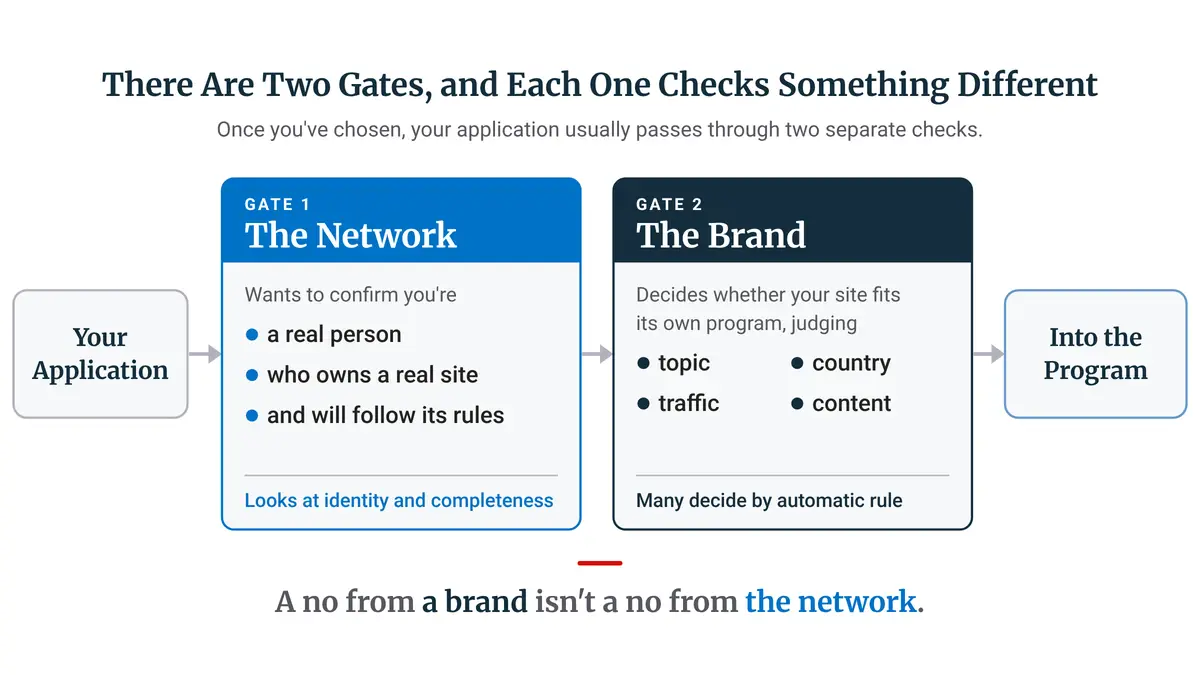
Once you’ve chosen, your application usually passes through two separate checks.
The first gate is the network, the platform that hosts lots of affiliate programs in one place, and it wants to confirm you’re a real person who owns a real site and will follow its rules.
The second gate is the brand. Each company on that network decides whether your site fits its own program, and many of them make that call by automatic rule.
You don’t have to take my word for that split, because the networks draw the line themselves:
- Awin says a publisher who’s rejected by one advertiser is still approved on Awin and can go on applying to other programs.
- PartnerStack asks you to apply to the network first, and then each company approves its own program separately.
- Rakuten Advertising doesn’t screen publishers when they join, so on Rakuten the decisions that matter come from the brands.
This matters because a no from a brand isn’t a no from the network, and the fix for each one is different.
A network decline usually means something about you or your details didn’t check out.
A brand decline usually means your site didn’t fit that one program. Everything else in this guide builds on telling those two apart.
Amazon is the one big exception, and it works the other way round. Amazon Associates reviews you once sales come in rather than at the door, so its approval question is really about timing, and the application itself isn’t where things get decided. If Amazon is on your list, I’ve laid out how Amazon’s three-sale review works in its own post.
What a Network Checks Before It Lets a New Site In
When a network reviewer opens your application, they’re mostly answering one question: who is this, and is the site really theirs? Here’s what each of the networks in this guide says it looks at.
Awin says it checks every application individually and by hand, then cross-references it against several parameters and third-party tools, including identity verification. You can read how that works on Awin’s application process page. Awin also asks for a small, refundable deposit, and you can expect a decision in a day or two.
Impact.com says its marketplace review checks for “authenticity and compliance,” with a decision within 72 hours. The decline reasons it names are worth reading closely: incomplete information, concerns about your media property (the site or channel you’d promote on), limited reach or activity, and policy or fraud flags. They’re set out in the network’s own words on impact.com’s application status page.
Rakuten Advertising is an open network, which means it doesn’t screen publishers when they join. It does ask for your website URL, monthly visitors, page views, a short description of your business and your tax information, so have those ready before you sit down with the form.
PartnerStack has a Network team that reviews the network application itself, and in most cases you’ll hear back within 5 business days.
There’s one more thing every reviewer can see without asking: whether the site looks finished, and whose it is. AvantLink is unusually direct about this. Its own list of denial reasons includes a new or incomplete site (one registered for less than four months), alongside limited traffic, a thin social presence, not owning a site and a poor fit.
If your site still looks half-built, the design decisions that make a new site look trustworthy are a better use of your next session than another application.
You’ll hear a lot that approval all comes down to traffic. It does count at some networks: AvantLink says limited traffic is the number one reason it turns down new applications, and impact.com lists limited reach.
But it’s one check among several. Identity, ownership and complete details count too, because the network’s first job is keeping fake and fraudulent accounts out, so a small site with honest, complete details isn’t out of the running.
Getting through the network gets you an account. It doesn’t get you into any program yet, and that’s where the second gate comes in.
What a Brand Decides After the Network Says Yes
Once the network has said yes, each brand on it runs its own review, and it’s looking at different things. Rakuten Advertising says its advertisers judge your web presence, your country of residence, your traffic and the quality of your content. Its own example is a fashion brand that wants to see a visitor count and fashion content on your site.
That example explains why the same site can get opposite answers on the same day. A small site with good fashion content could suit that brand and still be turned down by a brand that only takes publishers in its own country. Nothing about the site changed between those two applications, only whose rules it was being measured against.
Some brands on impact.com also switch on an automatic step called Partner Verification. It runs brand safety, fraud and content checks, and it confirms that you own at least one promotional channel. The brand’s own decision still sits on top of that, so passing verification doesn’t mean you’re in.
What a brand means by fit is fairly practical: can the person reviewing your application picture how your site would actually present their product? A small site on one tight topic can fit some brands really well and others not at all, and both answers can be right. If you want your content to make that picture easy, here’s how to write reviews a brand would want its name in.
So should you apply everywhere to improve your odds? I’d hold off. Each brand judges fit against its own program, so applying to programs your site doesn’t cover mostly collects declines, and those declines won’t teach you anything you can use. A short list of brands whose topic you already write about gives you answers that mean something.
Before you read anything into a decline, then, you need two things straight: which gate made the decision, and what that gate was looking at. The network looks at identity and completeness. The brand looks at topic, country, traffic and content, and the next section uses exactly those to work out what your no meant.
How to Tell Which Gate Said No, and Which Kind of No You Got
Two questions sort out most of the confusion. Did the network decline you, or one brand on it? And was the decline automatic, temporary or permanent? Answer those before you change anything on your site.
The reason so many declines arrive with nothing in the reason field is that many programs decline automatically. Rakuten documents automatic declines, and impact.com’s automatic verification shows how a brand can screen applications without a person reading each one.
On Awin, the reason for a brand’s decision sits with that advertiser, which is why Awin points publishers to the advertiser’s account manager. So an empty reason field often means the answer is with the brand, or that a rule made the call and nobody wrote anything down.
Rakuten Advertising sets out three kinds of decline on its partnership request rejections page:
- Automatic: a rule turned you down.
- Temporary: not yet. The brand sees potential but wants parts of your account information sorted out, so fix those, and you can send a new request after 15 days.
- Permanent: that brand won’t take you into its program.
If you want to ask about a decline, ask the person who can actually answer. On impact.com, appeals go through your Partner Development Manager, or through impact.com support in the portal if you don’t know who that is. On Awin, go to the advertiser’s account manager, since that’s where the reason sits.
You might be worried that one no has marked you everywhere. The networks’ own rules don’t point that way. On Awin, a brand’s decline leaves your network account in place, so you can keep applying to other programs; and Rakuten treats temporary and permanent declines as separate things, so not every no from a brand is final.
Here’s how the common declines line up, what each one usually means and what to do next.
Decline you got
Which gate
What it usually means
Your next move
Network application declined
Network
Identity, ownership or compliance details didn’t check out, or the form was incomplete
Correct the details and the site; on impact.com, appeal through your Partner Development Manager or portal support
One brand declined, network account still active
Brand
The site doesn’t fit that program’s topic, traffic or country rules
Apply to brands your content already covers; on Awin, ask the advertiser’s account manager
Automatic decline
Brand rule
A rule fired, and nobody may have read the site
Check the brand’s stated criteria
Temporary decline on Rakuten
Brand
Not yet
Sort out your account information, then send a new request after 15 days
Permanent decline on Rakuten
Brand
Not this program
Put the effort into other brands
Network application declined
Which gate: Network
What it usually means: Identity, ownership or compliance details didn’t check out, or the form was incomplete
Your next move: Correct the details and the site; on impact.com, appeal through your Partner Development Manager or portal support
One brand declined, network account still active
Which gate: Brand
What it usually means: The site doesn’t fit that program’s topic, traffic or country rules
Your next move: Apply to brands your content already covers; on Awin, ask the advertiser’s account manager
Automatic decline
Which gate: Brand rule
What it usually means: A rule fired, and nobody may have read the site
Your next move: Check the brand’s stated criteria
Temporary decline on Rakuten
Which gate: Brand
What it usually means: Not yet
Your next move: Sort out your account information, then send a new request after 15 days
Permanent decline on Rakuten
Which gate: Brand
What it usually means: Not this program
Your next move: Put the effort into other brands
Once you know which row you’re in, the fix gets a lot smaller and a lot more specific.
What to Fix Before You Apply Again
The fix has to match the gate. Fixing the wrong thing is how you end up writing more posts when the real problem was an incomplete form, or polishing your site when the brand only works with publishers in another country.
For a lot of early declines, though, both fixes point the same way: a real, finished site with real content on the brand’s topic. If you’re still building that site, here’s the platform I use to build and host the site itself.
If the Network Declined You
- Go back through the application and make sure every detail is complete and correct, from your name and contact details to the site URL and the description of what you publish.
- Then look at the site the way a reviewer would. Does it look finished, and could a stranger tell whose it is?
- If you want to ask about the decision itself, use the contact routes from the section above rather than reapplying blind.
If a Brand Declined You
Here the question is fit. Publish more on that brand’s topic, so a reviewer can see what your site would actually do with their product.
Before you apply again, check the brand’s country and traffic rules as well, because new content won’t get you past a country rule your site doesn’t meet.
Evidence Worth Keeping Before You Apply
What I keep ready before I apply is simple. First, screenshots of impressions from Google Search Console, which show how often your pages appeared in Google’s results, even before anyone clicked.
If you haven’t looked at that report yet, here’s how to find your impressions in Search Console.
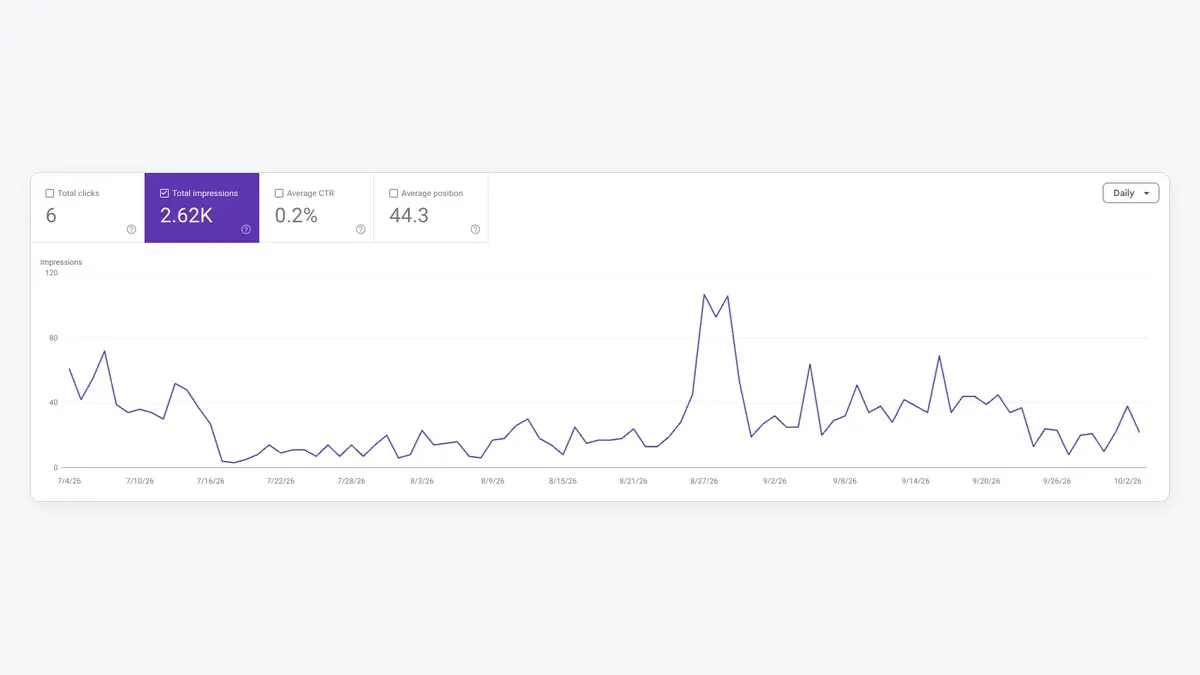
Second, a short list of published posts on the brand’s topic, with links, so the reviewer doesn’t have to go looking. Rakuten asks for monthly visitors and page views on its form, so know where your real numbers live before you start, rather than guessing in the box.
You might be tempted to round your numbers up on the form. Please don’t. Awin cross-references applications against third-party tools, and inflated numbers are exactly what a review is there to catch.
A small, honest number gives the brand something true to judge, while an inflated one gives the reviewer a reason to doubt everything else you wrote.
When to Go Back, and Which Doors to Try in the Meantime
Go back when something has changed, since a date on the calendar isn’t a reason by itself. Rakuten allows a new request 15 days after a temporary decline, and that’s the earliest you can try there, which isn’t the same as the right time.
AvantLink suggests a new site spend its first six months building content and authority before it applies. If that sounds slow, it helps to see what a realistic first year of traffic looks like before you decide you’re behind.
While one brand is a no, other doors are still open to a small site:
- A network account. Rakuten doesn’t screen at sign-up, and Awin’s review centers on identity and compliance, so an honest, complete application has a fair chance there. Impact.com and AvantLink also look at reach, so a very new site may need more traffic before it applies to them.
- Brands whose topic your site already covers, because fit is the one thing you can show them right now.
You’ll still find many beginner lists telling you to start with ShareASale. That advice is out of date. Awin closed the ShareASale platform by the end of 2025 and moved its relationships across to Awin, as it explains in Awin’s ShareASale announcement. If a list still sends you there, it’s fair to wonder what else in it hasn’t been updated.
Applying Now Versus Waiting
There isn’t one right answer here, so it helps to see what each side costs you. Applying early collects network accounts and gets you a clear first answer, which is useful even when the answer is no. Waiting builds evidence (more posts on your topic, more impressions to show), but it pushes your first affiliate link further out.
There’s one practical catch with applying early. Rakuten asks for tax information before you’ve earned anything, and for US publishers, missing tax details mean backup withholding.
That means Rakuten has to hold back 24% of each commission payment for the IRS until those details are complete. If you apply now, fill that part in properly rather than leaving it for later.
If your site already has a clear topic and a few solid posts on it, applying now to a network and a couple of well-matched brands makes sense.
If you’re still working out what the site is about, waiting will probably serve you better, because a brand can’t judge fit on a site that hasn’t decided its topic yet.
You can read that two-line email properly now: which gate sent it, what kind of no it was, and whether the fix is your details, your content or your timing.
The next step is small. Pick one brand whose topic your site already covers, check which network it runs on, and apply with your real numbers. If those numbers aren’t in one place yet, start by pulling them together.
Which gate turned you down, the network or a brand, and what did the message actually say? Leave it in the comments. I read and reply to every one.

Sonia Zannoni
Hi, I’m Sonia Zannoni, creator of Click to Prosper. I share practical tools, workflows, and honest guidance to help you build an online business with more clarity and less chaos.
About Sonia
Feeling stuck between too many tools and too much advice? Start with the beginner path.
View the Blueprint