
IM Mastery Academy Review: What You Are Buying When the Training Is the Product

Affiliate Disclosure: This post contains affiliate links. If you purchase through one of my links, I may earn a commission at no additional cost to you. Read the full Affiliate Disclosure for details.
Search for IM Mastery Academy, and a lot of what comes back reads like it was written for a company that’s still open. Reviews list monthly prices, walk through what members get, and some land on a version of “not technically a scam.”
The federal record says something else entirely: the company stopped operating in 2025, and in 2026 its owners settled with a $795.8 million judgment. If you’re reading this IM Mastery Academy review, it’s probably because someone’s posts made the academy look like a way out, and you want to know which of those two pictures is true.
That confusion is reasonable. The company went by four names, many of the reviews were written before the lawsuit, and every search returns a slightly different company with a slightly different verdict. And if you’ve been burned by a program like this before, keeping your guard up is the right instinct.
So here’s what you came for: what it was, whether it’s still running, and whether the “education” pitch holds up. I’ll walk through what the case record shows, what members actually paid, how a rule called “Two And It’s Free” made recruiting the way to stop paying, and a short test for spotting the same structure the next time it shows up under a new name.
TL;DR: IM Mastery Academy Review
Is IM Mastery Academy Still Running? What the Federal Case Settled
No, nothing is on sale. IYOVIA, the company’s last name, told members in late May 2025 that it had suspended operations, and the FTC cited that suspension in its May 30, 2025 motion for an injunction, as Truth in Advertising reported when the shutdown happened.
It isn’t the first program in this space to go dark on the people paying for it, and the Legendary Marketer review covers what happened when a high-ticket platform closed on its members. This post stays on the record.
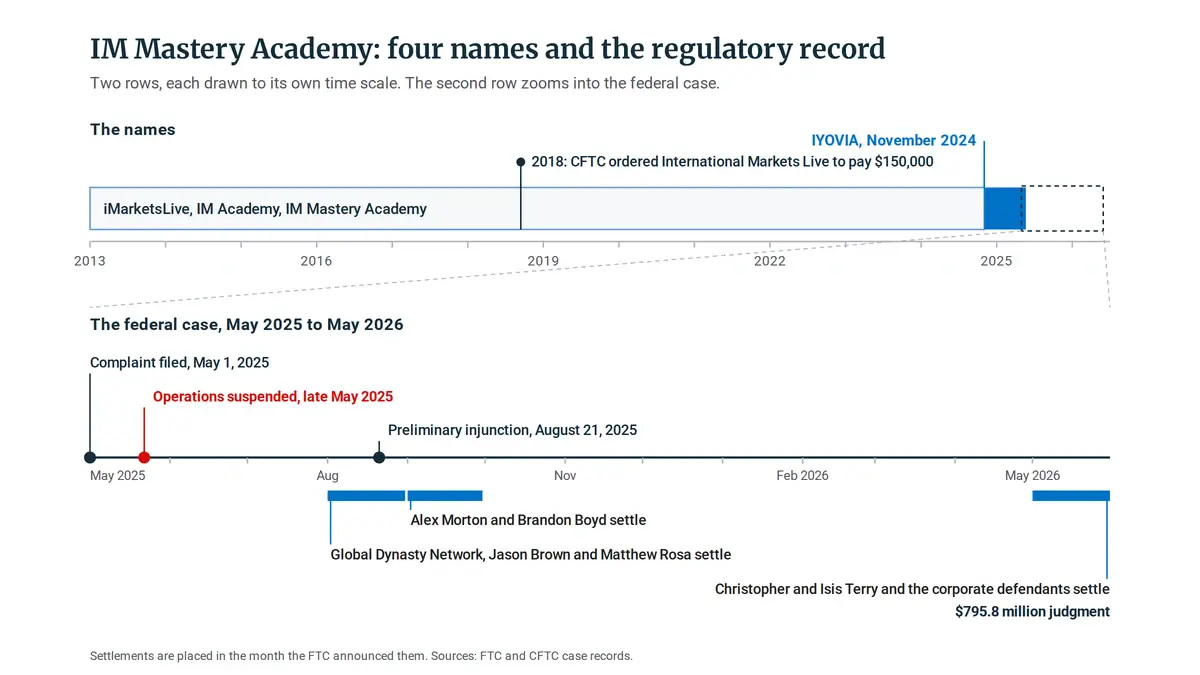
Part of why this company is so hard to pin down is the names. In a little over a decade, it went from iMarketsLive, formed in 2013, to IM Academy to IM Mastery Academy, and then, in November 2024, to IYOVIA, which added AI tools, travel and wellness products to the repackaged trading education.
Search any one of those names, and you mostly get reviews written under that name, often before anything on the record had happened. That’s how you end up reading an “honest review” that lists prices for a company that no longer sells anything.
The record also started earlier than most people realize. In 2018, the CFTC ordered International Markets Live to pay $150,000 because it ran a service that copied its own traders’ forex trades straight into customers’ brokerage accounts, without registering as a trading advisor as the law requires. That’s a second federal regulator, years before the FTC got involved.
The FTC case itself was brought jointly with the Nevada Attorney General. The complaint was filed on May 1, 2025, in the U.S. District Court for the District of Nevada, and it alleged worldwide sales of more than $1.2 billion since 2018.
A preliminary injunction against the company and its owners, Christopher and Isis Terry, followed on August 21, 2025. That’s a court order that stays in force while the case is decided.
Then came three settlements, the last of them set out in the FTC’s release on the lead defendants:
- Global Dynasty Network, Jason Brown and Matthew Rosa (August 2025): a $36 million judgment, with $2.5 million paid and the rest suspended. The gap between those two numbers is why a headline judgment tells you little about what was actually collected. A suspended judgment is one the defendants don’t pay unless they’re found to have lied about their finances, and then the full amount comes due.
- Alex Morton, the company’s executive vice president of sales, and Brandon Boyd, a salesman and instructor (September 2025): a $76.2 million judgment against Morton, suspended after he pays $10 million, and a $6.3 million judgment against Boyd, suspended after he pays $500,000.
- Christopher and Isis Terry and the corporate defendants (May 2026): a $795.8 million judgment, with assets worth nearly $90 million surrendered, including eight homes, 19 vehicles and a yacht. This is the settlement behind most of the headlines.
The order against the Terrys and their companies permanently bans them from selling trading-training services and investment opportunities. Every settling defendant is barred from making earnings claims without a basis, and Morton is also banned from multi-level marketing of trading-training services.
A settlement resolves the allegations rather than proving each one in court, which is why this post says “the FTC alleged” and “the complaint states” throughout.
What about refunds? The orders allow the settlement money to go into an FTC-administered fund for consumer relief. When this post was researched, no refund program had been announced. That’s everything the record says, so it’s everything I’ll say.
So that’s where the company stands now: closed, settled, and scattered across four names. The more useful question is what people were actually paying for while it ran.
What Members Paid For, and What It Cost Each Month
What members bought was a monthly subscription to trading education. This review doesn’t walk through the lessons, because the videos aren’t where the problem was. The problem was how the money moved.
The FTC complaint sets out what members were charged. These are past prices, taken from the complaint, and nothing is on sale today.
Fee
What It Paid For
Historical Range
How Often
Sign-up
The subscription’s first payment
Slightly over $100 to nearly $500
Once
Auto-renewal
Continued access to the training
Slightly under $100 to nearly $400
Every four weeks
Add-ons
Extra services
Typically slightly under $100
Every four weeks
IBO fee
The right to earn commissions
$24.95
Monthly
Sign-up
What it paid for: The subscription’s first payment
Historical range: Slightly over $100 to nearly $500
How often: Once
Auto-renewal
What it paid for: Continued access to the training
Historical range: Slightly under $100 to nearly $400
How often: Every four weeks
Add-ons
What it paid for: Extra services
Historical range: Typically slightly under $100
How often: Every four weeks
IBO fee
What it paid for: The right to earn commissions
Historical range: $24.95
How often: Monthly
The last row is the one most reviews skip. To earn commissions, members paid a separate $24.95 a month to become an “Independent Business Owner,” or IBO, which was the company’s term for its salespeople. Paying for the training didn’t make you eligible to earn. That took a second bill.
Here’s what that added up to at the low end, for someone who wanted to earn. Renewals of slightly under $100 every four weeks came to 13 charges a year, so close to $1,300. The IBO fee cost about $300 more over the same year ($24.95 times 12). That’s roughly $1,600 a year before a single add-on, all at the bottom of the complaint’s price ranges.
Keep that figure in mind. It’s the price side of the ledger, and later in this post I’ll weigh it against what it actually bought. First, though, there’s the rule that made the price feel temporary.
How “Two And It’s Free” Turned the Price Into a Recruiting Quota
The complaint describes a rule called “Two And It’s Free.” Members could get the training they were paying for at no cost once two other people bought the same service.
Follow that through. If the only way to stop paying is to sign up two people, and those two can only stop paying by signing up two more each, then at every level the incentive points at recruiting, not at getting better at trading. The price stops working like a price. It becomes a quota.
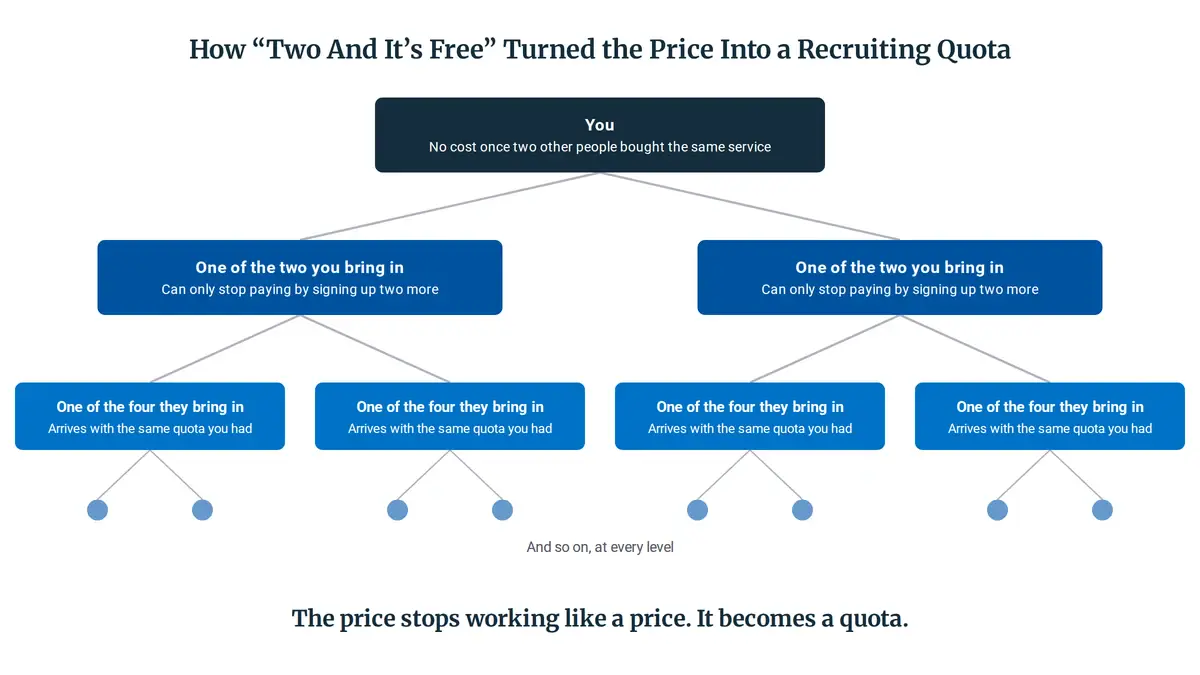
The terms invite a particular line of reasoning: I’ll only pay until I get my two. It sounds like a short, contained cost with an end date. But the two people you bring in are making the same calculation, and they arrive with the same quota you had.
This is also where IM Mastery Academy parts ways with a product MLM. There was no stock to buy and nothing to resell, because the subscription itself was the product.
The Herbalife review covers how the math works when the product is a shake instead of a course. Here, the thing being sold and the thing you had to recruit for were the same subscription.
Compare that with an ordinary affiliate commission. You’re paid for referring a customer who buys something they actually want; there’s no fee to be allowed to earn, and nobody you refer inherits a quota.
That’s how affiliate marketing actually pays: the commission doesn’t depend on recruiting anyone, and what you’re paid for is the recommendation. Two And It’s Free made the headcount the job.
So how did people sign up for a quota without seeing it as one? The answer is in how the pitch reached them.
How the Pitch Reached People: Lifestyle Posts, Not Trade Records
According to the FTC, the marketing was aimed at young people, including through posts to college social media pages. The posts flaunted luxury lifestyles said to be funded by trading and MLM commissions, alongside claims about “retiring in their 20s” and making money “in your sleep.”
Look at what those posts were actually selling. It was two things at once: the training, and the chance to recruit. The lifestyle in the photo stood in as proof for both, so you never had to decide which one you were buying.
That’s why the education framing lowers people’s guard. “Learn to trade, and if you share it you learn for free” doesn’t sound like joining a sales team.
It sounds like investing in yourself, with a bonus attached, which is a much easier yes for someone who’d scroll straight past a “business opportunity” post. What the posts never showed was the monthly bill, the separate fee to earn, or how few people ever earned more than they paid in.
It also helps to hold “retiring in their 20s” up against a realistic timeline for part-time income. Even a legitimate affiliate site built around a full-time job usually needs 6 to 12 months, often longer, before it earns anything meaningful. Nothing about it happens in your sleep.
“But someone I know really is doing well.” Maybe they are, and nothing here says otherwise about any one person. What the complaint’s income figures show is how the typical participant did, and that’s the number that tells you what your own odds would have been. That’s where the next section goes.
What the Training Was Worth Once the Recruiting Is Taken Away
Before the numbers, here are the three questions I use to judge any paid education sold through a recruiting structure. You can run them yourself:
- Who pays if nobody recruits? If the product only makes financial sense once you’ve signed people up, the product isn’t really what’s being sold.
- How many customers stay once the recruiting pitch fades? People who keep paying for training with no commission angle are telling you it’s worth something on its own.
- Did the people teaching have to prove results? A trading course is only as credible as the evidence that its instructors can trade.
Start with retention. The complaint states that nearly 60 percent of customers dropped the training within a month, and 90 percent within six months. That’s the customers’ own verdict on the training by itself, and most of them didn’t keep paying for long.
The income figures matter even more. The complaint states that in 2022 nearly 80 percent of IBOs made less than $500, and those people averaged $77.51 for the year. The median IBO made nothing.
The median is the person in the middle: line everyone up from lowest to highest earnings, and it’s whoever stands at the halfway point, so at least half of IBOs earned nothing that year.
Counting the fees makes it worse. After the required payments to the company, the complaint states that in 2022, 83 percent made $500 or less and the majority lost money.
Across 2020 to 2022, more than 99 percent made under $25,000 a year, and more than 80 percent made under $500. Remember that the IBO fee alone came to about $300 a year, so for most participants, commissions didn’t even cover the fee to be allowed to earn them.
Then there’s the teaching. According to the complaint, before November 2021 instructor qualifications “were not requested nor tracked.” After that, candidates still didn’t have to show trading success or licenses. One featured “Master Instructor” traded from a single brokerage account worth $1,585 as of September 2023.
Now put the three questions back on the table. Staying ahead depended on recruiting, most customers left within months, and the teachers didn’t have to prove anything. Taken without the recruiting, the record shows a product most buyers left quickly, taught by people who never had to show they could trade, inside a structure where most participants lost money.
“There’s a Real Course” Is Not the Defense It Sounds Like
You’ll run into some version of this in reviews of the company: it can’t be a pyramid scheme, because there’s a real course. It deserves a straight answer.
Start with what’s fair. Some members may well have learned something about trading. Saying so doesn’t weaken anything in this review. It just keeps the verdict honest.
But the case was never about whether any content existed. The FTC alleged earnings claims made without a reasonable basis, a structure in which most participants lost money, and instructors who never had to show trading success, licenses or accreditation.
A course can be real and still be the entry fee for a recruiting business. Those two things don’t cancel each other out.
“But people did learn to trade.” Same answer: what some members learned doesn’t change what most members paid and earned.
Whether the program was “technically” one thing or another is the least useful question here. The economics are what would have decided your outcome, and they’re what you can check before the next one takes your card number.
How to Spot the Same Structure When It Comes Back Under a New Name
It’s shut down, so why does any of this still matter? Because the structure doesn’t retire. It comes back under new names, and this one company used four.
Before you pay for any education sold through lifestyle posts, run these checks. Each one takes minutes:
- Does the price shrink or disappear when you bring in paying people? Then the price is a quota, and your real job is recruiting.
- Is there a separate fee to be allowed to earn? Then you’re paying to join a sales team, not buying a product.
- Do the people teaching have to show results, or only a lifestyle? A lifestyle post is not a track record, and only a track record tells you whether they can teach what they’re selling.
- Is there an income disclosure, and what does the median participant earn after fees? An average can be pulled up by a handful of big earners. The median tells you what the middle person actually took home.
- Is the program’s name newer than its complaints? Search every earlier name before you pay, because the record stays attached to the old ones.
Underneath all five sits one idea, and it works on almost any offer: take the recruiting away and see what’s left. That’s the question that separates a real product from a recruiting scheme, and it’s worth asking before the pitch, not after the first renewal.
If you came here because you still want a side income, just without a recruiting quota attached, that’s a reasonable thing to want.
Here’s a way to start that fits around a full-time job, with the honest caveat that it takes 6 to 12 months at minimum before it earns anything that matters.
And if you’re weighing a paid training platform for that, bring the same checks with you. One thing to know before you click: this site earns a commission if you join Wealthy Affiliate through it, and Wealthy Affiliate runs a referral program of its own. That’s exactly why the checks matter. Run all five on it, and on my recommendation too.
Have you been pitched a program where the price drops once you bring in two people, or seen IM Academy or IYOVIA come through your feed? Tell me in the comments what the pitch looked like. I read and reply to every comment.
The next time a post makes a course look like a way out, you don’t need to work out whether it’s “technically” anything. Ask what happens to the price when you recruit. If recruiting is how you stop paying, the course is a sales job with tuition.

Sonia Zannoni
Hi, I’m Sonia Zannoni, creator of Click to Prosper. I share practical tools, workflows, and honest guidance to help you build an online business with more clarity and less chaos.
About Sonia

Feeling stuck between too many tools and too much advice? Start with the beginner path.
View the Blueprint