Wealthy Affiliate Hubs and Gameplans: What They Do and When to Follow Them

Affiliate Disclosure: This post contains affiliate links. If you purchase through one of my links, I may earn a commission at no additional cost to you. Read the full Affiliate Disclosure for details.
The Gameplan Ace (Wealthy Affiliate’s AI planning assistant) drafts inside one of the new Wealthy Affiliate Hubs can be short, tidy and completely sure of itself, and still ask a site that’s been live for a while to make an About page and a beginner post on finding a niche. That site published both long ago.
If you’re starting with nothing built, the same plan feels like relief, though a quieter question tends to sit under it: is this a strategy, or a neat way to spend credits?
Both reactions are reasonable. The plan never says what it was drafted from, and without knowing that, you can’t tell whether it fits your site.
By the end of this, you’ll know what a Hub holds, what a Gameplan decides, who does each step and what it spends, the blind spot a plan can have, and which call fits your situation: follow the plan, correct it first, or hold off.
TL;DR: Wealthy Affiliate Hubs and Gameplans
What a Wealthy Affiliate Hub Holds
If you’re arriving from the older version of this page, My Businesses is now Hubs. A Hub holds one business, so each business you run gets its own.
The Hub card summarizes that business in six facets. Each one feeds the plans Ace drafts, so it helps to know what each one decides:
- Idea: what the business is, which sets the subject every step works on.
- Who: who it’s for, so the plan aims at a particular reader rather than at everyone.
- Where: where it publishes, such as your website, Instagram or YouTube.
- Money: how it earns, which points the plan at content that can bring that money in.
- Voice: how it sounds. The Hub carries that voice into what gets made.
- Goal: what it’s working toward, which shapes the outcome a plan points at.
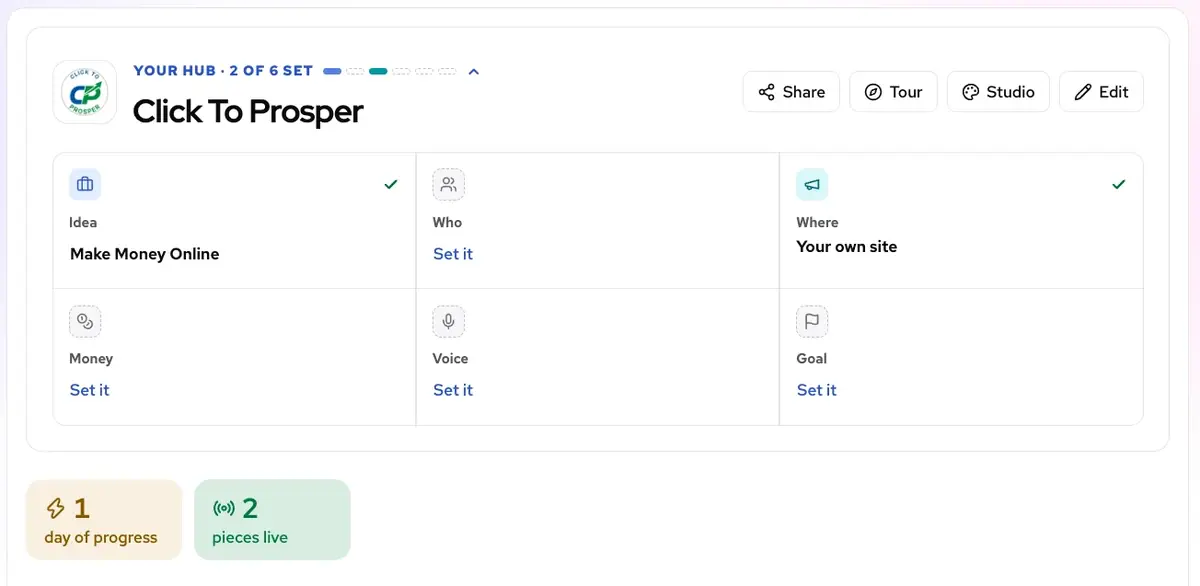
Three of those facets start as a guess. Ace fills in Money, Voice and Goal from your opening chat and marks them Suggested.
They’re a fair starting point, but they’re Ace’s reading of a short conversation, and you can rewrite any of them in your own words. That matters more than it looks, because Ace drafts your Gameplans from this profile. We’ll come back to it when we get to correcting a plan.
If you had a site before the relaunch, you might be wondering whether it survived. It did. Sites from before the relaunch carried over into Hubs, and former members log in with their original email to find their websites there. Whether the plan understands that older site is a separate question, and it’s the one most of this guide is about.
What a Gameplan Is (and What It Isn’t)
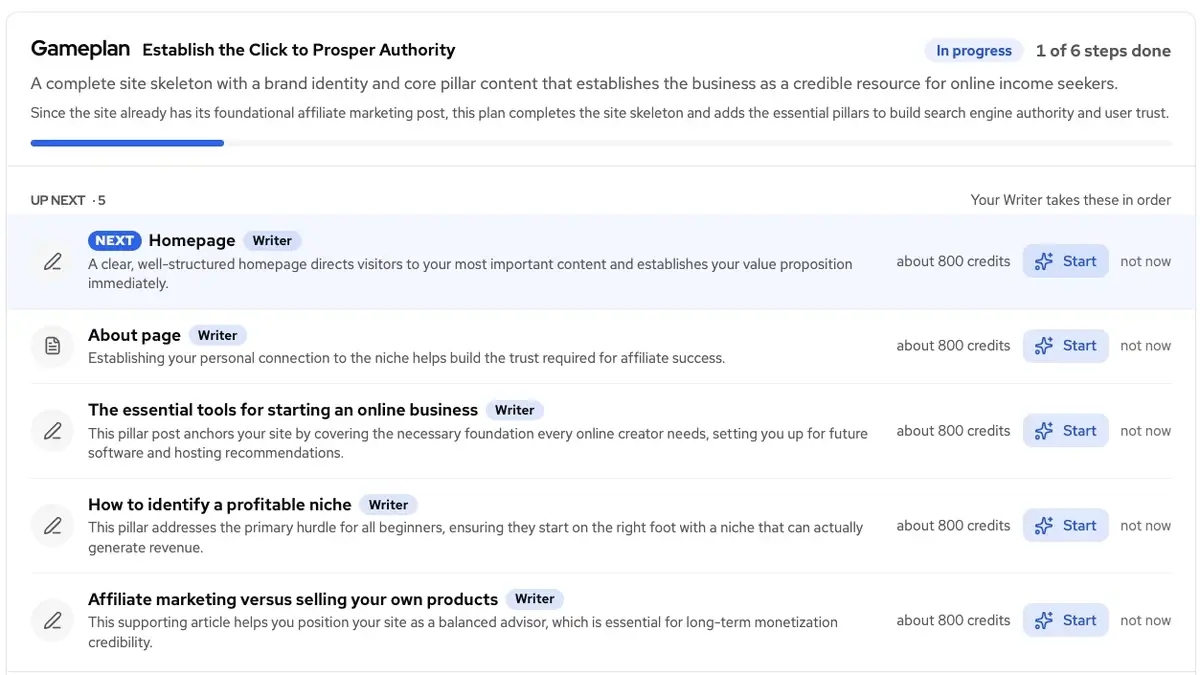
A Gameplan is a short, finite plan Ace drafts for one channel of a Hub, toward one outcome. Your website has its plan, an Instagram account has its own, and each one is saved in the Hub. There’s one live plan per channel, so you’re never weighing two competing plans for the same site.
That matches how Wealthy Affiliate’s homepage describes it: a short chain of concrete steps toward one outcome, kept in the Hub, with one Hub per business.
People tend to blur three separate moments together, and it’s worth keeping them apart:
- The plan goes live as soon as it appears. There’s nothing to approve.
- Nothing gets made until you start a step. A live plan sits there as a list until you act on it.
- Nothing publishes without your approval, even after a step has made something.
Ace drafts each plan from three things: the Hub’s profile (those six facets), the channel’s state, and what you’ve already finished. Keep those three in mind, because they’re what the plan is built on, and two sections from now they explain why a plan can miss.
Two worries come up early. The first is whether the Gameplan is the new course. It isn’t training: it’s a short plan toward one outcome for one channel. The second is whether it will publish on its own, and it won’t. Wealthy Affiliate’s own description puts you in charge of steering and approving.
Who Does Each Step, and What It Spends
Wealthy Affiliate’s guide puts every Gameplan step in one of two kinds. A manual step is yours: you do the work and check it off. An agent step is carried out for you once you start it, usually by the Writer or the Artist, Wealthy Affiliate’s AI agents, and sometimes by Ace itself.
Ace can also do a few things once you say yes, like ticking a step, staging an article, or making an image or a short post.
Credits are Wealthy Affiliate’s usage balance, and everything its AI makes for you draws from it. Agent steps use them, and so does every reply from Ace, including replies to a quick question. Manual steps don’t, and failed runs are free.
What credits buy on each plan, and how far they stretch, is covered in my full Wealthy Affiliate review, so I won’t repeat the arithmetic here.
What an agent step hands back decides the job that comes after it:
- A Writer step hands back a draft that waits for your approval. Approving it is a different job from editing an AI draft so it sounds like you, and the editing is where a draft starts to sound like your site.
- An Artist step makes an image. Getting images that match your site, rather than a different look on every post, takes some planning on your side.
- Site steps on a website Gameplan are about the site itself rather than a post, like a homepage or an About page. The choices behind those pages belong to setting up your website on Wealthy Affiliate, which is more than one step can hold.
- Social channel steps end with you. Posting is manual, so you copy or download what was made and post it yourself.
If you’re new, the quieter worry from the start of this post probably lives here: is the plan a way to get you spending credits? It’s a fair question, and the honest answer has two halves. Agent steps and Ace’s replies do use credits. The plan itself spends nothing by existing, though, so a step sitting on the list costs nothing, and what you start is what you spend.
Why a Confident Plan Can Still Be Wrong for Your Site
Ace drafts from the Hub’s profile, the channel’s state and what you’ve already finished. When you start a new Hub from a site Wealthy Affiliate hosts, Ace reads that site, and for a site hosted elsewhere it asks you what the site is about. Hubs that carried over from before the relaunch weren’t started that way, so their plans can miss work that’s already there.
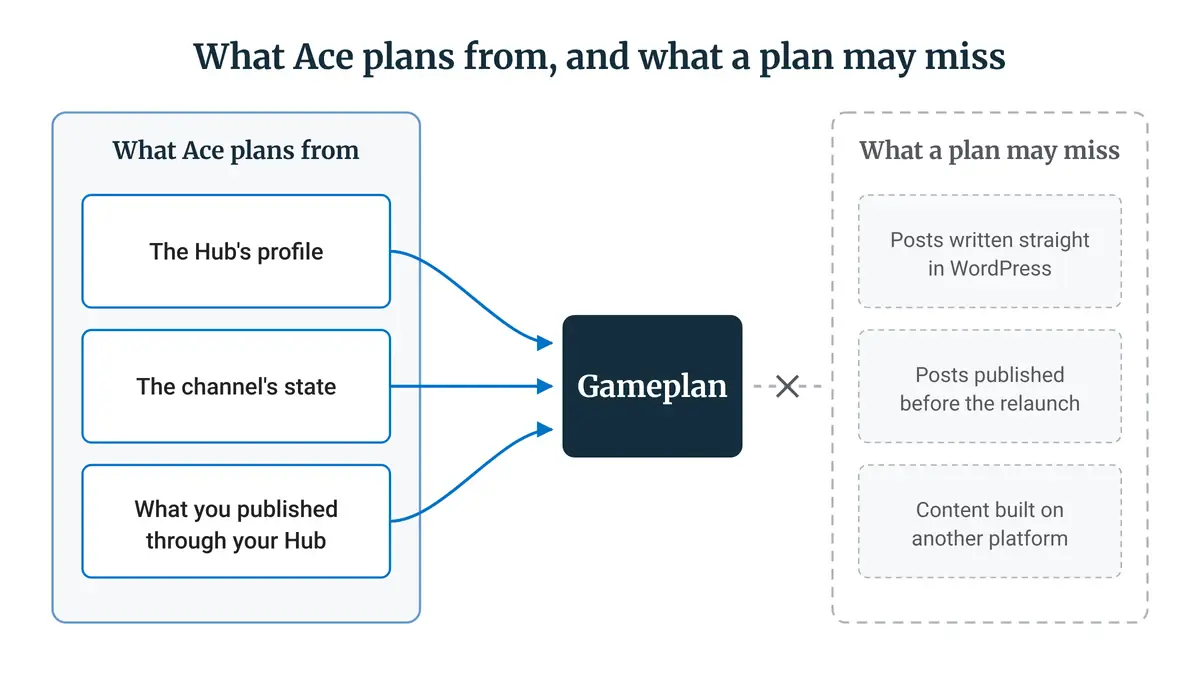
You can see this on a real account. When I looked at the first plan on the ClickToProsper Hub, it proposed a homepage, an About page and a post on identifying a profitable niche. It had counted the 2 posts published from Wealthy Affiliate and not the 35 others already on the site.
The question members ask is whether Ace understands the business they’ve already built, or plans as if they’re starting from zero. Going by what that account showed, it depends on how the work got there.
What you published through your Hub is part of the plan’s picture. Posts written straight in WordPress, published before the relaunch, or built on another platform may not be.
None of this makes the Gameplan a bad idea. A short, finite plan takes away one of the hardest parts of building around a full-time job, which is not knowing what to do next. The price is that it may not see everything you’ve already done, and a plan that sounds this sure of itself is easy to follow without checking.
Four Checks Before You Start the Next Step
Before you start a step, run it past these four checks. They take a few minutes, and the next section uses them to sort out which call fits your situation.
- Does the plan’s outcome match what you want this channel to do next? A plan toward the wrong outcome can be finished perfectly and still leave the channel where it was. If the Goal facet is still Ace’s guess, the outcome may be a guess too.
- Does the plan know everything you’ve already published? Open your site’s list of published posts in WordPress and compare it to the plan’s steps. Any step that repeats finished work is one you don’t need.
- Has the suggested topic been checked against what people actually search? Ace or the Gameplan can prefill the Writer’s target keyword, and you can edit it. Wealthy Affiliate says Ace works out what your readers search for, but it doesn’t show the volume or competition behind a topic. Running the topic through a simple keyword research routine shows whether a post can actually be found before you spend credits writing it.
- Is this step worth part of the credits you have left? Starting an agent step spends credits, and your first Gameplan shows about how many each step uses, so weigh it against the other steps you’d rather put them toward.
Follow, Correct or Set Aside: Matching the Plan to Your Situation
Those four checks point different readers to different calls. Here’s where they usually land:
Your situation
The call
Start with
New member
Mostly follow
Check the Suggested facets, then start the first step
Carried-over WA site
Correct first
Rewrite the facets, set aside steps that repeat finished work
Site built elsewhere
Correct, then follow the gaps
Set aside steps your site already covers, keep the ones it doesn’t
Second business idea
Decide before you build
Check your limits and whether it’s its own business (next section)
New member
The call: Mostly follow
Start with: Check the Suggested facets, then start the first step
Carried-over WA site
The call: Correct first
Start with: Rewrite the facets, set aside steps that repeat finished work
Site built elsewhere
The call: Correct, then follow the gaps
Start with: Set aside steps your site already covers, keep the ones it doesn’t
Second business idea
The call: Decide before you build
Start with: Check your limits and whether it’s its own business (next section)
If you’re new and nothing’s built yet, you can mostly follow the plan. Check the Suggested facets first, since the plan is drafted from them, but there’s no finished work for it to miss. This is the situation a Gameplan suits best, and it’s also the only one where following it without corrections makes sense.
If your older Wealthy Affiliate site carried over into a Hub, correct it first. Here’s what I’d do in your position, using the moves Wealthy Affiliate actually gives you:
- Rewrite the Suggested facets in your own words. Ace drafts from the Hub’s profile, so a wrong profile leads to a wrong plan, and a corrected profile is what the next plan starts from.
- Set aside steps that repeat finished work. “Not now” moves a step to the channel’s list, where you can still start it later. Nothing is made until you start a step, so a step you leave there costs nothing.
- Draft a fresh plan when the live one doesn’t fit at all. “Create the next Gameplan” moves the unfinished steps to the list and has Ace draft a new plan, which uses credits. Fix the facets first, so the new plan starts from the corrected profile.
If your site was built on another platform, the same moves apply with one difference. Your site may have gaps the plan has spotted correctly, so set aside the steps your site already covers and follow the ones it doesn’t.
You might wonder whether ignoring half the plan wastes what you pay for. It doesn’t. Leaving a step on the list costs nothing, and credits go on what the AI actually makes for you: the steps you start, Ace’s replies, and things like a fresh Gameplan.
Before You Start a Second Hub
Because a Hub holds one business, a second idea needs one question answered before you start another Hub: is this a separate business, or a topic your current site could carry?
A new angle on the same readers usually belongs on the site you already have, because it builds on the audience and posts you’ve already got. The thinking that goes into choosing what your site is about applies here too, before you split your evenings across two Hubs.
Your plan sets how many Hubs you can have, and you can see your own limits under Account, Settings. If there’s no room, the New Hub page warns you before you start. Some older review pages still print Hub counts per plan, and those no longer apply, so go by what your own account shows.
Your first Hub is free to build. Building another one uses credits, and Wealthy Affiliate shows you about how many before you start.
If you’re out of room and wondering whether to upgrade, my review walks through how the plans compare. You can also check Wealthy Affiliate’s pricing page yourself: the paid tiers don’t list a Hub number, which is why your account settings are the place to look.
What a Finished Gameplan Doesn’t Do for You
Ticking the last step of a Gameplan is real progress. What it tells you is that the steps are done, and whether the site is earning is a separate measure. On a part-time schedule, results usually take 6 to 12 months or more, and what the first 24 months look like depends far more on steady publishing than on any single plan.
You also stay responsible for everything the Writer and the Artist make. Wealthy Affiliate’s terms of service say AI output can be wrong, repetitive or out of date, that you should review it before publishing, and that you’re responsible for what you publish. Approving a step is the moment that review happens, so give it the attention you’d give your own writing.
There’s one more tradeoff worth knowing early. A Hub keeps a business’s context together in one place, which is what lets Ace plan for it at all. It also ties that business to your account, because closing the account ends access to its Hubs, content and hosted websites. If you ever decide to leave, export your work first.
If you’re a member, your next step is small. Open your Hub, read the three Suggested facets, and rewrite any that don’t describe your business. Then hold the next step of your Gameplan up against what you’ve already published, and start it only if your site doesn’t have it yet.
If you’re not a member yet, Wealthy Affiliate’s Starter tier lists your first Hub, so you can answer Ace’s three questions and see the Gameplan it drafts before you decide anything else.
What did Ace’s first Gameplan ask you to make, and did your site already have it? Tell me in the comments. I read and reply to everyone.

Sonia Zannoni
Hi, I’m Sonia Zannoni, creator of Click to Prosper. I share practical tools, workflows, and honest guidance to help you build an online business with more clarity and less chaos.
About Sonia
Feeling stuck between too many tools and too much advice? Start with the beginner path.
View the Blueprint